
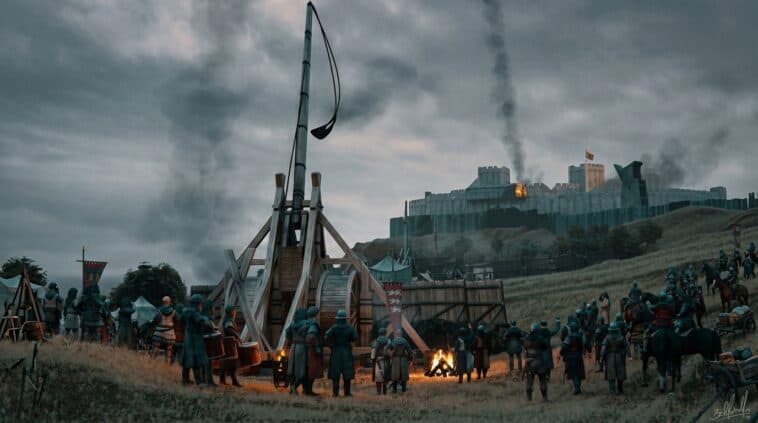
Forget swords, arrows, and getting dramatically thrown from a castle wall. Scientists may have identified something much more brutal in a medieval soldier who appears to have been obliterated by a giant catapult. Researchers studying a 14th-century skeleton found at Stirling Castle in Scotland say the man’s extraordinary collection of fractures is consistent with being struck by a high-speed projectile from a medieval siege engine known as a trebuchet.
Meet Skeleton 150
The unfortunate man is known to researchers simply as Skeleton 150. His remains were discovered in 1997 alongside seven other people who appeared to have died during warfare at Stirling Castle. Carbon dating placed five of the skeletons, including Skeleton 150, in the 1300s, when England and Scotland were locked in a particularly violent struggle.
But Skeleton 150 was different. His skeleton contained 167 fractures. His skull alone had been smashed in 61 places, while his shoulder suffered a deep, zigzagging fracture. Nearly 60 similarly bizarre fractures ran through his ribs. This wasn’t the sort of injury pattern you get from someone having a bad day with a sword. According to researchers, it looked like something had hit him with an absolutely ridiculous amount of force.
Scientists ruled out the obvious medieval disasters
Researchers considered several possibilities for how someone in medieval Scotland could end up looking like this. Maybe he fell from the castle wall or horses trampled him. Maybe he was struck by some other weapon. But looking sternly at the situation, none of those explanations really fit.
The pattern of the fractures suggested that he was struck from behind by something moving very, very fast, then essentially driven into the ground. Bioarchaeologist Jo Buckberry of the University of Bradford compared the injuries to the sort of trauma seen in modern car crashes and people hit by trains. Which raises the question of what was moving that fast in Scotland in 1304? Turns out, medieval Scotland had an answer.
Enter the trebuchet
Historical records show that King Edward I of England deployed massive trebuchets during his 1304 siege of Stirling Castle. A trebuchet is essentially a giant counterweighted throwing machine designed to launch heavy projectiles at fortifications.
Think of it as a medieval artillery system, except instead of quietly pressing a button from several miles away, you needed an enormous wooden machine, a giant counterweight, and a bunch of people who were presumably very confident about physics. Edward’s forces reportedly used a particularly enormous trebuchet nicknamed Warwolf.
Historical accounts describe the machine as capable of smashing through multiple stone walls. Unfortunately for Skeleton 150, the projectile didn’t necessarily have to hit the castle. It just had to hit him.
A 700-year-old case of “wrong place, wrong time”
Researchers don’t know whether Skeleton 150 was actually killed by Warwolf itself. There isn’t enough evidence to make that specific claim. But the injury pattern strongly points toward a trebuchet or similar siege engine.
And the researchers believe he may have simply been standing with his back turned when the projectile arrived. Trebuchets weren’t precision weapons. Their job was to hit buildings, not individual soldiers. So if someone happened to be standing somewhere near the intended target when several hundred pounds of rock came flying toward them, well… Very, very bad luck.
Source: New York Post