
When you think of the Egyptian desert, your mind probably jumps straight to towering pyramids, endless rolling sand dunes, and scorching heat. You would be right to think that, because who wouldn’t? What you probably don’t picture are apex oceanic predators cutting through waves. But paleontology has a remarkable way of turning our view of history completely upside down.
In a study published in the journal Cretaceous Research, a team of scientists led by Cairo University paleontologist Tarek Yassin announced an incredible discovery: an ancient “shark graveyard” buried deep within the arid landscape of Egypt’s southwestern desert.
Ancient predators lurking in the Duwi Formation
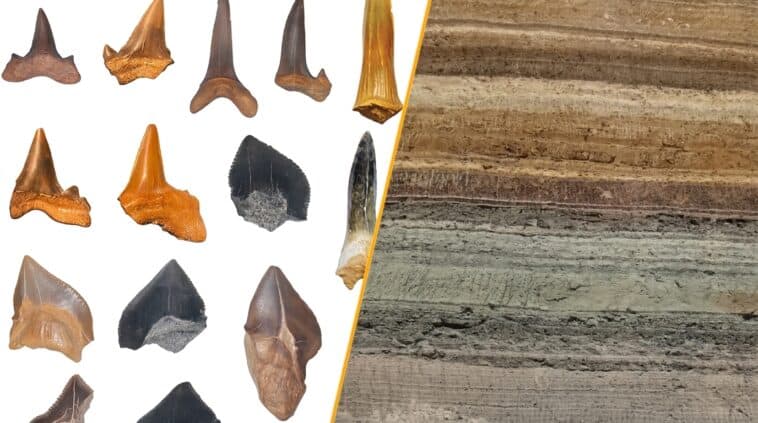
The discovery went down at the Abu-Tartur Plateau within the phosphate-rich rocks of the Duwi Formation. Field expeditions conducted between 2020 and 2022 yielded 14 fossilized shark teeth from five distinct extinct species.
When combined with previous findings in the area, researchers have now identified seven different shark species that once ruled these ancient grounds.
The ocean beneath the sand
So, how did the ocean’s apex predators end up in one of the driest places on Earth?
Well, it turns out that during the Late Cretaceous period, which is roughly 145 to 66 million years ago and when dinosaurs were still walking the land, global temperatures were significantly warmer and polar ice caps were practically non-existent. Sea levels were so high that large portions of North Africa were submerged beneath a warm, shallow, tropical ocean.
The site where researchers found the fossils was once a nutrient-rich marine margin. This nutrient-rich water rushed up from the deep ocean, feeding a great number of tiny plankton. This in turn created a giant buffet for all kinds of ancient sea creatures, and at the very top was a hungry mix of sharks sitting right at the peak of the food chain.
What the teeth reveal
Because sharks constantly shed and replace their teeth throughout their lives, dental fossils offer scientists a goldmine of information. The 14 newly recovered teeth showed a wild variety of shapes and sizes:
- Needle-sharp teeth: Belonging to species like Scapanorhynchus cf. raphiodon (an ancient relative of today’s deeply creepy goblin shark), perfect for grabbing fast, slippery prey in deeper waters.
- Broad, serrated teeth: Found on species like Squalicorax bassanii and Squalicorax pristodontus (extinct crow sharks), ideal for slicing through larger marine animals in shallower waters.
- Versatile cutting teeth: Belonging to extinct lamniform predators like Cretalamna cf. maroccana and Serratolamna cf. serrata.
Two of these species (Serratolamna cf. serrata and Squalicorax bassanii) had never been recorded in Egypt before. This variety shows the ancient ecosystem was diverse enough to support several top predators, each hunting in its own unique way.
Is it really a graveyard?
Calling it a “shark graveyard” sounds like the plot of a monster movie. Like a single spot where a bunch of sharks perished all at once in a catastrophic event. The real story is very far from that.
Instead, the region experienced a very slow sediment accumulation over millions of years. As generations of sharks lived, hunted, shed teeth, and eventually died, their remains settled into the nutrient-dense phosphate layers. Time compressed all those millions of years into a single, rich fossil bed.
Today, those ancient waters are long gone, and they have been replaced by the sun-baked rock that we are all so familiar with. But thanks to a handful of preserved teeth, we get a window into a time when Egypt’s sands were a thriving underwater ecosystem.
Sources: Vice, ScienceDirect