
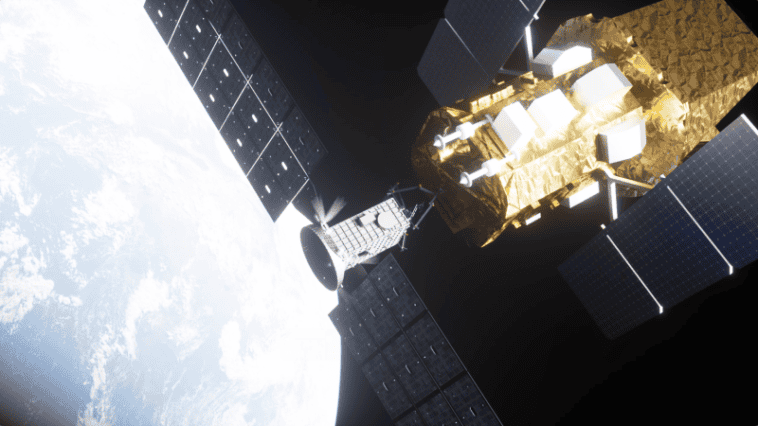
NASA has called off the $30 million mission to save the Neil Gehrels Swift Observatory after efforts to reach the aging telescope resulted in terminal technical issues.
The rescue spacecraft, Link, built by Katalyst Space Technologies and launched in early July, suffered an uncontrollable spin just weeks into its flight. Although flight controllers managed to slow the tumble, persistent pointing and positioning errors made successful capture of the telescope impossible.
Consequently, there will be no further capture attempt, and the mission has been abandoned, and Swift is now expected to burn up in the atmosphere at some point later this year.
“This is not the outcome we were working toward, but it does not change why this mission was worth attempting,” NASA Administrator Jared Isaacman said in a statement regarding the failed capture.
An ambitious venture from the start
The high-stakes mission has been in the works since about a year ago, when NASA first awarded Katalyst a $30 million contract to attempt to boost Swift with the company’s LINK satellite. Before LINK launched in early July, the agency’s scientists were just glad that the mission could even take place.
Solar activity expanding Earth’s atmosphere is what put Swift in this position, dragging the telescope down faster than anyone had expected. Launched in 2004 at about 370 miles altitude, the aging gamma-ray telescope is now at roughly 214 miles.
“To be totally honest, the idea of boosting it had occurred to us, but it seemed sufficiently far-fetched that I did not think there was any reasonable likelihood that NASA would go along with this,” Brad Cenko, the mission’s principal investigator, had told Mashable back in July.
Katalyst CEO Ghonhee Lee said the mission was ambitious, thrown together on an aggressive timeline. “We took on this high-risk, high-reward challenge and are proud of the milestones we reached along the way,” Lee said in a statement. “We have already learned a tremendous amount,” he added.
Despite calling the mission off, the Link spacecraft will remain in the vicinity. Katalyst intends to fly the craft near the telescope to test capabilities for future rescue missions.
Meanwhile, Swift leaves behind a legacy spanning over two decades of capturing gamma-ray bursts and exploding stars. Its science instruments were deactivated earlier this year in a final effort to preserve its orbit.
As Swift descends, the focus shifts to other aging assets in orbit, such as the 36-year-old Hubble Space Telescope, which is experiencing similar orbital decay. The long-term plan for Hubble’s survival remains uncertain.
Sources: NASA, Katalyst, NASA Swift Blog, Mashable, New York Post