
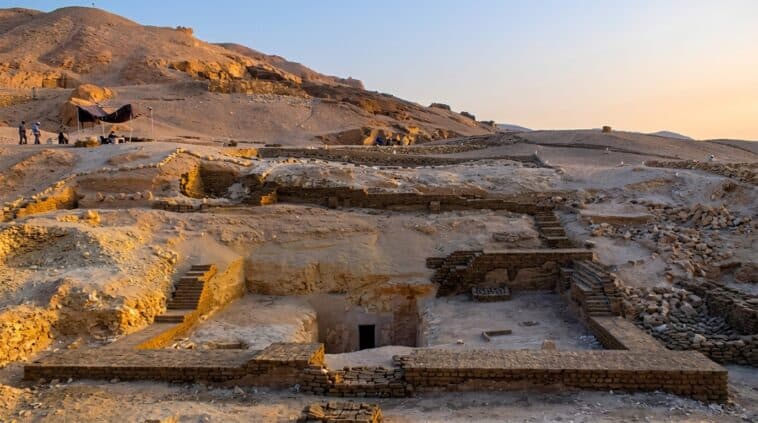
A 2,000-year-old Egyptian tomb just gave archaeologists something considerably more interesting than another pile of mummies. Inside chamber three of tomb TT 209 in the Theban Necropolis, researchers found 16 mummified humans and a mummified dog carefully placed directly on top of the remains of a man and a woman.
The Spanish team studying the tomb discovered that what initially looked like a chaotic pile of bodies was actually a carefully layered burial space that had been reused for centuries. The dog, meanwhile, may offer a small but fascinating glimpse into how ancient Egyptians understood the relationship between people, animals, and the afterlife.
This tomb was basically an ancient Egyptian group chat
The chamber wasn’t filled all at once. Researchers identified 16 mummified human individuals and one mummified dog, along with a disturbed area containing the remains of at least four additional people. The tomb was used from Egypt’s Twenty-fifth Dynasty, roughly 754 to 656 B.C.E., through the Ptolemaic period, which ended in 30 B.C.E.
That’s centuries of people coming back to the same burial space. Naturally, that created a bit of a space-management problem. The earliest burials were relatively spread out. Some were placed in coffins and accompanied by funerary nets, amulets and valuable goods, including items kept in Phoenician amphorae. Researchers say those details suggest some of the earliest occupants were people of relatively high social standing.
But as the chamber filled up, there wasn’t exactly a lot of empty real estate left. Later burials were fitted into whatever spaces remained. Some bodies were positioned vertically, and in roughly two-thirds of the chamber, newer mummies ended up stacked over earlier ones.
The mummy pile actually had rules
By carefully documenting where every body was positioned, how the mummies touched one another and which layers sat above others, the researchers were able to reconstruct a sequence of burials. They used photographs, sketches and detailed notes to track the position and orientation of the remains.
That showed that the chamber had not simply descended into disorder. Instead, each new burial appears to have been adapted around the people who were already there.
The researchers describe this as a kind of “funerary memory,” the burial space changed over time, but the people using it still followed recognizable rituals and spatial patterns. Even when bodies were stacked together, some later bodies were still carefully mummified, with certain positions appearing to have carried ritual meaning. Researchers also identified mummies in the Osirian position, with both arms folded across the chest, a pose associated with Osiris, the Egyptian god connected with death and the afterlife.
Then they found the dog
The biggest surprise was a mummified dog buried alongside the humans. More specifically, the animal was placed directly on top of the mummies of a man and a woman.
Archaeologist Jared Carballo-Pérez, the study’s first author, said the placement could indicate a meaningful relationship between the animal and the people buried beneath it. That interpretation doesn’t require much imagination, as people have been burying beloved animals for thousands of years. The idea that someone in ancient Egypt might have wanted their dog close to them after death feels surprisingly familiar.
But exactly what the dog meant to the people in the tomb is not known. There is another possibility. The dog could have played a ritual role as a psychopomp, a symbolic guide believed to help the dead make their journey into the afterlife.
So it could have been someone’s beloved companion. Or it could have been part of a religious ritual. Right now, archaeologists don’t have enough evidence to pick one answer.
The mess was funerary memory
The researchers say the most important discovery may not be the dog at all. It’s the realization that crowded ancient tombs can preserve a kind of funerary memory. Every time someone was buried, the people responsible for the burial had to account for everyone who had come before them. Bodies could not simply be moved around without consequence.
That meant each new burial was adapted to the existing arrangement.
Flooding, fires and repeated visits to the chamber did disturb some of the remains, making parts of the sequence difficult to reconstruct. But overall, the researchers found evidence of a spatial logic rather than centuries of random accumulation.
Sources: Discover Magazine, The Debrief