
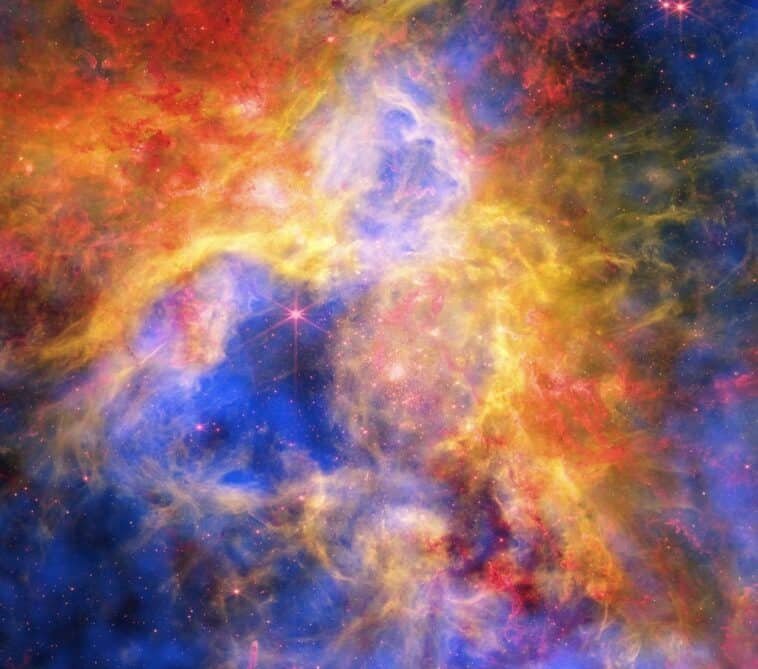
Space scientists just dropped a jaw-dropping new composite image of the Tarantula Nebula, and it looks less like a standard space photo and more like a high-tech cosmic art project.
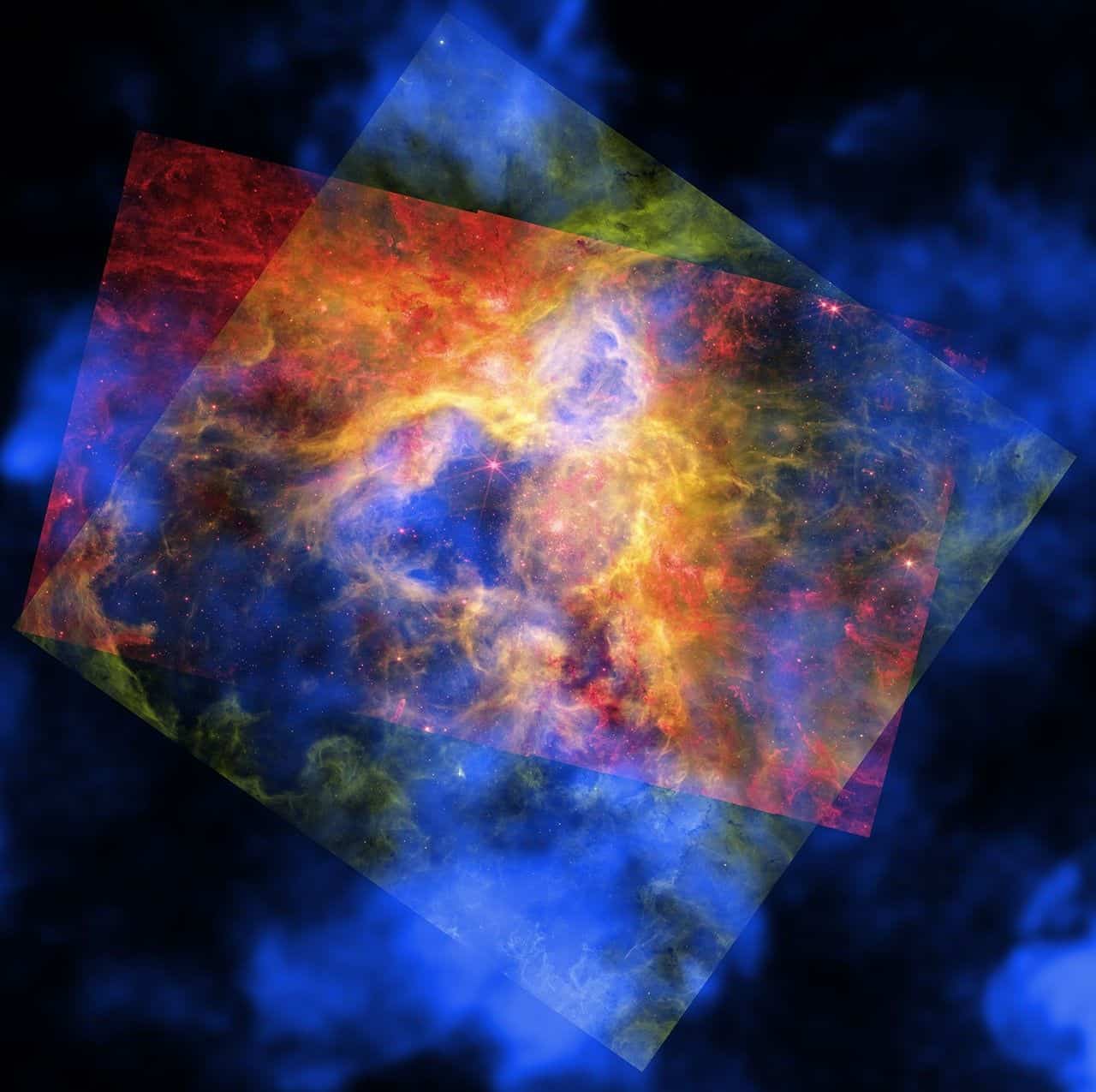
NASA described the colorful observation as “like a collage made of layered sheets of colored cellophane.”
This mind-blowing multi-telescope masterpiece, which brings together data from the Chandra X-ray Observatory, the James Webb Space Telescope (JWST), and the Hubble Space Telescope, reveals fresh details about 30 Doradus, a massive star-forming region better known as the Tarantula Nebula.
A neighborhood 160,000 light-years away
Situated about 160,000 light-years from Earth in the Large Magellanic Cloud, a dwarf neighbor galaxy to our Milky Way, the Tarantula Nebula is one of the largest and brightest star-forming regions around.
The region is home to thousands of newborn stars embedded within a vibrant, honeycomb-like structure of gas and dust. These fiery young stars work round the clock, shaping their cosmic environment.
The making of a cosmic masterpiece
To capture the region’s full complexity, NASA astronomers didn’t rely on just one view or a single perspective. Instead, they layered observations from NASA’s top observatories into a single visual masterpiece, combining full Hubble and Webb images along with a large section of Chandra’s view:
- Blue (Chandra X-ray Observatory): This highlights super-hot gas that can reach millions of degrees. This gas then gets blasted away by powerful stellar winds and heated up by intense shock waves. It’s basically a cosmic sonic boom triggered by supersonic stellar activity. Chandra X-ray Observatory has repeatedly observed the Tarantula Nebula over the course of its mission.
Red (James Webb Space Telescope): It captures infrared views of thousands of young stars alongside massive swathes of cool dust. This dust provides the necessary ingredients that are required to form new stars and planets.
Green (Hubble Space Telescope): Reveals optical light showing warmer hydrogen gas than that seen with Webb. It also shows individual stars glowing throughout the nebula.
Where all three telescope images overlap in the middle, they create a breathtaking spectrum of red, orange, yellow, green, and blue.
The mystery of the tamed tarantula
Beyond looking ridiculously cool, this visual compilation helps solve a genuine scientific mystery recently published in The Astrophysical Journal.
Astronomers originally expected the Tarantula Nebula to contain massive amounts of high-energy X-ray gas, fueled by intense winds radiating off large young stars. Surprisingly, Chandra’s data revealed significantly less hot gas than theoretical models predicted. That raised an obvious question for the research team led by Jennifer Rodriguez at The Ohio State University: Where did all that energy go?
By analyzing the combined data from Chandra, Hubble, Webb, and the retired Spitzer Space Telescope, scientists realized the Tarantula Nebula is actively losing energy through three distinct escape routes:
- Gas leakage: Up to half of the hot X-ray gas is escaping through cracks and holes in the nebula’s dense outer shell walls.
- Turbulent mixing: As hot gas meets cooler gas near the shell walls, violent mixing cools down the overall gas temperature.
- Thermal conduction: Just like a hot frying pan heating up a cold stove burner, heat transfers directly from hot gas to cooler shell material through physical contact, cooling the region down without needing the gas to mix.
These three cooling channels combine to keep the nebula’s energy in check while giving us one of the most stunning layered views of deep space ever put together.
Sources: New York Post, NASA