
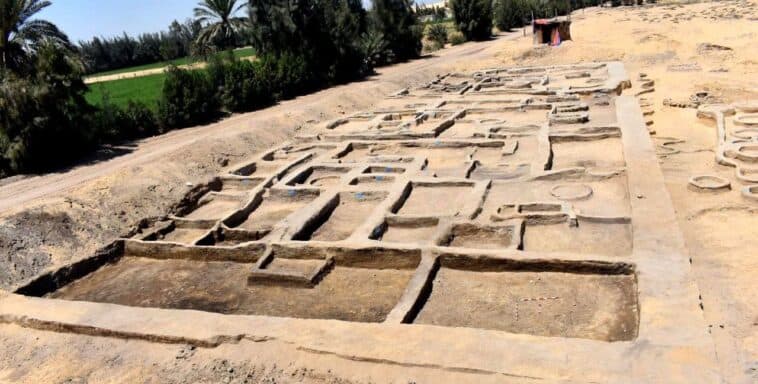
Archaeologists have been uncovering a settlement at Tell el-Koua, out in the Wadi Tumilat, in the New Qassasin (Qasasin al-Jadida) district of Ismailia Governorate. The Ministry of Tourism and Antiquities announced the discovery in late June.
Wadi Tumilat itself served as a vital corridor, linking the eastern Nile Delta to Egypt’s eastern edge. Whoever lived there stayed a while. Fifteenth Dynasty tombs sit in the ground, and the settlement remained occupied into the Eighteenth Dynasty, spanning the whole messy handoff from Hyksos rule into the New Kingdom.
Evidence recovered from the site suggests it functioned as a fully integrated community rather than a mere outpost. By examining the distribution of grain silos, kilns, and domestic dwellings alongside the burial grounds, experts at the Ministry have identified a rare glimpse into the daily survival and social structure of the Second Intermediate Period.
The findings indicate the settlement was a self-sustaining hub, where the proximity of tableware and cooking vessels to residential structures points to a high degree of daily activity and long-term habitation.
Where legend meets the ground
The place in question dates to the Second Intermediate Period (roughly 1650–1550 BCE), the 200-year stretch of instability between Egypt’s Middle and New Kingdoms when the Hyksos (foreign rulers of West Semitic origin) controlled much of the north until Egyptian forces drove them out.
It is precisely the era that some scholars reach for whenever possible historical settings for the biblical Exodus come up, though others doubt that the Exodus unravelled the way it’s been written or that it happened at all. Nobody’s winning that fight soon.
At Tell el-Koua, the ground yielded ten mudbrick tombs, houses worn down to their outlines, and ovens that once fired pottery and silos emptied of grain centuries ago, all enclosed by a surrounding wall.
Smaller things surfaced as well, the kind people carry and lose. Scarab amulets, bronze tools, pottery, and alabaster jars that once held someone’s cosmetics alongside mixed human and animal bones, the latter likely from daily meals and funeral offerings.
For the first time at the site, archaeologists also found human burials outside the formal mudbrick tombs, including some individuals interred in a crouched position, an unusual practice that researchers say will require further study.
One structure stood out for its size, however, measuring nearly 98 by 197 feet, its halls and rooms still visible in the dirt. Just east of it lay kilns and additional grain storage beside those.
Whether or not the site eventually yields evidence that ties into the biblical narrative, it remains a critical piece of the puzzle in understanding the complex, often turbulent transition that defined ancient Egypt’s trajectory.
Sources: Ministry of Tourism and Antiquities, Archaeology, New York Post