
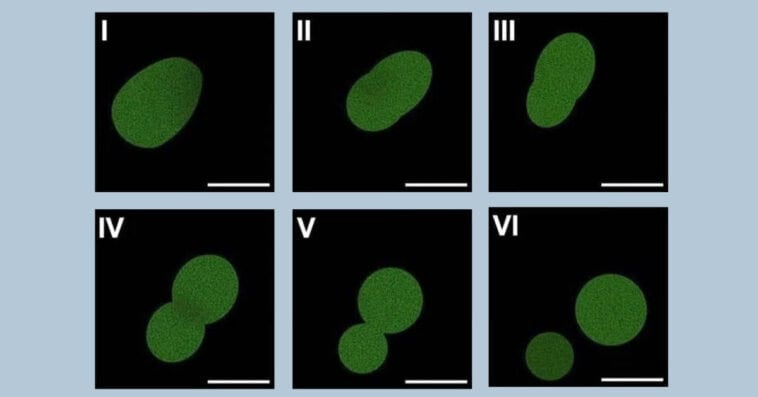
For centuries, humanity has wrestled with a profound question: what truly separates non-living matter from actual, breathing life? We used to think it took a mysterious, magical spark to bridge that gap, but a team of researchers just proved otherwise by building a living organism completely from scratch. Dubbed SpudCell, this man-made creation can feed, grow, and replicate just like an organic cell — yet it was constructed entirely from inert, non-living chemicals. By mimicking the biological cycle through pure chemistry, this breakthrough doesn’t just rewrite the rules of modern science; it opens a door to engineering custom living machines that could fundamentally transform how we produce medicine, advanced materials, and industrial chemicals.
Building life from scratch
In a milestone victory for synthetic biology, researchers at the University of Minnesota’s College of Biological Sciences have engineered the world’s first synthetic cell capable of navigating a complete biological life cycle. Developed by associate professors Kate Adamala and Aaron Engelhart alongside their research teams, the project has yielded a microscopic marvel named “SpudCell.”
Unlike previous scientific triumphs that merely modified existing organisms, SpudCell was constructed entirely from non-living chemical components. Yet, it effectively mimics organic behavior: it feeds, grows, and replicates.
“This is likely the most exciting project I’ve ever worked on,” said Prof. Adamala. “We’ve replicated in chemistry what only used to be possible in biology: the complete set of behaviours of a cell. It proves that the most fundamental functions of life, like growth and replication, do not need a mysterious magical spark.”
How SpudCell multiplies
To breathe life into inanimate chemicals, the Minnesota team had to solve a mechanical puzzle that has long stalled synthetic cell research: cell division.
Natural, organic cells rely on a complex internal scaffolding known as a cytoskeleton to pull themselves apart and divide. Recreating this intricate architecture from scratch is incredibly difficult. The creators of SpudCell engineered a clever workaround. Instead of an internal skeleton, they designed proteins that gather and crowd together on the cell’s outer membrane. As these proteins pack tightly, they create intense mechanical stress on the surface, ultimately forcing the cell to split in two.
By tweaking SpudCell’s genetics to ramp up production of this specific fusion protein, the team successfully created synthetic cells that grew at accelerated rates and produced a higher number of offspring. The result is a fully functional lifecycle that ticks every major biological box: selection, genome replication, growth, feeding, and genetically encoded division.
From lab breakthrough to real-world use
Because SpudCell is engineered rather than born, it features a highly modular structure. This allows scientists to essentially “program” various functions of the cell independently—much like installing apps on a smartphone. Currently, manufacturing essential products like pharmaceuticals, advanced materials, and industrial chemicals requires hijacking natural cells or relying on harsh, energy-heavy industrial chemistry. Synthetic cells built entirely from scratch could revolutionize these industries by performing delicate, custom molecular transformations that traditional manufacturing simply cannot replicate.
As development progresses, the team anticipates that SpudCell and its future generations will tackle these increasingly complex behaviors. However, unlocking this potential requires moving beyond isolated laboratory success.
The hurdles ahead
Despite the excitement, turning the creation of individual SpudCells into a streamlined engineering pipeline will require significant time and effort. Scientifically, the cell’s genetic blueprint is still fragmented; it relies on seven separate DNA molecules called plasmids, which researchers must first stabilize into a single, cohesive genome.
Logistically, the challenges are even greater. Because synthetic biology is a relatively young frontier, different laboratories across the globe lack uniform standards for building and analyzing working cells.
“This was exceptionally difficult work to scale,” Prof. Adamala explained. “The knowledge in this space is very hard to explain, so we had collaborators on the project fly in for in-person demonstrations just to get particular techniques working. That’s not scalable.”
Standardization through Biotic
To bridge this gap and establish much-needed industry modularity, researchers are utilizing Biotic, an international collaborative initiative designed to standardize synthetic biology. Think of Biotic as the universal operating system for artificial life, establishing the shared protocols needed so global labs aren’t forced to reinvent the wheel.
“This work is just the beginning,” Prof. Adamala added. “To fully realise the promise of this technology – to make it robust and practical – we need combined international effort. The role of Biotic is to focus engineering efforts and make them compatible with a shared chassis. SpudCell is that chassis, and with Biotic setting the protocols for collaboration, we are eager to start applying this technology to serious challenges.”
By advocating for this open-source framework rather than private, proprietary systems, the creators hope to build an infrastructure in the open. As Prof. Adamala notes, “an infrastructure foundation built privately just gives someone a toll booth.” Through global collaboration, the team aims to pave a clear path forward — one where programmable life can be safely scaled to meet global health and industrial demands.
Source:
Independent