
For centuries, stories of the Nephilim — mysterious giants mentioned in the Bible — have fueled speculation about whether they were based on real beings. Now, an extraordinary discovery beneath the ocean is adding a surprising new twist to the debate: ancient human remains linked to an extinct human group have scientists and researchers asking whether these findings could shed light on one of history’s most enduring mysteries. But what exactly was discovered, and is there really any connection to the biblical Nephilim?
Ancient bones offer a new look at Denisovans
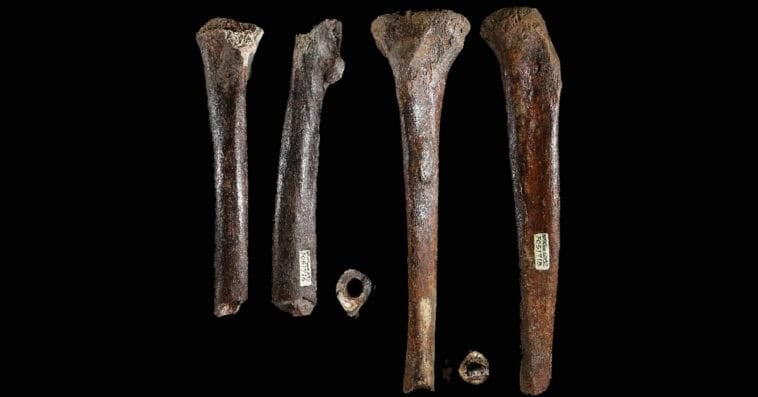
The mystery began in the Penghu Channel, a stretch of water separating Taiwan from mainland China. Deep beneath the ocean surface, researchers from the University of Tokyo recovered two extraordinary fossilized leg bones: part of a thigh bone (Penghu 2) and a shin bone (Penghu 3).
Through advanced protein analysis, scientists identified the specimens as belonging to Denisovans. This elusive, extinct human lineage split from Neanderthals roughly 550,000 years ago and once roamed vast swathes of Eastern Asia.
While scientists have long known that Denisovans possessed large brains, powerful jaws, and massive teeth, a lack of skeletal remains below the skull left their physical proportions a complete mystery.
Until now.
By comparing the partial fossils to similar bones from modern and ancient humans, a University of Tokyo-led team reconstructed the individuals’ original dimensions. The results were staggering:
- The Thigh Bone (Penghu 2): Belonged to an individual estimated at 5 feet 11 inches tall and 183 pounds.
- The Shin Bone (Penghu 3): Belonged to an individual who likely stood 6 feet 3 inches tall and weighed over 200 pounds.
To put that into perspective, the average modern man stands around 5 feet 9 inches. These individuals would have dwarfed their contemporary evolutionary cousins, standing 8 to 12 inches taller and weighing up to 66 pounds more than Homo erectus populations living in Northern China at the time.
“Our findings demonstrate that the Denisovan population at the northern circle had larger body size than earlier Homo erectus as well as Late Pleistocene Homo sapiens in eastern Asia,” the researchers stated in the study.
The ‘Nephilim’ connection
The combination of massive physical dimensions and an underwater resting place quickly set alternative history circles ablaze. Independent researcher Jimmy Corsetti pushed a provocative theory on social media platform X, suggesting the discovery might be tangible proof of the Bible’s legendary giants — the Nephilim.
“New discovery indicates that Denisovans were 8in TALLER than the average man today,” Corsetti posted. “I’ve asked before, and I’ll ask again: Were Denisovans the ‘Nephilim Giants’ described in the Bible? Btw, the discovered bones were found on the SEAFLOOR! Gee, almost as if a Great Flood actually happened…”
In biblical tradition — specifically Genesis 6:4, Numbers 13:33, and expanded religious texts like the Book of Enoch — the Nephilim are depicted as colossal, violent offspring of fallen angels and human women whose reign ended when God sent a global deluge to cleanse the Earth.
However, mainstream scientists urge extreme caution. The study presents zero evidence connecting the Denisovan remains to biblical scripture or a universal flood, and the research paper has not yet gone through formal peer review. Sea levels fluctuated dramatically during ancient ice ages, meaning the ocean floor where the bones lay was once dry, exposed land.
Rewriting the rules of human evolution
Beyond the viral theories, the legitimate scientific implications of the Penghu bones are ground-breaking.
For decades, biologists relied on Bergmann’s Rule — an evolutionary concept predicting that species in warmer, lower-latitude climates (like Taiwan) should be smaller than those in freezing northern regions. The massive Taiwanese Denisovans shatter this expectation. Scientists note that climate alone cannot account for their immense size.
Instead, their build may have been an evolutionary response to their environment and hunting style:
- High-protein diet: Chemical analysis of the shin bone reveals a diet packed with meat. Denisovans were apex hunters who pursued massive prey, from mountain goats to large herbivores.
- Brute force hunting: Scientists suggest their heavy, powerful frames helped them overpower large game using simpler, less sophisticated tools than those favored by Homo sapiens.
- Extreme mobility: The thigh bone features a thick, angular ridge typically seen in modern human hunter-gatherers, signaling a lifestyle defined by intense long-distance travel across prehistoric landscapes.
Researchers also note this modern-like bone structure could be the result of early interbreeding with Homo sapiens, as genetic records confirm our ancestors exchanged DNA with Denisovans across Asia.
What comes next?
While the Penghu fossils are helping fill one of the biggest gaps in the Denisovan fossil record, they also raise more questions than they answer. Scientists still need additional Denisovan remains and genetic evidence to determine how widespread the observed physical characteristics were among the Denisovans and what forces shaped them.
For now, the evidence offers a fascinating glimpse into an extinct human population that may have been far more physically imposing than previously understood. However, the idea that these ancient people were connected to the biblical Nephilim remains speculation rather than a scientific conclusion.
Source:
Daily Mail