
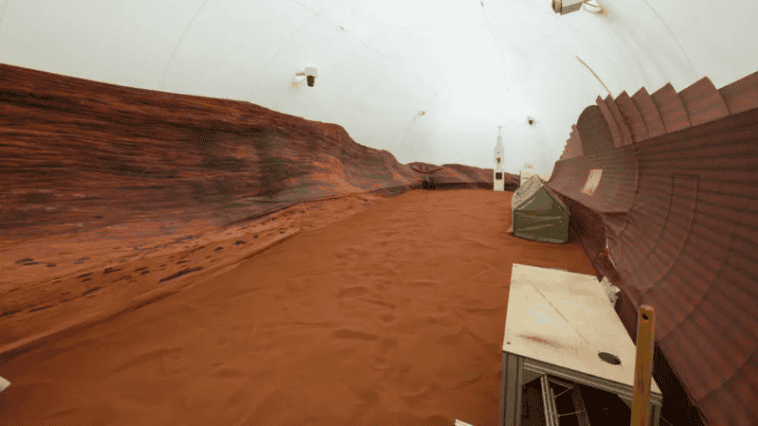
For the closest thing to spending a year on Mars, without leaving Earth, look no further than Houston.
NASA has opened recruitment for the Moon and Mars Exploration Analog (MMEA), a yearlong simulated deep space mission at Johnson Space Center, set to begin no earlier than August 2027.
The mission will take place inside two habitats, with a four-person crew spending twelve months experiencing nearly everything a real deep space mission could throw at people, minus the actual vacuum of space, of course.
NASA is pulling from two of its existing analog programs and merging them. The HERA habitat (Human Exploration Research Analog) will serve as the simulated spacecraft, while the CHAPEA habitat (Crew Health and Performance Exploration Analog) will become the planetary surface base.
Volunteers will “fly” to their destination, conduct a surface stay, and “return” home, all without leaving Houston. The schedule also includes mock Mars walks and rover excursions.
What NASA gets out of the mission is data. Over the course of the year, the crew will live cut off entirely from the outside world, operating with limited resources and a demanding daily work schedule.
Researchers will then closely monitor how volunteers will handle the constant isolation and the very likely stress that comes with it. Findings will feed directly into NASA’s Human Research Program (HRP), also located at Johnson Space Center. The program studies the medical and psychological side of long space missions and uses research to develop methods to protect the health and performance of astronauts in space.
For the application side of things, candidates must meet physical and educational requirements, undergo a multi-day selection process, and pass rigorous physical and psychological screenings to qualify.
It’s worth noting that NASA wants people who are looking for unusual experiences and are actually interested in the lunar and Mars work. If living without sunlight or fresh air for twelve months sounds unappealing to you, this probably isn’t your thing.
Source: NASA, NASA Analogs, HERA, CHAPEA