
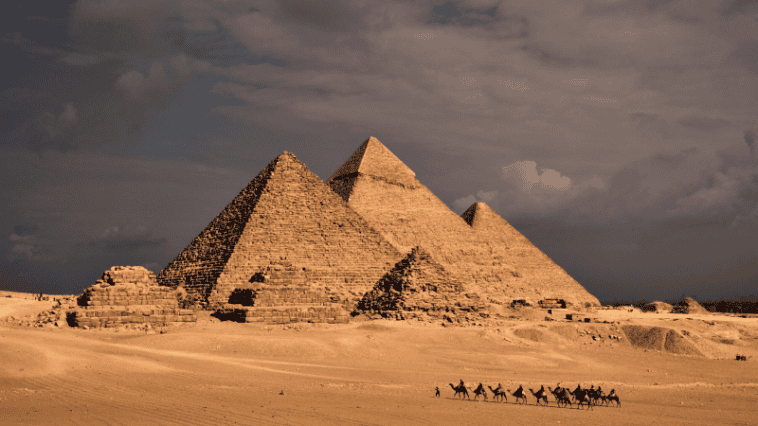
Buried beneath the sand next to the Great Pyramid of Giza lies an unexplored anomaly that is now under investigation.
In a geophysical survey of the Western Cemetery conducted between 2021 and 2023, the elite burial ground west of the Great Pyramid, a joint Japan-Egypt research team involving Tohoku University, Higashi Nippon International University, and Egypt’s National Research Institute of Astronomy and Geophysics used ground-penetrating radar (GPR) and electrical resistivity tomography (ERT) to examine a previously overlooked patch of desert.
The scans uncovered an L-shaped structure roughly 10 by 15 meters (33 by 49 feet) at a shallow depth of about 0.5 to 2 meters (1.6 to 6.6 feet) below the surface. A second, deeper anomaly measuring about 10 by 10 meters was also detected, at roughly 5 to 10 meters (16 to 33 feet) deep.
The findings, which were detailed in a 2024 paper published in Archaeological Prospection, have fueled speculation about a possible hidden chamber.
Natural formation or man-made void?
Researchers believe the L-shaped feature may have been backfilled with sand after it was constructed. Motoyuki Sato, who led the survey, told Live Science back in 2024 that the shape is too sharp for it to be considered natural.
The paper characterizes the deeper anomaly as “highly electrically resistive,” which could point to either packed sand and gravel or air voids, though the team stopped short of specifying which.
“It may have been an entrance to the deeper structure,” Sato and his colleagues wrote. As the cautious wording highlights, ‘may’ is doing a lot of work here.
The Western Cemetery is packed with mastabas, the flat-roofed elite tombs for which Giza is famous. This particular patch of ground went unexcavated for years because nothing was visible on the surface. It was only the application of GPR that brought it to attention. The same technique has previously revealed Viking longships in Norway and Roman cities across Europe.
“From the survey results, we cannot determine the material causing the anomaly,” the researchers note, “but it may be a large subsurface archaeological structure,” they explained. The paper called for further excavation to clarify the nature of the anomalies.
When shovels struck stone
Since the paper appeared, the site has moved beyond remote sensing and into active excavation. Reports presented in 2025 and 2026 by members of the Japanese-Egyptian team say the once-empty stretch of ground has already produced substantial archaeological remains, including tomb structures and a processional road, turning what began as a geophysical anomaly into a live excavation with tangible results.
It’s worth noting that these findings are distinct from last year’s viral claims of massive hidden structures beneath the Pyramid of Khafre. Egyptian archaeologist Zahi Hawass rejected those assertions in 2025.
Exactly how those finds connect to the original subsurface signals has not yet been fully detailed in public, but the story is no longer just about suggestive scans beneath the sand. Unlike the Khafre-related claims, the Western Cemetery results come from a peer-reviewed geophysical study, but their precise nature remains unresolved and still requires confirmation from the ongoing excavations.
Sources: JSWAA, Popular Mechanics, Archaeological Prospection, Live Science