
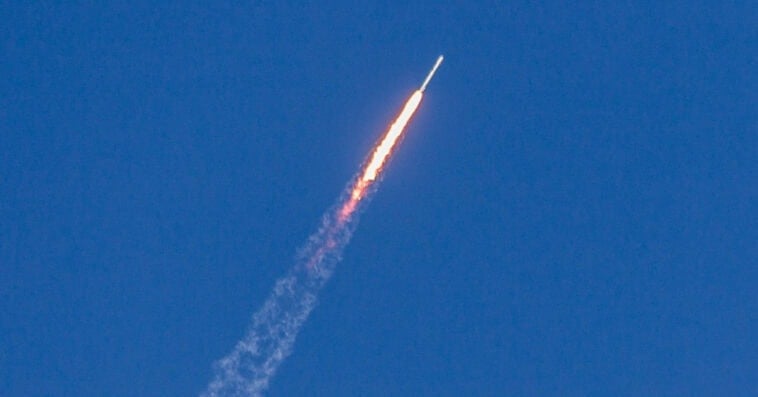
A Chinese rocket has disintegrated in orbit in a dramatic failure that occurred alarmingly close to SpaceX’s Starlink satellite network, adding yet another layer of concern to the increasingly crowded environment above Earth. The breakup has not been linked to an immediate collision, but its proximity to active satellites has quickly drawn attention from space safety experts watching the rising risks of orbital debris. Coming amid ongoing worries about space traffic management, the incident is already fueling renewed questions about China’s space safety standards and what this latest failure could mean for the stability of low Earth orbit.
A blast in a busy neighborhood
On June 9, a commercial Chinese rocket named Zhuque-2E successfully delivered two direct-to-cell communications satellites into space. The launch, managed by the private Chinese aerospace company LandSpace, went according to plan. However, the real trouble began immediately after the payload was deployed.
Evidence suggests that as the rocket’s upper stage — the large, final section responsible for pushing the satellites into their final position — attempted a “disposal burn,” something went catastrophically wrong. This routine maneuver is designed to safely empty residual fuel and vent high-pressure gases so the empty hull doesn’t turn into a ticking time bomb. Instead, the vehicle fractured mid-orbit.
The U.S. Space Force confirmed the destruction on space-track.org, a military site that monitors orbital traffic. While the military is still calculating the fallout, they offered some immediate reassurance: “The tracked pieces are being incorporated into routine conjunction assessment to support spaceflight safety,” the Space Force noted in a public advisory. “There are currently no threats to human spaceflight. Analysis is ongoing.”
Counting the fragments
While official military catalogs have yet to list every individual shard, experts on the ground are already calculating the damage. Darren McKnight, a senior technical fellow at the orbital intelligence firm LeoLabs, estimates that the fragmentation event likely weaponized the rocket into 100 to 150 pieces of traveling debris.
Before it split apart, this upper rocket stage was a massive piece of machinery, measuring roughly 30 feet long and 11 feet wide — about the size of a city bus. Now, its metal carcass and shattered remains are trapped in an orbital path ranging between 208 and 263 miles above Earth.
This specific altitude creates an invisible intersection with some of humanity’s most expensive space infrastructure:
The International Space Station (ISS): The peak of the debris cloud’s path briefly crosses the altitude of the ISS. Fortunately, natural atmospheric drag is expected to quickly pull the fragments below the station’s orbit, shielding the astronauts from immediate danger.
SpaceX Starlink: The bigger worry is for Elon Musk’s internet satellites. The debris cloud sits right in the path of hundreds of Starlink craft, specifically targeting newly launched units and specialized satellites built for direct-to-smartphone connectivity, which operate at these lower thresholds.
The silver lining
If there is any comfort to be found in this incident, it comes down to basic physics and altitude. Because the explosion occurred relatively close to Earth, thin layers of the upper atmosphere will act as a natural brake.
This drag will degrade the speed of the fragments, causing the vast majority of the Zhuque-2E debris to fall back toward Earth and cleanly burn up in the atmosphere within a few months. Experts point out that this is a far better alternative to explosions that happen above 400 miles, where a lack of atmospheric friction means space junk can circle the planet as a permanent hazard for decades or even centuries.
A growing pattern of orbital pollution
Despite the short lifespan of this specific debris cloud, space safety experts view the incident as part of a troubling, systemic problem.
Historically, older rocket bodies from Russia and the United States have made up the bulk of abandoned space junk. However, Western nations and modern launch operators have largely cleaned up their acts, utilizing stricter protocols to guide spent rockets back to a controlled crash in the ocean. According to space domain awareness expert Jim Shell, while American and Russian debris numbers are stabilizing or dropping, the mass of abandoned Chinese rocket bodies left in long-lived orbits has skyrocketed by more than 150 percent over the last five years. This surge mirrors Beijing’s aggressive push to build its own massive satellite networks to rival Starlink.
Abandoned rocket bodies are considered the most dangerous type of space pollution. They are heavy, unsteerable, and frequently packed with leftover fuel and pressurized tanks that can ignite without warning.
While McKnight described this particular Zhuque-2E incident as a “slight space safety issue,” he warns that China’s broader track record is becoming impossible to ignore, pointing specifically to older government models like the Long March 6A, which previously exploded and left thousands of permanent fragments in higher orbits.
“Three of the top four breakup events in LEO [low-Earth orbit] are of Chinese origin,” McKnight emphasized, “with two of these events being from Chinese [rocket body] explosions in the last four years.”
Source:
Ars Technica