
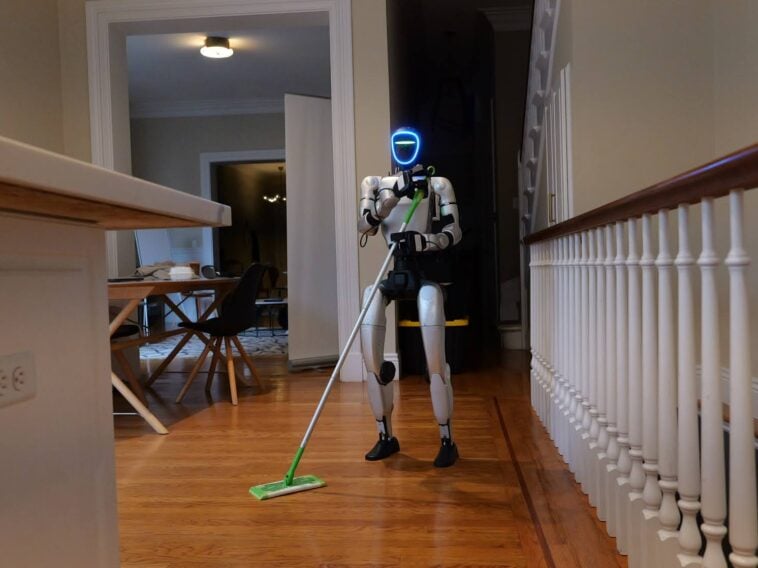
A humanoid robot cleaned an apartment in San Francisco last week, which is being called the first time that has happened for a paying customer in the United States.
The company behind the job is Gatsby, a robotics startup operating under West Egg Labs. The customer was selected at random from a waitlist and booked the cleaning through Gatsby’s iOS app. The robot worked alone in the apartment for about three hours.
Gatsby is not selling the robot. It is selling the service. Customers open the app, pick a time, and a robot is sent to their home, similar to booking a ride or a food delivery.
To be clear – we aren’t talking about a glorified Roomba here. It is a full-size humanoid built to do the kinds of tasks people do, including dishes, floors, surfaces, bed-making, and folding laundry. Gatsby charges a flat $150 per visit regardless of apartment size, with no tipping or surcharges. The company says a typical human cleaning in San Francisco costs between $150 and $300.
No human cleaner is physically present during the visit. Gatsby has clarified, however, that harder portions of a job can be handled through remote human teleoperation, meaning an operator elsewhere may take control of the robot when it runs into something it cannot manage on its own.
CEO Aron Frishberg said the company chose cleaning as a starting point because of how much unpaid time it takes from people’s lives.
“Housework is the largest unpaid job in human history, and it falls hardest on the people with the least time to give,” Frishberg said. “Right now, somewhere, there’s a parent scrubbing floors who would rather be with their kid. A worker mopping after a sixteen-hour shift. We’ve mapped every neuron and synapse in a fruit fly’s brain, yet we still clean our homes the same way our ancestors did hundreds of years ago. We didn’t build this to clean apartments, we built it to give that time back to humanity.”
Unlike most robotics companies, Gatsby is not building the hardware. It describes itself as robot-agnostic, meaning it intends to work with whichever humanoid robot performs best at any given time. The company sees itself as the consumer distribution layer for the technology, with the flexibility to swap in better robots as they become available.
The service does raise practical questions, including how customer data is handled when a remote operator is involved, what a remote operator can see, and whether any video or mapping information is stored. Gatsby has not publicly outlined those details in full.
The company says it will replace any items the robot damages during a cleaning.
Gatsby is currently operating only in San Francisco. A waitlist is open for other cities.