
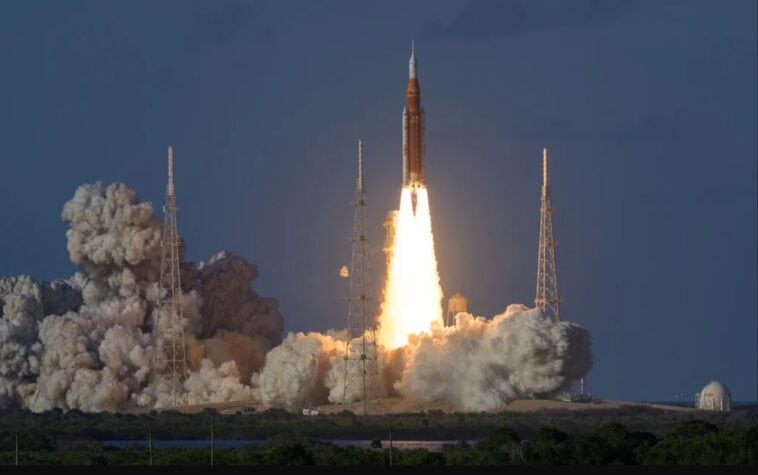
NASA made history yesterday evening as Artemis II successfully lifted off from Kennedy
Space Center in Florida, launching four astronauts on humanity’s first crewed mission
toward the Moon in more than half a century. The Space Launch System rocket and
Orion spacecraft roared off the pad at 6:35 p.m. EDT, marking the first time NASA has
sent a crew into deep space since Apollo.
I watched the launch from Space View Park in Titusville, where thousands of people
had gathered along the waterfront for a clear view of ascent. Long before liftoff, the park
was packed with space fans, families, and locals, all waiting for the moment Artemis II
finally left the pad. The atmosphere was electric. Every update from the countdown
seemed to ripple through the crowd, and when the rocket finally ignited, the reaction
was immediate — cheers, applause, chants of USA, USA, USA and that unmistakable
feeling that everyone was witnessing something historic.
The road to launch had just enough countdown drama to keep the tension high. NASA
teams worked through a few final technical issues, including a hotter-than-expected
battery sensor reading tied to the launch abort system and earlier work involving flight
safety hardware, before the vehicle was cleared for liftoff. Those last-minute checks
only added to the sense of anticipation from the ground, especially as the launch
window opened and the crowd realized this one was really happening.
Part of what made the moment so overwhelming in person was the sheer power of the
rocket itself. At liftoff, NASA’s Space Launch System generated 8.8 million pounds of
thrust. The twin solid rocket boosters supplied more than 75% of the force needed to lift
the 5.75-million-pound vehicle off the pad, working in concert with the rocket’s four RS-
25 engines to send Orion skyward. When ignited their sheer brightness is breathtaking
yet it is the kind of brute force that you do not just see, you feel it. Even from Titusville,
the launch looked violent in the best possible way, with the sound and vibration arriving
as a physical reminder that this is what it takes to send humans beyond Earth orbit.
That power is only the beginning, though, because getting to the Moon is not simply
about blasting straight to escape velocity from the launch pad. Artemis II builds energy
in stages. First, SLS places Orion into Earth orbit. Then the rocket’s Interim Cryogenic
Propulsion Stage, powered by a single RL10 engine producing nearly 25,000 pounds of
thrust, performs the precise burn needed to send the spacecraft out toward the Moon.
NASA describes that translunar injection burn as the final push that puts Orion on its
outbound path.
That distinction matters because “escape velocity” is often used as shorthand, but in
reality this mission is a carefully choreographed series of accelerations. Artemis-era
mission profiles show Orion reaching roughly 22,600 mph at translunar injection main
engine cutoff, the point where the spacecraft has built enough speed and energy to
head toward deep space. In other words, Artemis II does not rely on one single burst of
speed; it uses an enormous launch followed by a highly precise in-space burn to send
astronauts on their way to the Moon.
Artemis II is not a Moon landing mission, but it is one of NASA’s most important lunar
flights in decades. The mission will send the crew around the Moon and back on a
roughly 10-day journey, serving as the first crewed test flight of both Orion and the
Space Launch System. Its purpose is to prove that the spacecraft, systems, and crew
operations all perform as expected in deep space before astronauts eventually attempt
a lunar landing on a later Artemis mission.
The crew includes commander Reid Wiseman, pilot Victor Glover, mission specialist
Christina Koch, and Canadian Space Agency astronaut Jeremy Hansen. The mission
also carries major symbolic weight: Koch is the first woman assigned to a lunar mission
of this kind, Glover is the first Black astronaut on such a flight, and Hansen is the first
Canadian to travel into deep space toward the Moon.
From Space View Park, all of that felt very real. This was not just another Florida launch
or another impressive rocket rising over the coast. It felt like the return of something
bigger, the return of human deep-space exploration as a lived event, not just a future
plan. Watching Artemis II climb away with that much power, and knowing it was carrying
astronauts toward the Moon, made the whole thing feel less like history repeating and
more like history restarting