Warning: I’m going to sound like a broken record in this review. It’s not my fault. Between its flagships, cameraphones, and foldables, Chinese smartphone manufacturer Oppo just keeps releasing banger after banger – like the Find X9 Pro, the subject of this review. So yes, I’m going to repeat myself quite a bit here. Sorry, not sorry.
For a few years now, Oppo’s X series has consisted of three flagships, a base model, a “Pro” model, and an “Ultra” model. All three always have top-notch shooters designed in partnership with Hasselblad, but the base version downgrades the camera specs a little while the “Ultra”, which always comes later, cranks imaging performance up to eleven.
The “Pro” version always hits the sweet spot, delivering a good balance between flagship and cameraphone. Like the Find X8 Pro I reviewed in 2025, the Find X9 Pro actually came out last year, but it soon became my favorite winter flagship – and 2026 flagship, at least so far. So let’s dive in and find out what makes the Find X9 Pro tick.
Oppo Find X9 Pro vs. X8 Pro: what’s changed?
There are several notable differences between the Oppo Find X9 Pro and its predecessor, the Find X8 Pro, alongside a few similarities. Let’s start by focusing on what’s remained the same. The display size (6.78 inches) is identical, the overall dimensions are similar (8.3mm thickness), and so is the IP68 and IP69 water and dust resistance rating.
Charging speeds (80W wired and 50W wireless) are also unchanged, and both phones boast a flagship SoC from MediaTek – Dimensity 9400 on the Find X8 Pro, and Dimensity 9500 on the Find X9 Pro. Both also share identical 50MP ultrawide shooters and the same capacitive camera button (Quick Button). That’s where the similarities end.
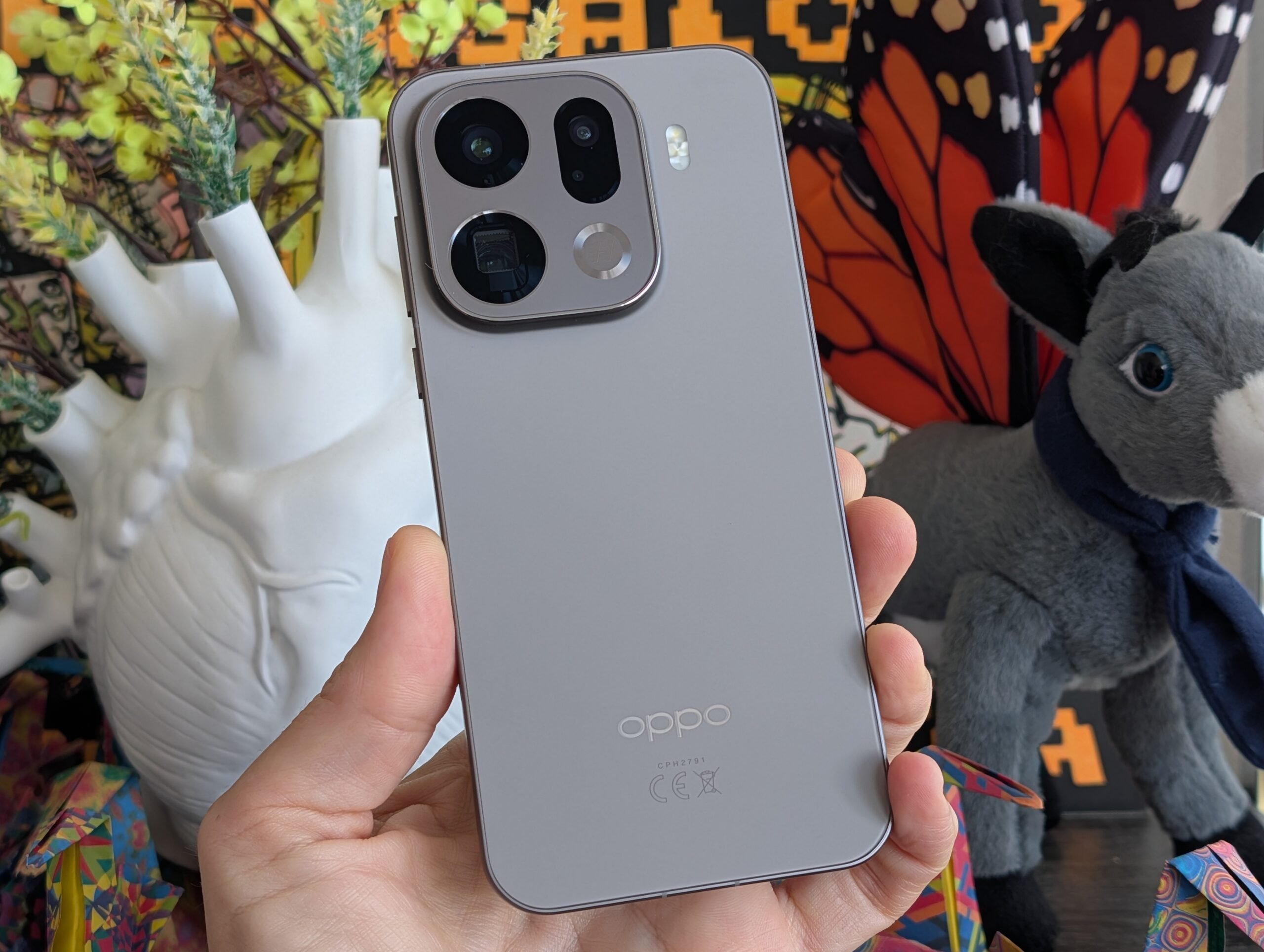
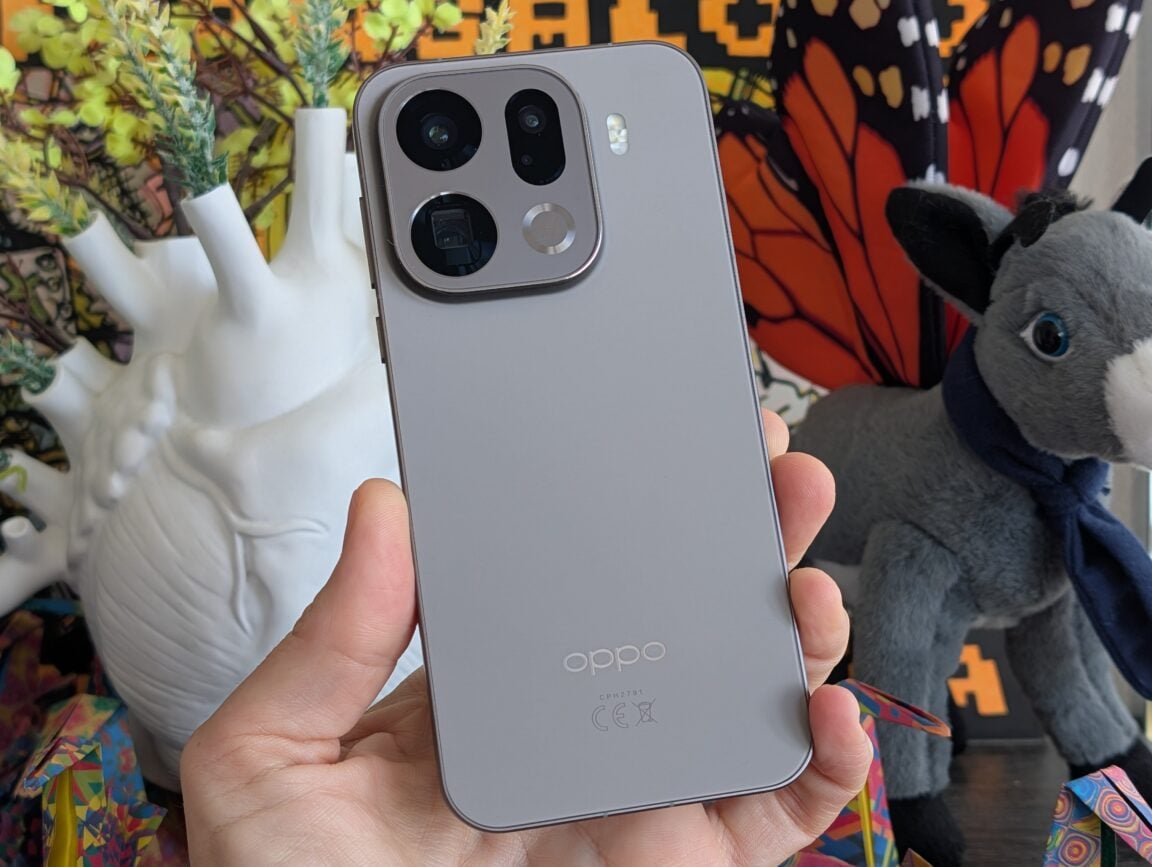
Put the two phones side-by-side and the design changes are really obvious. Gone is the Find X8 Pro’s slim edges and tapered 2.5D front and rear glass, replaced instead by the Find X9 Pro’s slab-like sides, rounded corners, and perfectly flat screen and back – think iPhone 17, Galaxy S25/S25+, and Pixel 10 series, and you have the right idea.
It makes the Find X9 Pro look and feel more substantial, but not as comfortable to hold as the Find X8 Pro. And that’s a bummer. The other big difference is with the camera pod, which is no longer a large disk that’s perfectly centered, like on the Find X8 Pro. Instead, the Find X9 Pro’s camera island is a large rounded-off square that’s mounted top left.
This new camera bump is reminiscent of the Pixel 10 Pro Fold’s, but larger and rotated 90 degrees. Instead of two black, horizontal, pill-shaped glass windows, the Find X9 Pro features two round openings for the main and telephoto lenses flanked by a vertical pill-shaped opening for the ultrawide, spectral sensor, and laser AF system.
By now, you’ve probably noticed that the Find X9 Pro and OnePlus 15 look quite similar. That’s not by accident. OnePlus is owned by Oppo, and while the OnePlus 15 was also released in October, right after the Find X9 Pro, this new design language originated with the OnePlus 13s compact flagship (OnePlus 13T in China) back in April 2025.
Speaking of cameras, the most significant change between the Find X9 Pro and Find X8 Pro is the switch from a dual 50MP 3x and 6x telephoto setup to a massive single 200MP 3x telephoto. In addition, the 50MP main sensor is larger, the lenses are overall faster, and the selfie camera gets a bump from 32MP to 50MP, and gains autofocus.
Here’s another important difference. The alert slider Oppo borrowed from OnePlus for the Find X8 Pro is now gone, replaced by a programmable button (Snap Key) on the Find X9 Pro. It copies the iPhone’s Action button in both UI and functionality, but lacks the alert slider’s delightful tactile feedback. And frankly, that’s disappointing.
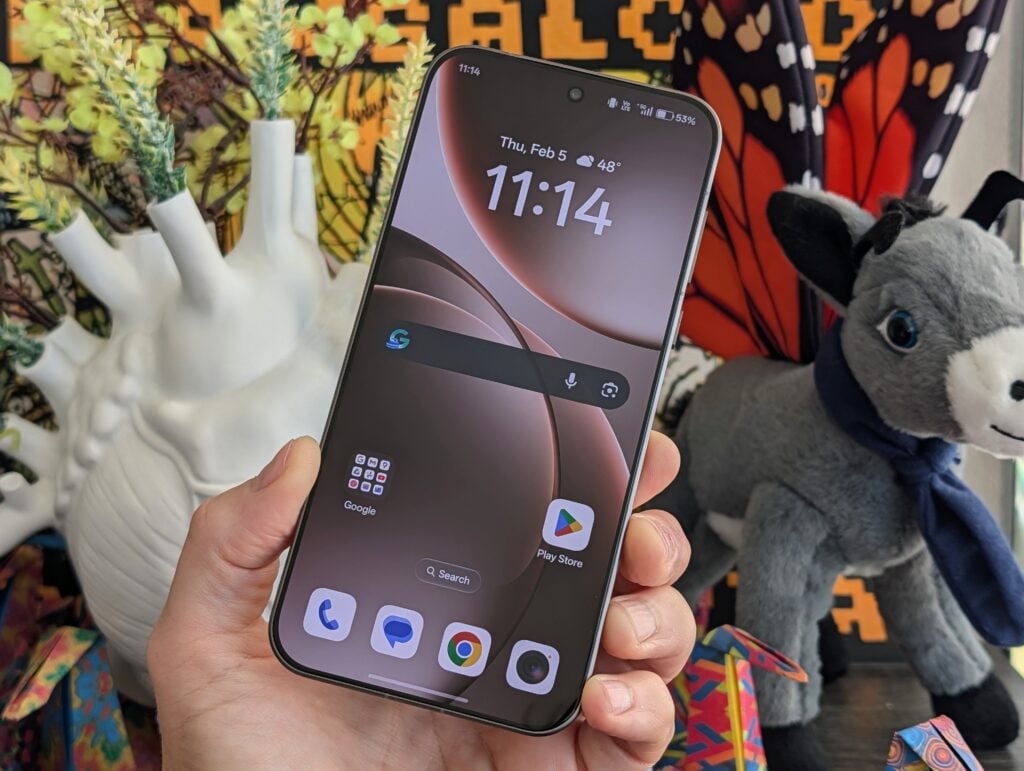
Both phones have almost identical, bright and beautiful 6.78-inch, 1.5k-resolution, 120Hz LTPO AMOLED screens. The Find X9 Pro features an ultrasonic in-display fingerprint sensor instead of the optical fingerprint sensor found on the Find X8 Pro. It’s also worth noting that the Find X9 Pro is slightly heavier than the Find X8 Pro (224 vs. 215g).
Like its predecessor, the Find X9 Pro is available in several global markets, but not in North America. As such, it’s missing some 4G LTE and 5G bands for the US, and isn’t compatible with Verizon’s network. Then again, the Find X9 Pro worked just fine on T-Mobile, AT&T, and Telus in places like San Francisco, Denver, Austin, and Vancouver (Canada).
As I mentioned above, the Find X9 Pro is powered by MediaTek’s latest flagship processor, the Dimensity 9500, which packs a serious punch. So the Find X9 Pro never skips a beat no matter what you’re doing. This chip is paired with 12 or 16GB of RAM plus 256GB, 512GB, or 1TB of storage, which is slightly faster than the Find X8 Pro’s (UFS 4.1 vs. 4.0).
While both phones feature silicon-carbon cells, the Find X9 Pro boasts a gigantic 7,500mAh battery, which is significantly larger than the Find X8 Pro’s 5,910mAh battery. In practice, this results in outstanding battery life, even on busy days. And with light use, you can expect the Find X9 Pro to keep on ticking for three days or more on a full charge.
The Find X9 Pro follows in the Find X8 Pro’s footsteps and supports 80W SuperVOOC and 55W USB PPS fast wired charging plus 50W AirVOOC fast wireless charging (Qi-compatible), and 10W reverse wireless charging. Unfortunately, due to EU regulations, our European-market review unit didn’t include an 80W SuperVOOC charger in the box.
In addition, the Find X9 Pro’s stereo speakers sound just as rich and crisp as the Find X8 Pro’s. The Find X9 Pro runs ColorOS 16, which is based on Android 16. Alongside OnePlus’ Oxygen OS and Realme UI, Oppo’s Color OS delivers a clean and refined user experience, making it my favorite Android skin from any Chinese phone manufacturer.
That being said, while Color OS doesn’t stray too far from stock Android, it’s beginning to look and feel a bit too iOS-like for my tastes. My review unit also came with more bloatware than I’m comfortable with. On the plus side, Oppo is promising five years of OS upgrades and six years of security updates for the Find X9 Pro, which is reasonable.
A cameraphone with a “cannon”?
Instead of boasting four 50MP cameras (main, ultrawide, plus 3x and 6x telephotos) like the Oppo Find X8 Pro, the Find X9 Pro packs a 50MP main shooter, a 50MP ultrawide, and a huge 200MP 3x telephoto. The ultrawide is pretty much identical, but the main sensor is bigger than before, and both the main and telephoto lenses have larger apertures.
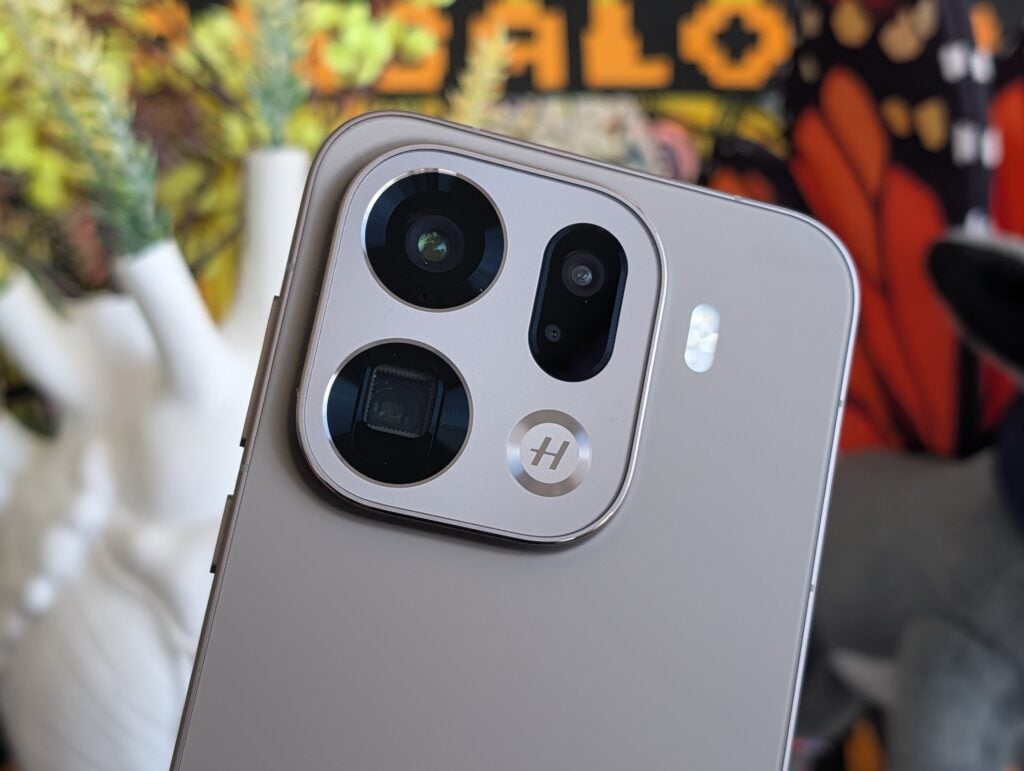
Here are the specs for the Find X9 Pro’s rear cameras:
- 50MP f/1.8 1.22-micron 23mm main sensor (1/1.28-inch Sony LYT-828) with laser AF, omni-directional PDAF and OIS
- 50MP f/2.0 0.64-micron 120-degree 15mm ultrawide lens (1/2.75-inch Samsung S5KJN5) with omni-directional PDAF
- 200MP f/2.1 1.0-micron 70mm (3x) periscope telephoto (1/1.56-inch Samsung S5KHP5) with omni-directional PDAF and OIS
Eagle-eyed readers will have noticed a tiny fourth lens in the back. It’s Oppo’s 2MP f/2.4 True Color shooter, a spectral sensor that divides the image into 8×6 zones and optimizes the color temperature for each zone. Finally, up front you’ll find an updated 50MP f/2.0 0.64-micron 21mm selfie camera with PDAF (1/2.75-inch Samsung S5KJN5).
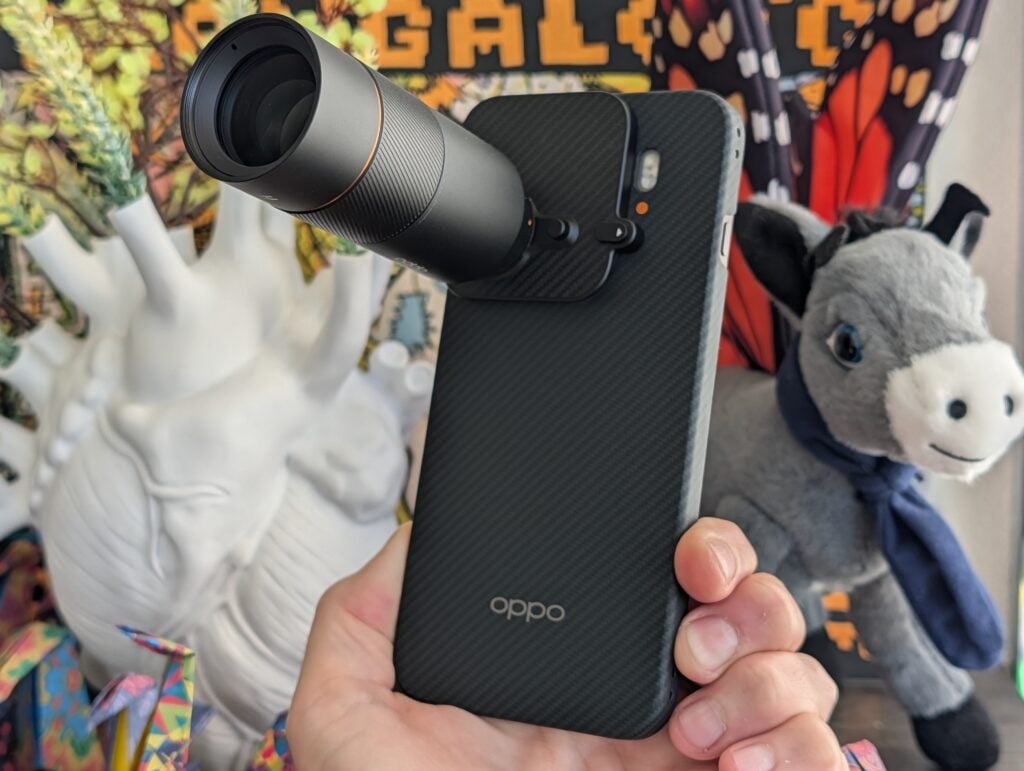
But what really sets the Oppo Find X9 Pro apart is the aforementioned “cannon” – a 3.28x teleconverter lens that attaches to the telephoto camera and boosts its 3x optical magnification to 10x. This optional kit comes in four parts. An aramid fiber case, a mounting plate, the teleconverter lens (with protective lens caps), and a tripod collar.
To use the teleconverter, you must first snap the phone into the aramid fiber case, then slide the mounting plate onto the case (this covers up all shooters but the telephoto), then twist the teleconverter onto the plate. Optionally, you can also fit the tripod collar to the teleconverter. The result looks like a cannon attached to the back of a phone.
I’ll dive into the teleconverter’s benefits in a moment, but obviously, it makes using the Find X9 Pro quite impractical. The whole contraption weighs in at 437g (0.96 lbs) without the tripod collar (itself 72g). Sure, you can remove the mounting plate from the case with the teleconverter attached, but then you can’t install the protective lens cap on the small end.
Say you’re on a photo walk. You now need a bag or pocket to store the plate and teleconverter when you’re not using them. And remember, you have to slide the mounting plate off the case to use the main camera or the ultrawide. In other words, the optional teleconverter kit is really only best suited for hard-core mobile photography enthusiasts.

The Find X9 Pro’s shooters all support pixel binning, which improves low-light performance by combining groups of nearby pixels into one larger pixel. The 50MP main, ultrawide, and front sensors use 4-to-1 pixel binning to generate 12MP pictures, and the 200MP telephoto uses either 4-to-1 or 16-to-1 pixel binning to output 50MP or 12MP images.
In addition, the main camera and telephoto both support in-sensor cropping. This works by reading the 12MP center portion of the 50MP main sensor to capture near-lossless 2x photos and by reading the 50MP center area of the 200MP telephoto sensor to achieve near-lossless 6x zoom – at the expense of slightly worse low-light performance.
When taking pictures at 1x or 3x (the main camera and telephoto’s native magnification) – and when enough light is present – the Find X9 Pro is able to merge a 50MP image for detail with several pixel-binned 12MP shots for dynamic range. This results in high-quality 26MP photos. Recent iPhones use a similar approach, but generate 24MP photos.
The Find X9 Pro’s comes with a wide range of photo modes including night (all four cameras), portrait, macro (main and telephoto), pro, action, burst, high-res (50MP), panorama, long exposure, sticker, text scanner, and document scanner. Master mode is a pro (manual) mode with additional controls that’s available on all three rear shooters.

XPAN mode replicates Hasselblad’s classic shooting experience, complete with the requisite 65:24 aspect ratio. This mode is ideal for those wide, epic landscape shots. Plus, in addition to the usual collection of standard filters, the Find X9 Pro also offers several nice film emulation filters (Neon, Cold Flash, Warm flash, Fresh, Vintage, and Clear).
Clear Burst carries over from the Find X8 Pro. This burst mode reduces motion blur without sacrificing detail or dynamic range by merging one long and one short exposure in real time. Enabling Action Mode alongside Clear Burst allows the Find X9 Pro to capture remarkable low-light action photos with zero shutter lag using all three rear lenses.
The Find X9 Pro captures stabilized at up to 4k 120fps with the main and telephoto shooters, and up to 4k 60fps with the ultrawide and selfie cameras. This, alongside LOG support, is an upgrade over the Find X8 Pro which maxes out at 4k 60fps on all its shooters. Audio is captured in stereo, with optional audio zoom (Sound focus).
Video modes include HDR (Dolby Vision), portrait (main, telephoto, selfie, 4k 30fps), ultra steady (up to 4k 60fps rear, 1080p 30fps selfie), pro (manual, with LOG support), slow motion (main and telephoto, 4k 120fps / 1080p 240fps / 720p 480fps), time lapse (all cameras, 4k 30fps), and dual view (main or telephoto plus selfie, 1080p 30fps).

As you’d expect, this camera system lives up to its lofty specs. The Find X9 Pro simply takes spectacular pictures in almost any situation. Check out the results in our gallery below. You’ll find a collection of beautiful shots with superb exposure, accurate colors, and tons of detail. In addition, low-light performance and dynamic range are top-notch.
But it’s zoom performance where the Find X9 Pro really shines — and leaves most of the flagship competition behind. That massive 200MP 3x telephoto captures great photos at up to 13.2x. And thanks to Oppo’s AI zoom algorithms, 20x images look good, 30x pictures are decent, 60x results look acceptable, and even 120x shots are usable.
And if you want to crank things up to eleven (well, 10x actually), just install the teleconverter lens. With this “cannon” attached, the 200MP telephoto’s zoom range jumps from 3-120x to 10-200x. This means you get sharper images at 10x and beyond, and a shallower depth-of-field, for even more creamy bokeh (background blur).
Finally, while the Find X9 Pro delivers solid video performance, it still doesn’t quite match the iPhone in terms of overall quality. It’s close, though. Regardless, between this handset’s state-of-the-art camera specs, Oppo’s new Lumo imaging engine, and Hasselblad’s color science, the Find X9 Pro is my favorite cameraphone yet.
Oppo Find X9 Pro review: Verdict
It’s been three months since I started using the Oppo Find X9 Pro and every time I think it’s time to move on, I come back to it within a few days. The reason is simple. While I do have access to the majority of flagships currently available – from Apple to Google to Samsung to OnePlus to Xiaomi – the Find X9 Pro just keeps hitting the sweet spot.
The Find X9 Pro isn’t just a fantastic cameraphone, it’s also an extremely well rounded flagship. It delivers some of the best hardware and software currently available in any smartphone, including a beautiful display, superior performance and battery life, fast wired and wireless charging, plus a responsive and polished user experience.
But most importantly, the Find X9 Pro strikes the right balance between cameraphone and flagship. It pushes the envelope in both domains without making compromises, and that’s what makes it so special. So yes, I highly recommend the Find X9 Pro. Just remember the limited band support if you decide to import this handset to North America.
The Oppo Find X9 Pro is available in the US to purchase from Newegg.