
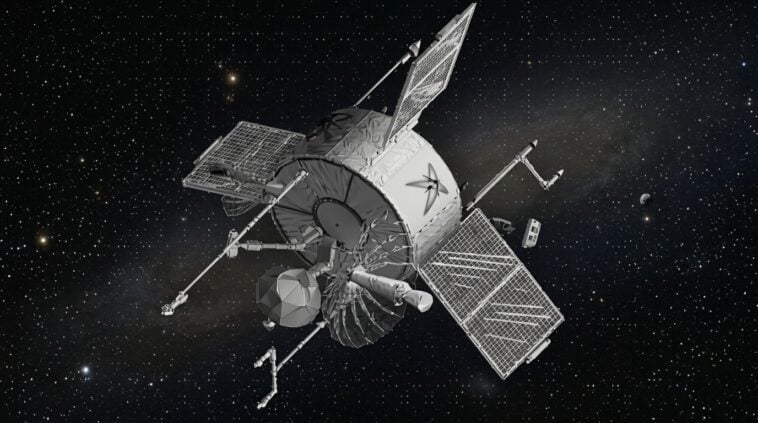
In a mysterious orbital event, a retired American Cold War-era spy satellite unexpectedly shattered into pieces hundreds of miles above our heads. With zero warning, the aging reconnaissance spacecraft abruptly fragmented, sending fresh space junk tumbling through one of the most crowded traffic lanes in low Earth orbit.
What was the USA 32 satellite?
The spacecraft in question, officially cataloged as USA 32 (and affectionately nicknamed “Farrah III”), wasn’t just any random piece of space hardware.
Launched back on Sept. 5, 1988, aboard a Titan II SLV rocket, USA 32 was a signals-intelligence spacecraft operated by the National Reconnaissance Office (NRO). Its original Cold War mission was to sweep its antennas across the globe to intercept and monitor Soviet radar systems.
Shaped like a squat cylinder, or a “tuna can,” the satellite was designed to spin rapidly while sweeping for signals. After decades of secrecy, the government only fully declassified the program earlier this year.
Caught by tracking systems
The unexpected breakup occurred on September 13 at an altitude of approximately 775 kilometers (481 miles) above Earth.
U.S. Space Forces-Space (S4S) officially confirmed the fragmentation notice via Space-Track.org after independent tracking platforms, including KeepTrack Operations Center and private firm s2a systems, flagged unusual activity and photographed the satellite’s largest remaining fragment.
Why did a 38-year-old satellite explode?
Because the breakup occurred without warning, space analysts are working to piece together what caused the failure. They are currently evaluating two leading theories:
- Internal rupture: The leading theory suggests an internal pressure explosion. After nearly four decades in space, leftover propellant inside a pressurized tank or an old battery cell may have finally ruptured after endless cycles of solar heating and cooling.
- Impact event: Another possibility is a high-speed strike from an undetected piece of small space debris or a tiny micrometeoroid.
Tracking teams have found no evidence indicating a deliberate anti-satellite weapon test or intentional act.
Threatening a crowded orbital neighborhood
While the explosion didn’t immediately endanger crewed habitats like the International Space Station, which orbits much lower down, it created a serious hazard for robotic spaceflight.
USA 32 broke apart in a congested band of space. Over 200 active satellites operate within 30 miles of its breakup altitude, including the entire Iridium NEXT communications constellation and NOAA weather satellites.
Tracking networks will spend the coming weeks mapping every single piece of debris from USA 32 to ensure operational satellites can safely steer clear.
Sources: Live Science, KeepTrack