
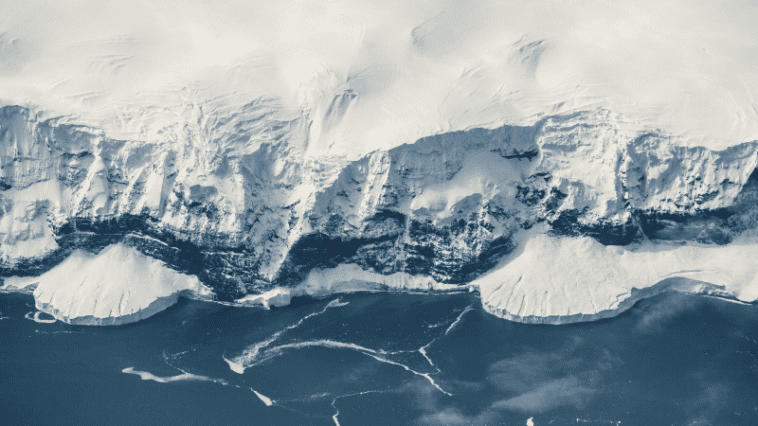
The entire continent of Antarctica lies under ice sheets that can run thousands of meters thick, keeping its ancient bedrock out of sight for millions of years. Over the decades, radar surveys and other geophysical measurements have gradually revealed glimpses of this hidden landscape.
Yet, the newest discovery reveals something on a far bigger scale than anyone expected.
An international team of geophysicists, geologists, and glaciologists led by geophysicist Egidio Armadillo at the University of Genoa (a public research university in Genoa, Italy) has mapped a giant province of around 30 connected basins under East Antarctica.
The ice sheet in question spreads out toward the coast, wide at the edge and narrowing to a point further inland, almost as if a corner of the continent had been pulled apart around a central pivot.
The researchers have named it the East Antarctic Fan-Shaped Basin Province and say that it could have formed before the supercontinent Gondwana broke up, which once joined Antarctica, Australia, Africa, and other modern landmasses, leaving a weak zone that may later have helped steer the split between Antarctica and Australia.
This ancient structure might still be shaping the continent today and sits under about half of the East Antarctic Ice Sheet, which puts it directly in the path of the moving ice. “Because these basins underlie about half of the East Antarctic Ice Sheet, they are likely to heavily influence both ice-flow and landscape evolution, making them essential to Antarctic glacial and hydrological processes,” Armadillo and colleagues write in their recently published Nature Geoscience paper.
Shifting ice and missing history
The finding matters beyond academic curiosity, as the Antarctic ice sheet on top isn’t sitting still. It is constantly, if slowly, on the move, and its flow is directed by the underlying rock that steers it. Knowing and understanding these hidden contours in detail is therefore essential for predicting how fast the ice will move and where it is headed.
Interestingly, the newly mapped province incorporates several previously known features, including the large Wilkes Subglacial Basin, the focus of a 2024 study that highlighted its potential instability and ability to raise global sea levels by up to three meters if thawing occurs at its base.
Add to it all is the historic angle, as the discovery fills an important gap in the Earth’s geological history. Antarctica makes up roughly a tenth of Earth’s land, but because most of it is buried beneath thick ice, it leaves many questions about our understanding of ancient continents and mountain-building processes.
By revealing what looks like a major episode of rotational extension, where the crust was pulled apart from a central point, almost like fanning out, the discovery fills in an important gap. It may help explain how this region influenced the eventual breakup between Antarctica and Australia.
Oddly enough, the team wasn’t looking for a fan at all. They were simply trying to reconstruct what East Antarctica would look like with the ice stripped away. This ice-free picture differs markedly from radar surveys alone because the massive ice sheet in question weighs the land down.
Remove it, and the ground would slowly rebound, rising by as much as a kilometer in places. When the researchers combined this rebound map with radar, gravity, seismic, and magnetic data, they noticed a pattern: many of the large basins fanned out from a single point near the South Pole.
The match isn’t perfect, and the team says so. The timing is hard to pin down, and the fan could be several separate stretching events layered over each other. Sorting that out is the next job.
Sources: Nature Geoscience, Durham University, ScienceAlert, University of Genoa