
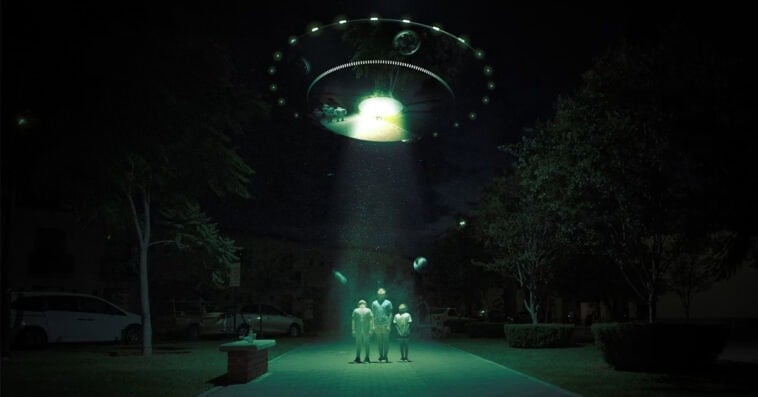
If the U.S. government is hiding top-secret proof of extraterrestrial encounters, Secretary of State Marco Rubio insists President Donald Trump won’t be the one keeping quiet. Addressing long-standing allegations of a deep-state cover-up, Rubio hinted that if concrete evidence ever reaches the Oval Office, it won’t trigger a cover-up. Instead, it will trigger a primetime presidential address to reveal the truth directly to the nation.
From conspiracy theory to national security issue
Speaking on The Katie Miller Podcast, Rubio explained that his fascination with Unidentified Anomalous Phenomena (UAPs) isn’t rooted in sci-fi tropes, but in concrete national security concerns dating back to his time in the Senate.
“I don’t know who it is. I don’t know what it is, but there are things flying over our military installations, and they’re not ours, and we should look into this, be serious about it,” Rubio emphasized.
He pushed back against labeling legitimate airspace inquiries as mere internet folklore:
“So, I don’t call it a conspiracy. I don’t know if I — I don’t know the answer to any of it. I’m just, you know, asking the questions about, we should know what’s flying over our airspace. But I don’t think that’s a conspiracy theory as much as it is just — it can be in some sense, because people do believe we’re covering something up.”
The push for ‘maximum disclosure’
According to administration officials, the current White House is aggressively pursuing transparency rather than suppressing findings. The Pentagon has released several UAP video recordings throughout 2026, accompanied by executive moves to loosen information restrictions.
White House spokeswoman Anna Kelly affirmed the administration’s stance in a statement:
“President Trump directed the Department of War to identify and release government files related to alien and extraterrestrial life, unidentified aerial phenomena, and unidentified flying objects because he is the most transparent president in history. While past administrations have sought to discredit or dissuade the American people, the President is focused on providing maximum disclosure to the public, who can ultimately make up their own minds about the information contained in these files. The American people asked, and President Trump delivered.”
To support this mission, President Trump directed federal agencies in July to void previous nondisclosure agreements (NDAs) for former government workers and military contractors willing to cooperate with official inquiries.
A senior official associated with the All-domain Anomaly Resolution Office (AARO) clarified that former personnel with relevant insights could now present evidence to designated representatives like AARO or the President’s specialized UAP task force, ‘PURSUE’, without fear of violating past NDAs. Administration officials noted, however, that the policy shift allows witnesses to step forward through internal government channels rather than serving as a blanket declassification order.
Political distraction or genuine inquiry?
Despite his serious stance today, Rubio dropped a candid admission that raised eyebrows across the UFO research community: he used to deploy UAP chatter as a tactical media smoke screen.
“I did that for a long time in the Senate … It was extraordinarily effective as a diversionary tactic,” Rubio admitted. “In addition to — now, that said, it’s also a very legitimate topic that we should be covering.”
That double-edged admission drew sharp critique from veteran researchers. Joshua Golembeske, host of Cosmic Disclosure and Lead UFO Investigator for Gaia, acknowledged Rubio’s pivotal role in pushing Senate UAP legislation but argued the admission undermines progress.
“This is the same guy who spent years saying the stigma is the problem, that guys won’t report what they see because they’ll get laughed at,” Golembeske pointed out. “And now the Secretary of State is on a podcast saying he used it to change the subject. Pilots hear that. Witnesses hear that. That’s the exact thing he was trying to fix.”
Golembeske also expressed skepticism about Rubio’s promise of a primetime address, arguing that highly compartmentalized intelligence programs could potentially keep even top executive officials from knowing everything. He pointed to past whistleblower allegations that some UAP-related information was withheld from Congress and AARO, suggesting that a lack of presidential briefings would not necessarily mean no such programs or evidence exist.
Source:
FOX News