
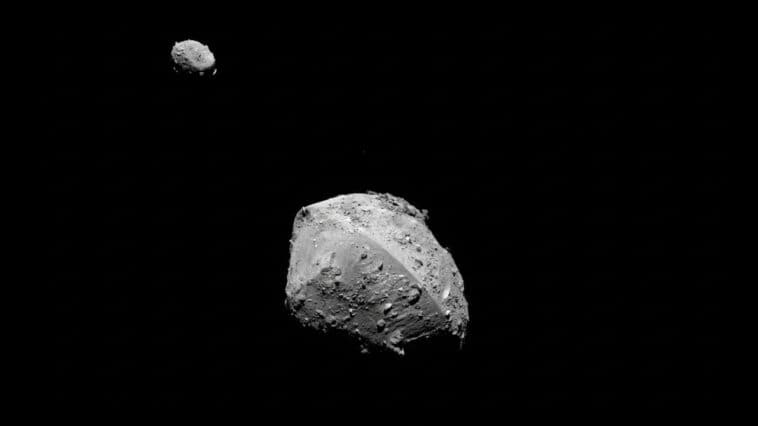
Remember when NASA deliberately crashed a spacecraft into an asteroid to see if humanity could stop a giant space rock from hitting Earth? Well, we finally have a much better look at the damage, and let’s just say Dimorphos did not walk away from that encounter looking the same.
New images captured by the European Space Agency’s Hera spacecraft reveal that NASA’s 2022 planetary defense experiment left a massive crater stretching across almost the entire width of the asteroid. We are talking about a space rock roughly 151 meters wide with what scientists describe as an impact crater the size of a sports stadium.
NASA’s asteroid punch was more effective than expected
The collision was part of NASA’s Double Asteroid Redirection Test, known as DART. In September 2022, the spacecraft deliberately slammed into Dimorphos at approximately 22,530 kilometers per hour.
The target wasn’t chosen randomly. Dimorphos is the smaller member of a two-asteroid system, orbiting a much larger space rock called Didymos, which measures approximately 730 meters across. Scientists wanted to find out whether smashing a spacecraft into an asteroid could change its trajectory. If a dangerous asteroid were ever heading toward Earth, changing its speed or orbital path even slightly could potentially prevent a catastrophic collision.
DART was designed as a proof-of-concept mission, and it absolutely delivered. NASA had initially set a relatively modest target: reduce the time Dimorphos takes to orbit Didymos by at least 73 seconds. Instead, the collision shortened its orbital period by approximately 33 minutes.
But while scientists knew the spacecraft had successfully changed Dimorphos’ orbit, they didn’t immediately know exactly what the collision had done to the asteroid itself. A massive cloud of debris obscured the impact site, leaving researchers without a clear picture of the damage.
Meet Hera
Launched in October 2024, Hera has finally provided a much closer look at the impact site. According to Hera principal investigator Patrick Michel, scientists had debated whether Dimorphos would develop an impact crater, change its overall shape or remain relatively unchanged.
Surprisingly, the answer is all three. In Michel’s words: “The face struck by DART has been flattened into an impact crater the size of a sports stadium, which extends across the asteroid’s entire width.”
Michael Küppers, Hera’s mission scientist, also described the impact side as looking as though a piece of the asteroid had been cut off.
The asteroid is now tumbling through space
Before DART arrived, scientists believed Dimorphos was tidally locked to Didymos. This meant it consistently presented the same side toward its larger companion, much like our Moon always shows roughly the same face to Earth. That arrangement has now changed.
Hera’s observations show that Dimorphos is tumbling in a chaotic fashion following the impact. In other words, the collision didn’t just alter its orbit; it also disrupted the way the asteroid rotates.
Scientists have also spotted hundreds of boulders floating around the Didymos-Dimorphos system. Some of these rocks could be debris knocked loose during DART’s collision. Earlier observations from the Hubble Space Telescope identified a swarm of 37 boulders apparently ejected from Dimorphos, and subsequent simulations suggested that some could remain gravitationally bound to the asteroid system.
However, researchers still need to determine where the much larger population of boulders observed by Hera came from.
Hera is getting ready for an even closer look
Hera is absolutely not finished investigating the scene. The spacecraft, roughly the size of a small car, reached the asteroid system in November 2026 and is currently observing Didymos and Dimorphos from a distance of approximately 25 to 30 kilometers. Its next move is to get even closer, approaching within roughly 13 kilometers to capture higher-resolution images.
The mission also has another interesting trick planned. In January, Hera is expected to deploy two shoebox-sized CubeSats called Juventas and Milani. Juventas will investigate the asteroids’ internal structure using radar measurements, while Milani will study their external environment and surface composition.
These observations could help scientists determine how much material was displaced during DART’s impact, how the asteroid’s internal structure responded and how efficiently the spacecraft transferred its momentum.
Flattening an asteroid is some good news
Around 66 million years ago, an asteroid impact helped trigger the mass extinction that wiped out the non-avian dinosaurs. Humanity obviously has a vested interest in making sure a similar event does not happen again.
DART demonstrated that a spacecraft could deliberately change an asteroid’s trajectory. Hera is now helping scientists understand the physical consequences of doing so. As Hera mission manager Ian Carnelli put it, DART demonstrated that humanity can change an asteroid’s orbit, while Hera is revealing what happened to the asteroid itself.
It is a combination of missions. NASA delivered the punch, and ESA showed up to investigate the damage. For now, Dimorphos remains a very expensive-looking science experiment floating around its larger companion. But the information Hera collects could eventually help humanity deal with something considerably more frightening than a stadium-sized crater.
Sources: ABC.net, ScienceAlert