
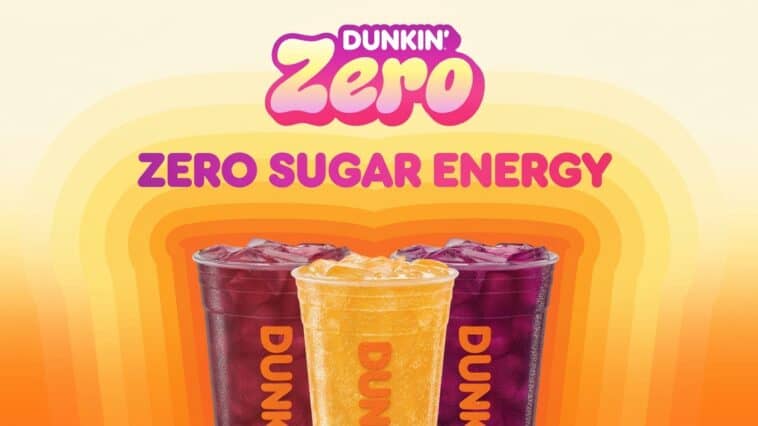
If you’ve been sipping on Dunkin’s popular “Zero” beverages to cut back on sugar, your go-to drink might come with a surprising plot twist — and a potential payout. A new nationwide class-action lawsuit claims the coffee giant’s Dunkin’ Zero lineup is packed with up to 13 grams of sugar per serving, blatantly violating federal labeling standards that cap “zero sugar” claims at a fraction of a gram. Read on to find out which sweetening ingredient is at the center of the lawsuit.
The sweetener at the center of the storm
When health-conscious coffee runs lead to court filings, the cause usually sits right in the ingredients list. In a proposed class-action lawsuit filed on September 30 in the U.S. District Court of Massachusetts, Illinois resident Phyllis C. Wells targets the Canton-based coffee giant over its popular Dunkin’ Zero beverage line.
According to the complaint, customers who ordered these sparkling, fruit-flavored drinks under the impression that they were entirely sugar-free were actually consuming substantial amounts of allulose, a type of simple sugar.
While Dunkin’ advertises the beverage lineup with prominent “zero sugar” branding, the legal filing points out that the chain’s own official ingredient guide tells a very different story. The guide reveals that allulose serves as a primary ingredient in the flavored syrups mixed with sparkling water to craft the beverages.
What counts as ‘zero sugar’?
Under federal labeling regulations enforced by the FDA, food and beverage manufacturers are held to strict standards when making health claims on their products. A product can only carry a “zero sugar” label if it contains less than 0.5 grams of sugar per serving.
The lawsuit alleges that Dunkin’ Zero drinks exceed that threshold by a wide margin. Under federal regulations, a product can only carry a “zero sugar” label if it contains less than 0.5 grams of sugar per serving. According to the lawsuit, Dunkin’ Zero beverages exceed that threshold by a wide margin, with a medium drink containing roughly 9 grams of allulose and a large drink containing between 11 and 13 grams.
Because allulose is chemically classified as a monosaccharide, the lawsuit argues it unequivocally counts as a simple sugar under applicable federal labeling standards — meaning the drinks fall well outside federal compliance for zero-sugar claims.
“Unbeknownst to reasonable consumers, defendants sweeten the products with allulose. Allulose is a monosaccharide and therefore a sugar under the applicable federal labeling standards,” the complaint states.
Could Dunkin’ customers receive compensation?
For Wells, the issue came down to relying on clear front-of-package marketing while attempting to monitor her dietary habits. Wells purchased Dunkin’ Zero beverages two to three times a week at an Illinois restaurant location explicitly to limit her sugar intake.
She claims that had she known the drinks contained allulose, she either would not have bought them at all or would have paid significantly less for them.
The lawsuit seeks to represent two groups:
- A nationwide class of consumers who bought Dunkin’ Zero drinks since March 4, 2026.
- A specialized Illinois subclass of affected buyers.
In addition to seeking financial damages, restitution, and attorneys’ fees for impacted customers, the lawsuit asks the court to step in with an order requiring Dunkin’ to immediately cease its “Zero Sugar” marketing or issue clear, corrective disclosures on its products.
Dunkin’ has yet to comment on the pending allegations.
Source:
Boston 25 News