
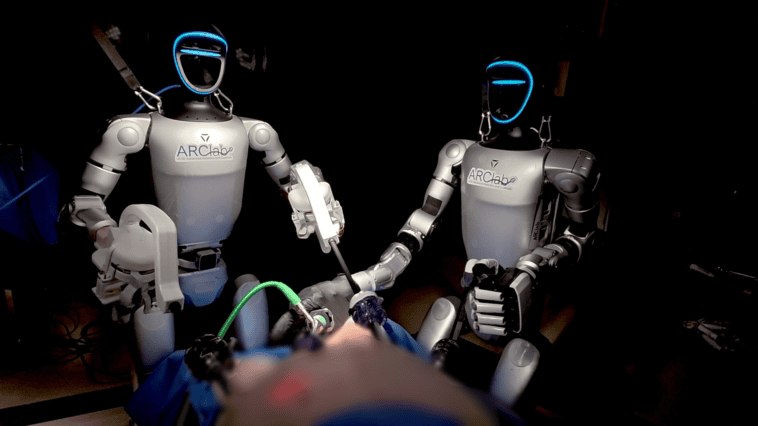
Your future surgeon might not be a doctor in scrubs. Instead, it might look like a pair of five-foot-tall, 60-pound metallic humanoids named “Surgie.”
A historic first for the operating room
In a global first for medicine, a team of engineers and surgeons at the University of California San Diego (UCSD) successfully used remotely controlled robots to execute a live, minimally invasive surgery.
According to the study published in Nature, the milestone involved a successful laparoscopic cholecystectomy, the medical term for a gallbladder removal. The machines handled everything from retracting tissue and dissecting to clipping and lifting the organ out.
For this specific operation, the human surgeons stepped back from the table entirely, leaving a tag-team duo of two humanoid robots working completely side-by-side to get the job done under remote control.
Don’t cancel your human doctor just yet
Before you sign up to let a humanoid poke around your organs, there are a couple of major caveats to note. First, this initial preclinical trial wasn’t performed on a human—the live patient was actually a pig.
Second, the humanoids weren’t exactly operating with total freestyle freedom. As a crucial safety precaution, the robots had to be tethered during the procedure so they couldn’t accidentally lose balance, fall over, and injure their porcine patient.
Another thing to note is that the team admitted in Nature that there are still some major technical bugs to squash before these bots ever touch a human patient.
The bugs that still need fixing
Because this was a proof-of-concept experiment, the tech still has some way to go before it goes mainstream.
During the live procedure, the Surgie bots had to be manually recalibrated multiple times. All those tech timeouts meant the surgery took significantly longer than it would have on a standard surgical system.
There’s also the classic issue of latency—the slight delay between when the human surgeon moves the remote controller and when the robot actually moves. This lag becomes an even bigger drag the further away the doctor is sitting from the patient.
However, the team isn’t discouraged by the early slowdowns. They point out that the very first machine-assisted laparoscopic surgeries decades ago used to take six hours, whereas today they take about 30 minutes.
Upgrading the entire hospital staff
The ultimate goal isn’t just to keep doctors strapped into remote control rigs. The UCSD team wants to develop these humanoids into fully autonomous surgical assistants.
Because these robots mimic human form and movement, the researchers are planning a future where the bots can walk around, fetch instruments for human surgeons, and clean up the operating room after a procedure is done. It’s a highly flexible setup that could help ease global staffing shortages and bring critical surgical care to remote communities where specialists can’t physically travel.
We might still be a few system updates away from letting a droid handle your appendectomy, but the era of the humanoid hospital staff has officially left the lab.