
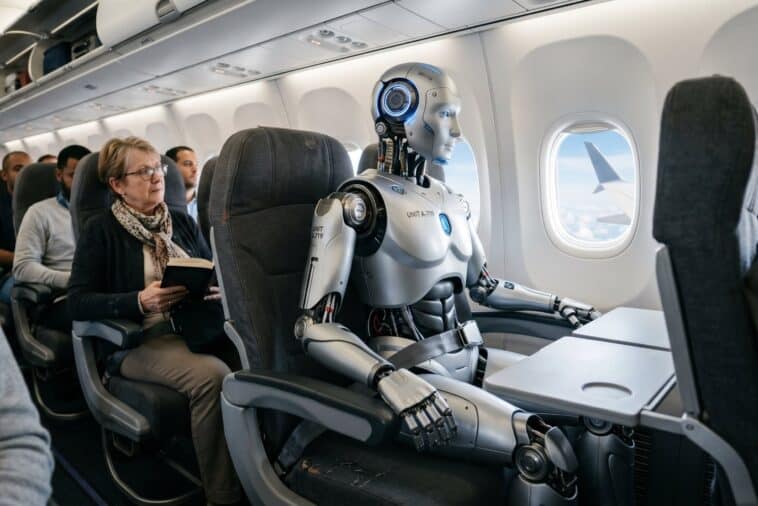
What started as a bizarre viral moment aboard a Southwest flight quickly turned into a real-world policy change that nobody saw coming. After a humanoid robot named “Stewie” was spotted sitting in its own seat, snapping selfies with passengers and turning heads across the internet, Southwest Airlines moved fast to ban human-like robots from both cabins and checked baggage.
Now, the strange incident is raising bigger questions about airline safety, lithium battery risks, and how prepared the travel industry really is for a future where robots may become more common in public spaces.
Southwest bans lifelike robots on all flights
Southwest Airlines has officially changed its rules to ban human-like and animal-like robots from its planes. You can no longer bring them into the passenger cabin or check them underneath the plane as baggage.
What exactly is banned?
The Dallas-based airline states that the ban applies to these high-tech machines no matter how big or small they are, or what they are used for. They define the restricted items as:
- Human-like robots: Any machine built to look, move, or act like a human.
- Animal-like robots: Any machine built to copy the look or actions of an animal.
What is still allowed?
If you are traveling with a standard electronic toy, you are likely in the clear. Everyday toy robots are still allowed on board, as long as they meet two conditions:
- They are small enough to fit inside a standard carry-on bag.
- They follow the airline’s existing safety rules for batteries.
This new rule comes right after a video went viral online showing a 3.5-foot humanoid robot named “Stewie” flying on a Southwest flight from Las Vegas to Dallas.
According to CBS News Texas, the robot’s owner—a Dallas businessman named Aaron Mehdizadeh—decided to buy the robot its own passenger seat instead of shipping it in the cargo hold. Mehdizadeh owns The Robot Studio, a company that rents out lifelike robots for parties and corporate events.
To get through airport security, the owner had to make a few adjustments, including swapping out the robot’s regular power source for a smaller battery to meet safety rules.
Stewie actually walked through the airport terminal and down the jet bridge onto the plane, instantly turning heads. The high-tech passenger was a massive hit with the crowd. “Most people were very excited to see a robot flying and (it) provided so much entertainment,” Mehdizadeh told CBS News Texas.
Using a pre-programmed voice, the robot even joked with the crowd that it had “the perfect window seat” while excited passengers took selfies with it throughout the flight.
What’s the real reason behind the ban?
Southwest Airlines explained that the new rule is all about the safety risks of lithium-ion batteries, which are the types of batteries used to power most robots.
According to NBC 5 Dallas-Fort Worth, the flight crew originally had no idea what to do with the robot. Because of airline rules, it was technically considered a carry-on item, meaning it wasn’t actually allowed to sit in a passenger seat. To solve the problem, crew members eventually moved the robot to a window seat and completely removed its battery before the plane took off for Dallas.
Southwest later confirmed to CBS News Texas that the policy update was made to strictly follow lithium-ion battery safety rules. These types of batteries are known to be a fire hazard; in fact, a previous battery fire on a flight even forced an emergency landing in San Diego.
However, Mehdizadeh doesn’t agree with the airline’s safety excuse. He told CBS News Texas that the battery inside Stewie was no different than what passengers carry every day. “It’s not a battery policy because the battery we used is essentially a laptop battery,” he said.
Even though his robot is now banned, Mehdizadeh hopes Southwest will eventually change its mind and let humanoid robots fly in the future if they can prove they are safe.
View this post on Instagram
Sources: USA Today, CBS News Texas, NBC 5 Dallas-Fort Worth