
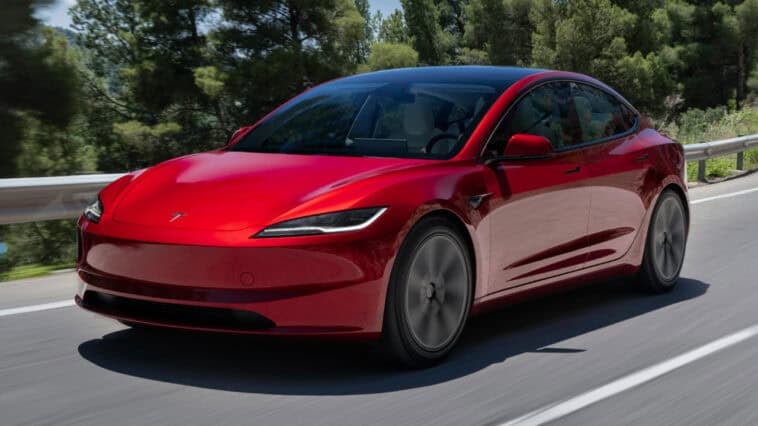
Tesla’s self-driving technology is facing fresh scrutiny after a driver was killed when his Model 3 reportedly came to a complete stop in the middle of an Arizona highway. The car was struck from behind by a pickup truck, but newly uncovered records reveal a crucial detail that wasn’t known when the crash happened: Tesla’s driver-assist system had been verified as engaged. Now, questions are emerging about why the vehicle stopped—and Tesla’s own data may hold the answer.
Tesla’s driver-assist system was active during the crash
The fatal crash happened shortly after 3 a.m. on October 31, 2025, when a 2020 Tesla Model 3 was traveling on the eastbound Loop 202 freeway near Dobson Road in Mesa, Arizona. The Tesla was struck from behind by a Ford F-350 pickup, and the Model 3’s driver was killed at the scene. The freeway was closed for several hours following the collision.
At the time, however, publicly available reports offered few details about what happened. Authorities did not identify the vehicle as a Tesla equipped with driver-assistance technology, and there was no indication that Autopilot or Full Self-Driving had been active.
That changed after tech news website Electrek matched the crash to a redacted report Tesla submitted to the National Highway Traffic Safety Administration (NHTSA).
The filing was made under NHTSA’s Standing General Order, which requires automakers to report certain crashes involving Level 2 advanced driver-assistance systems. Under the order, manufacturers must report qualifying crashes when such a system was engaged shortly before the collision.
According to Tesla’s report, the vehicle’s automated driving system was “verified engaged” when the crash occurred. Even more strikingly, the report lists the Tesla’s “pre-crash movement” as “Stopped – 0 mph.” In other words, the Model 3 was stationary in a freeway lane when the pickup struck it from behind.
The report also indicates that Tesla has access to data that could potentially shed light on what happened. The company said it retained the vehicle’s event-data recorder, telematics, and video, but several potentially important details were redacted from the NHTSA filing.
The biggest question: Why did the Tesla stop?
That missing information leaves a critical part of the crash unexplained.
Tesla’s report does not reveal whether the vehicle was operating with Autopilot or Full Self-Driving. The software version was redacted, along with the crash narrative and information about whether the road was within the system’s approved operating area. Tesla classified those details as “confidential business information.”
There are several possible explanations for why the Model 3 ended up stopped in a live freeway lane, but the available evidence does not establish which one was responsible.
One possibility is Tesla’s long-running “phantom braking” issue, in which its driver-assistance systems can unexpectedly apply the brakes after detecting what the vehicle believes is an obstacle. NHTSA has previously investigated Tesla’s Autopilot system, including concerns about how the technology and driver engagement can contribute to crashes.
Still, phantom braking does not necessarily explain a vehicle coming to a complete stop in the middle of a freeway. Another possibility is that the driver became incapacitated or otherwise stopped responding while the driver-assistance system remained active.
Without the underlying vehicle data, it is difficult to determine what happened in those final moments.
A second crash raises more questions
The Arizona collision is particularly notable because it appears to closely resemble another fatal Tesla crash that occurred in Florida just weeks earlier.
According to Electrek, both incidents involved 2020 Tesla Model 3 vehicles in which a driver-assistance system was “verified engaged.” In both cases, the cars were reportedly stopped at 0 mph in active freeway lanes before being struck from behind, killing the drivers.
That similarity does not prove that Tesla’s driver-assistance technology caused either death. Electrek itself notes that the available evidence cannot establish whether the systems were responsible.
But the similarities make the unanswered questions more significant. If a vehicle using driver assistance can unexpectedly remain stationary in a high-speed traffic lane, understanding why it happened could be critical to determining whether the crashes were isolated events or signs of a broader problem.
Tesla has faced scrutiny over crash reporting
The controversy also comes as Tesla faces separate scrutiny from federal regulators over how it reports crashes involving its driver-assistance technology.
In August 2025, NHTSA opened an investigation into Tesla’s compliance with its Standing General Order after identifying numerous reports in which crashes had occurred months or more before Tesla submitted the required reports. The agency said many of those incidents were supposed to be reported within one or five days of Tesla receiving notice of the crash.
NHTSA has also investigated other safety issues involving Tesla’s driver-assistance technology. A 2024 preliminary evaluation examined whether Full Self-Driving could appropriately detect and respond to reduced roadway visibility, while a separate 2025 investigation looked at traffic-safety violations occurring while FSD was engaged.
For the Arizona crash, however, the central mystery remains the same: the Tesla was stopped in a freeway lane, its driver-assistance system was confirmed as engaged, and the vehicle was subsequently hit from behind.
What caused the car to stop is still unclear — and the data Tesla holds could be crucial to finding out.