
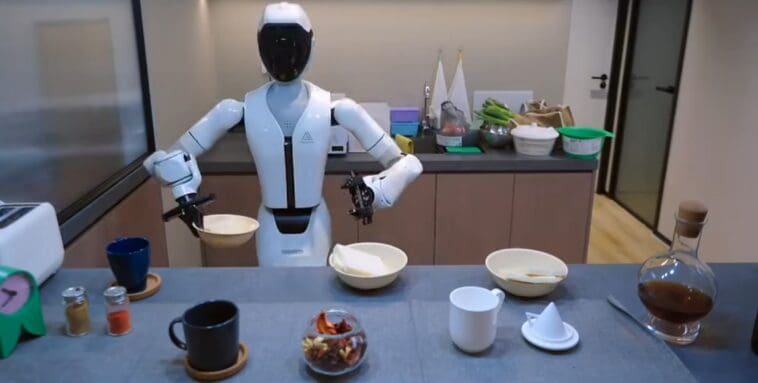
China continues to expand trials of robots in everyday households. In Wuhan, a humanoid robot recently demonstrated its ability to perform a full set of morning household routines in a real apartment.
Promotional footage shows how the android manages to ease a bed back into order, warm bread in the microwave while watching over a pan of tomatoes with eggs sizzling on the stove, pour out the milk, and set breakfast on the table before the humans of the household have so much as left for work.
The machine doing it all is the SeeLight S1, developed by Hubei Giga World Robot Co., also known as GigaAI, a Huawei-backed startup founded in 2025.
The robot made its public debut in Wuhan, Hubei province, back in May, and now forms the core of an unusual two-phase experiment of sorts. The initial rollout will involve placing 100 units in employee and tech-related households (which is reportedly already imminent), followed by a broader free public trial in selected ordinary homes slated for the first half of 2027.
This latest initiative builds on a pilot launched two months ago in Shenzhen, where robots developed by X Square Robot, a firm founded in 2023, began accompanying professional cleaners on service calls booked through the 58.com platform. In that project, however, the machines handled repetitive tasks such as wiping tables, collecting debris, tying trash bags, and assisting with bedsheets, while humans managed more complex judgment calls.
Managing the daily grind
The company’s footage then shows how the day unfolds after the residents of the household head out. The robot loads the washing machine, sets to work on the bathroom, and scrubs the toilet, then wipes its own hands clean with a sheet of wet tissue before turning to the laundry. It hangs the wet clothes out, folds them once they have dried, coaxes a slumped sofa back into shape, and closes out the round by feeding the fish and watering the plants.
What sets the android apart has less to do with the chores than with the judgment behind them, according to Ye Yun, the firm’s vice president of research and development. “Its intelligence lies in its ability to independently complete long-sequence, multistep, and meticulous housework in real, unstructured home settings, rather than mechanically repeating single actions,” he told China Daily.
The robot can also read a room it has never seen before, shift the furniture around, and, rather than blindly running a fixed program, takes the rearranged space afresh and adjusts as it goes. “It also keeps learning through daily use and becomes smarter over time,” Ye added.
The road to mass adoption
Word of the trial spread quickly. Even before GigaAI spelled out the fine print, its official WeChat account was filled with more than 2,000 messages from people angling for a spot. Zhu Zheng, the company’s co-founder and chief scientist, said households chosen would be picked on a principle of “reflecting real-life households and covering diverse family structures,” with usage guidance and open feedback channels promised throughout the run.
There is, inevitably, a data dimension to the trial. Ye Yun explained that with the informed consent of users, Hubei would gather the information generated while the robot works. The data would help verify its functions, track down its faults, and feed a steady cycle of upgrades. Ye stressed that everything collected would go toward product research and nothing else.
The economics of mass adoption are still taking shape. A company survey found that consumers would be willing to pay between 50,000 and 100,000 yuan (roughly $7,400 for the lower end), though costs are expected to slide sharply over the next year or two as more units roll off the line.
Such projections sit within a much larger industry outlook. A Morgan Stanley report has floated the prospect of a global humanoid robot market swelling to 5 trillion US dollars by 2050, with more than a billion of the machines at work worldwide, China leading the pack at 302.3 million units, and the United States trailing well behind at 77.7 million.
For Huang Quanzhou, who runs operations at the Hubei Humanoid Robot Innovation Center, the experiment represents a crucial crossing point. It is essentially the moment robots step out of the controlled hum of labs and factories into homes that are anything but tidy. He reads the free trial as a chance to let ordinary people get a feel for the machines while testing a business built around maintenance and after-sales support.
Within one to three years, GigaAI expects the robots to surface mainly in upscale residential complexes and elderly care facilities. Beyond five years, as mass production keeps grinding prices down, they’re projected to slip into ordinary households with the same quiet ubiquity the refrigerator and the washing machine earned long ago.
Sources: XRoboHub, Morgan Stanley, SCMP, PR Newswire, China Daily, Wuhan