
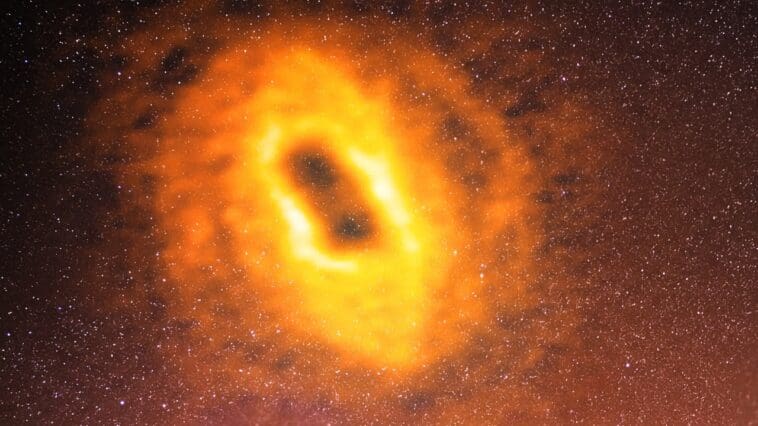
Astronomers usually piece together how stars die by running numbers through computer models and watching distant objects freeze in place. With IRAS 06530-0213, a star roughly 12,000 light-years away in the constellation Monoceros, researchers got something closer to a cosmic crime-scene timeline, complete with a ring of gas acting like a fossil record of its last major nuclear flare-up.
A frozen fossil 12,000 light-years away
Using the 66-antenna Atacama Large Millimeter/submillimeter Array (ALMA) in northern Chile, a team led by NASA Jet Propulsion Laboratory researcher Raghvendra Sahai examined how this dying star is transitioning from a bloated red giant into a glowing planetary nebula. Their findings, published in The Astrophysical Journal, offer a rare look at the messy final stages of a star’s life and turn up a few details that do not fit standard expectations.
What ALMA Spotted Around IRAS 06530-0213
Instead of a tidy, spherical puff of gas, ALMA revealed a complex structure surrounding the star:
A frozen “heartbeat” ring: A molecular gas shell roughly half a light-year wide appears to mark a final thermal pulse, a violent nuclear flare in shells around the core, blasted outward about 6,500 years ago.
Shifting mass loss: After that flare, mass loss slowed for roughly 2,000 years before ramping back up sharply over the next 1,000 years, leaving tangled, spiral-shaped filaments that hint at an unseen companion star stirring the material.
A young hourglass nebula: Right near the center, an hourglass-shaped planetary nebula began taking form around 700 years ago, showing the star recently wrapped up its red giant phase on a cosmic timescale.
Why the Findings Raise Questions
Even when stars follow the broad script for medium-mass stars—burning through core hydrogen, expanding as red giants, shedding outer layers and leaving behind a white dwarf core—the fine details around IRAS 06530-0213 can still get complicated.
Researchers detected an unexpected surplus of heavy isotopes of carbon, oxygen and nitrogen that does not line up neatly with standard models of how these stars create and mix elements outward, though similar signatures have appeared around unusual stars tied to intense nuclear bursts.
Just as notably, ALMA did not detect a compact dust disk around the star, something astronomers often expect when companion stars help shape bipolar or hourglass outflows, suggesting any disk that helped power shaping jets may have been short-lived and already faded.
For readers wondering what it means for our own Sun, the Sun’s end is still billions of years away and will not end in a supernova. However, observations like this remind astronomers that the transition from red giant to planetary nebula can involve uneven mass loss, hidden companions and chemical twists that are messier than textbook summaries make them sound.
Source: Space.com