
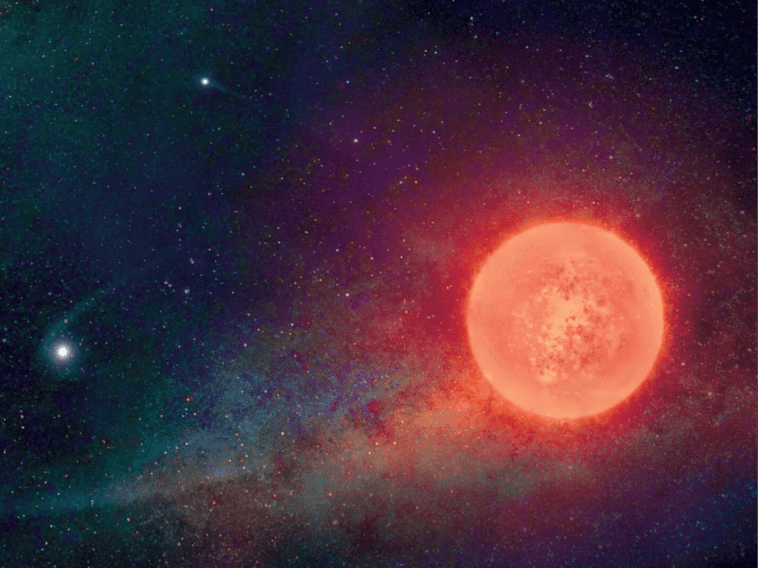
Astronomers went looking for planets around a nearby star and ended up discovering something that has left them scratching their heads. Just 28 light-years from Earth, they found a bizarre three-star system containing two dead stars and one living red dwarf. According to conventional theories of stellar evolution, this cosmic trio shouldn’t have survived together.
Located just 28 light-years from Earth, the system, named Welopōʻai, is unlike anything astronomers have identified within 100 light-years of our planet. According to researchers, there is no straightforward explanation for how that happened.
“This system should not exist,” said Patrick Dufour, an astrophysicist at the Université de Montréal and co-author of the study. “We have no clean explanation for how it got here. That is the question driving our next observations.”
Astronomers were looking for planets, not dead stars
The discovery began at the Trottier Institute for Research on Exoplanets at the Université de Montréal. Researchers were studying a nearby red dwarf, a relatively small and cool star that burns through its fuel much more slowly than our Sun. They were using an instrument called SPIRou, mounted on the Canada-France-Hawaii Telescope in Hawaii. Its job is to help astronomers find exoplanets by detecting tiny changes in a star’s movement caused by the gravitational pull of an orbiting object.
Normally, when a planet circles a star, its gravity produces a subtle wobble that scientists can measure. But this star wasn’t doing anything subtle. Its velocity was changing by nearly 10 miles per second, more than 1,000 times the signal the researchers had expected from a typical planet. Whatever was pulling on it was far too massive to be an ordinary world.
Years of observations suggested that the invisible companion weighed more than half as much as the Sun. Yet it was giving off remarkably little light.
That combination was a clue. “The unusual combination of high mass and very low brightness left only one plausible explanation: It was the remnant of a dead star,” explained Charles-Antoine Parent, an undergraduate student at Université Laval and co-author of the study.
The leading suspect was a white dwarf, essentially the incredibly dense leftover core of a star that has exhausted its nuclear fuel. The researchers initially couldn’t rule out more exotic possibilities, including a neutron star or even a black hole. So they needed a closer look.
The mystery deepened when they found a second dead star
To identify the invisible companion, the team turned to the Gemini North telescope in Hawaii. Using its high-resolution ʻAlopeke imaging instrument, the astronomers managed to spot the faint object. It was indeed a white dwarf.
But that wasn’t the end of the discovery. Researchers already knew another white dwarf was orbiting farther away. Suddenly, what looked like a star with an unusually massive companion turned out to be something much stranger: a triple-star system containing one living red dwarf and two stellar remnants.
White dwarfs are what stars like our Sun eventually become when they run out of fuel. Before reaching that stage, stars swell into enormous red giants, shedding much of their outer material before the remaining core becomes a compact, extremely dense object. Now imagine two stars going through that dramatic transformation while another star remains gravitationally connected to them. That’s the situation astronomers are trying to understand with Welopōʻai.
How the red dwarf survived all that
Triple-star systems aren’t particularly rare. Astronomers have found plenty of them, often with two stars orbiting relatively close together while a third circles the pair from farther away. Welopōʻai is different because of what its members have been through.
Two stars have already passed through their final evolutionary stages, expanding into giants and losing substantial amounts of mass. Yet the smaller red dwarf remains part of the same gravitationally bound system.
Those dramatic changes should have affected the gravitational relationships between the stars. Losing mass changes how strongly stars hold onto one another, potentially altering their orbits or even disrupting the system entirely.
So how did this particular arrangement survive? That’s the question the researchers haven’t answered yet. And because Welopōʻai is only 28 light-years away, they have an opportunity to find answers. For context, the Milky Way is roughly 100,000 light-years across.
A cosmic mystery hiding in our backyard
The research team now wants to investigate how the three stars interact gravitationally and reconstruct the system’s evolutionary history. Understanding how the red dwarf survived could offer new clues about what happens when multiple stars age together. It could also help astronomers improve their understanding of the complicated ways stellar systems change over billions of years.
While they try to make more sense of it, this discovery shows that even relatively close to Earth, the universe still has plenty of surprises tucked away. As lead author Étienne Artigau put it, “Discoveries like this remind us that our own cosmic neighborhood still contains remarkable surprises.”
Sources: ZME Science, Gizmodo