
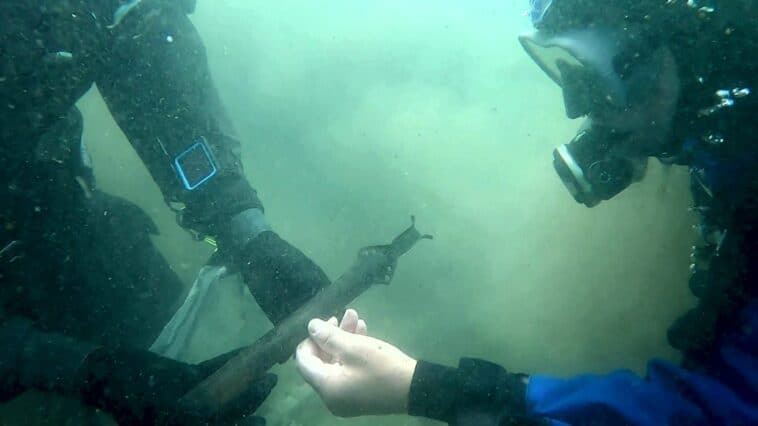
Archaeologists in Italy have recovered a 3,300-year-old bronze sword from the bottom of Lake Mezzano, in central Italy’s Lazio region, and the weapon’s blade is still sharp.
The weapon was found during an underwater excavation on the lake’s southern shore, an area that had been largely unexplored.
Lake Mezzano is a small volcanic lake about 60 miles northwest of Rome, and this is the third sword that’s been discovered there since the 1970s.
The regional SABAP VT-EM (Superintendence of Archaeology, Fine Arts, and Landscape for the Province of Viterbo and Southern Etruria) announced the find.
Researchers date the sword to the 13th century B.C., in the Late Bronze Age. At the time, a community lived along the shoreline in houses built on wooden stilts over the water. Over the centuries, rising lake levels flooded and submerged the settlement, sealing its remains under water and mud where they were preserved until modern times.
The sword in question was lying near a bronze razor, which suggests the two objects belonged to the same person. Researchers think that the individual may have been a warrior or someone of high standing in the community. Divers also found intact vases and a number of bronze objects, including axes, arrowheads, daggers, spearheads, and pins.
Weapons like this were seen as signs of status and power during the Bronze Age. Similar finds in other European lakes have led experts to believe people sometimes left their arms in the water deliberately, possibly as offerings to gods.
The now submerged village was discovered in 1971 by geologist Lamberto Ferri Ricchi. Research at the site went on until the mid-1990s, then stopped for nearly 30 years until new funding came through. Since returning last year, archaeologists have mapped more than 600 wooden posts from the settlement and found bronze ingots that suggest residents made their own metal goods.
The new artifacts will go on display in an upcoming exhibition.
Sources: SABAP Viterbo Etruria, Museo Di Valentano, Smithsonian Magazine