
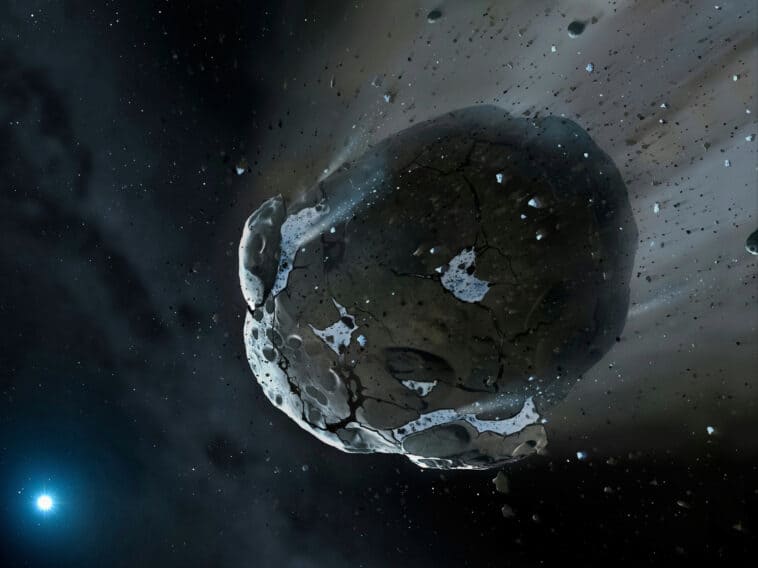
If an asteroid were heading straight for Earth, blowing it up with a nuclear weapon might sound like a pretty reasonable plan. Unfortunately, scientists have discovered that even getting the explosion right might not be enough. Where you hit the asteroid could determine whether you successfully push it away or barely change its course.
A new study published in Icarus found that the direction of a nuclear X-ray burst can dramatically affect how an asteroid moves through space. In one simulation, changing the direction of the radiation produced nearly five times the difference in how much the asteroid’s forward speed changed.
Its rotation was even more sensitive. For another simulated asteroid, the change in its spin varied by a factor of 17 depending on where the X-rays hit. So, planetary defense planners might have another problem to worry about: an asteroid isn’t a perfectly round target, and guessing which side to blast could make a potentially life-saving mission considerably less effective.
It’s not just about how big the explosion is
The idea behind nuclear asteroid defense is not necessarily to blow an incoming space rock into thousands of pieces. Instead, scientists want to use the powerful X-rays released by a nuclear explosion to heat the asteroid’s surface.
That intense heat can vaporize some of the material on the surface, creating a force that pushes the asteroid in the opposite direction. If timed and positioned correctly, even a relatively small change in its velocity could alter its trajectory enough to prevent an eventual collision with Earth.
However, most earlier computer simulations treated asteroids as smooth spheres. That’s convenient for calculations, but real asteroids look nothing like perfectly polished balls. They have ridges, craters, depressions and all kinds of irregular surfaces.
Those differences affect how radiation heats the surface and how much material gets vaporized. Consequently, the direction of an explosion can produce very different results, even when scientists are targeting the exact same asteroid.
Nathan Moore, a physicist at Sandia National Laboratories who led the research, said the team expected the direction of the blast to matter. What surprised them was just how much it mattered.
Scientists built a much faster asteroid simulator
To understand the problem, Moore and his colleagues developed a new computer simulation capable of modeling irregular asteroid shapes while calculating the physical effects of an X-ray burst. Previously, researchers faced a trade-off. They could model an asteroid’s complicated shape or perform highly detailed calculations of the forces acting on it, but combining both approaches required more computing power than was practical.
The new algorithm tackles that limitation and is reportedly more than 1,600 times faster than the previous approach.
The researchers achieved this by combining two existing simulation systems at Sandia National Laboratories: ALEGRA, which models high-energy physical experiments, and SPARTA, which simulates the movement and interaction of particles. Bringing the two together allowed the team to model complicated asteroid surfaces without sacrificing the detailed calculations needed to understand how nuclear radiation would affect them.
A wrongly aimed blast could change the asteroid’s spin
In one simulation, exposing the same asteroid to X-rays from different directions changed its forward speed by 3.9 millimeters per second in one scenario and just 0.8 millimeters per second in another. That is almost a fivefold difference in deflection velocity.
The researchers also found that the direction of the radiation could have an even bigger effect on an asteroid’s rotation. In another simulated object, the change in spin varied by a factor of 17 depending on where the X-rays arrived.
The research team developed tools that can reconstruct an asteroid using detailed 3D images captured during spacecraft flybys. Researchers can then adjust the strength of an explosion, its distance from the asteroid and the direction of the incoming radiation.
The software estimates how much material would vaporize across the surface, using heat maps to calculate the resulting push, rotational changes and surface damage.
Still no guarantee the asteroid stays in one piece
As impressive as the new simulation is, it does not solve every problem associated with nuclear asteroid defense. One major limitation is that the model currently considers the breakup of rocks on an asteroid’s surface but cannot accurately predict whether the entire asteroid body would fracture.
The goal of planetary defense is to prevent an impact, not turn one potentially dangerous space rock into several smaller objects that could still threaten Earth. Understanding how an asteroid’s internal structure responds to an intense nuclear X-ray burst will require additional research and more sophisticated simulations.
There is also the practical problem of getting a nuclear device into the right position. Scientists would need detailed information about an asteroid’s shape from different viewing angles before deciding where to direct the blast. If an incoming asteroid were discovered with little warning, collecting all that information and preparing a precisely positioned deflection mission could be difficult.
Moore has summed up the finding with a rather memorable warning: “Pick the right side and you win. Guess wrong and it could be a bad day.”
Source: Science Daily