
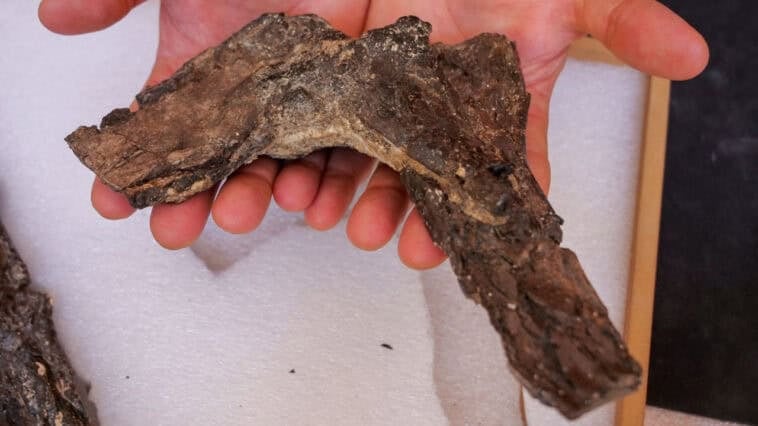
Dinosaur fossils have revealed countless secrets about life millions of years ago, but scientists may have just uncovered something truly extraordinary. After examining an ancient dinosaur bone, researchers found tiny structures that could be traces of red blood cells preserved for more than 100 million years. The discovery offers a rare opportunity to investigate the biology of creatures that disappeared long before humans arrived on Earth. But how could something as fragile as blood survive for so long inside a fossilized bone? Keep reading to discover what scientists found and why this unusual discovery could change how we study prehistoric life.
A breakthrough frozen in time
For paleontologists, finding soft tissue inside a fossil has long been considered the ultimate needle in a haystack. Tissues and cells almost always decay into nothingness shortly after death. However, a new study published in Proceedings of the National Academy of Sciences presents what may be the strongest evidence yet of preserved red blood cells inside a 115-million-year-old dinosaur bone.
By deploying advanced microscopic imaging alongside chemical analysis, researchers uncovered microscopic oval structures inside the fossilized leg bone of Aratasaurus museunacionali — a theropod unearthed in northeastern Brazil’s Romualdo Formation back in 2008. Crucially, they also detected chemical traces of heme, the oxygen-carrying molecule in hemoglobin, located right inside the microstructures themselves.
“The exciting implication is not just what we have found in this dinosaur,” said lead author Kliti Grice, an organic geochemist and John Curtin Distinguished Professor at Curtin University in Australia. “It is that we now have approaches that can be applied to other fossils to ask how much original biological information may still be hidden within them.”
How researchers identified the possible blood cells
How could something as delicate as blood survive over 100 million years? The secret lies in a unique chemical shield provided by the dinosaur’s final resting place.
Paleontologists believe the animal sank into stagnant, low-oxygen waters that dramatically slowed down natural decomposition. Over eons, microscopic channels within the bone protected the cell-like structures. The team also identified traces of manganese oxides (specifically hausmannite) which likely acted as a stabilizing agent during fossilization.
While previous studies since the late 1990s have reported similar findings, this effort stands out because it combines structural placement, physical appearance, mineral composition, and direct chemical signals.
“Bones provide extraordinary information about anatomy, growth, locomotion and evolution,” Grice noted. “But cellular and molecular preservation potentially gives us access to a different layer of biological information: the chemistry of the living animal and its tissues.”
Scientists urge caution over the findings
Despite the compelling evidence, not everyone in the scientific community is completely convinced.
Mary Schweitzer, professor emeritus at North Carolina State University and a pioneer in ancient soft-tissue research who was not involved in the study, noted that the findings do not yet meet all established standards for identifying fossilized blood cells. She raised questions about the unusual sizes and shapes of the structures compared to modern birds and reptiles, as well as the presence of manganese oxide, which does not exist in living blood.
Grice clarified that the team views hausmannite as a fossilization byproduct rather than an original cell component. Schweitzer nevertheless praised the team’s multi-technique approach, calling it an exciting advancement.
“The usability of fossil molecules preserved in deep time is only just beginning to be explored, as conventional wisdom states preservation like this is not possible,” Schweitzer said. “If we can get beyond ‘It can’t’ to ‘What if it can?’, there is no telling what may lie ahead!”
What this means for the future
Before movie buffs get their hopes up, finding intact heme does not mean scientists are anywhere near cloning a living dinosaur.
Timothy Cleland, a physical scientist at the Smithsonian Institution’s Museum Conservation Institute who was not involved in the research, explained that heme and DNA are entirely different molecules that fossilize differently. Finding one does not guarantee the survival of the other.
“This study opens new research avenues to explore heme b preservation within bone, especially in exceptional sites like this one,” Cleland explained. “Additionally, this study begs the question, does this kind of preservation extend beyond this single dinosaur… to other locations with exceptional preservation?”
Grice and her team plan to examine fossils across various species, time periods, and environments. If preserved cells turn out to be more common than previously thought, dusty museum collections worldwide could soon unlock radical new insights into how extinct animals breathed, moved, and lived.
Source:
CNN