
McDonald’s is pushing back against claims that artificial intelligence is making your Big Mac more expensive. The fast-food giant says its AI-powered system doesn’t set prices or automatically charge customers more, and individual franchisees still have the final say on what items cost. But as AI is increasingly used to analyze sales and recommend pricing decisions, questions remain about how much influence the technology has behind the scenes. Read on to find out what McDonald’s says its AI system actually does and who really decides the price of your next Big Mac.
The spark behind the controversy
The tension began when a Reuters investigation pulled back the curtain on how algorithm-driven software operates inside the Golden Arches. The report revealed that McDonald’s relies on sophisticated technology to analyze millions of customer transactions, generating tailored price recommendations for individual locations. By factoring in local economic conditions and estimates of what nearby diners are willing to spend, the system aims to optimize store profits.
However, the report also highlighted friction on the ground. Five separate franchisees reported feeling corporate pressure to adopt these AI suggestions, claiming the parent company actively tracks whenever restaurant owners decide to stray from the automated pricing guidelines.
The Golden Arches fires back
Unwilling to let public anxiety fester over high fast-food costs, McDonald’s mounted a direct defense. In a public statement titled Separating Fact from Fiction: AI Does Not Set Prices at McDonald’s, the burger giant released a detailed six-part breakdown, complete with a fact-checking visual, designed to debunk growing rumors.
“There’s been inaccurate reporting about how menu prices are set at McDonald’s. So let’s set the record straight,” the company stated, adding firmly that “AI does not set the price of a Big Mac or any other menu item.”
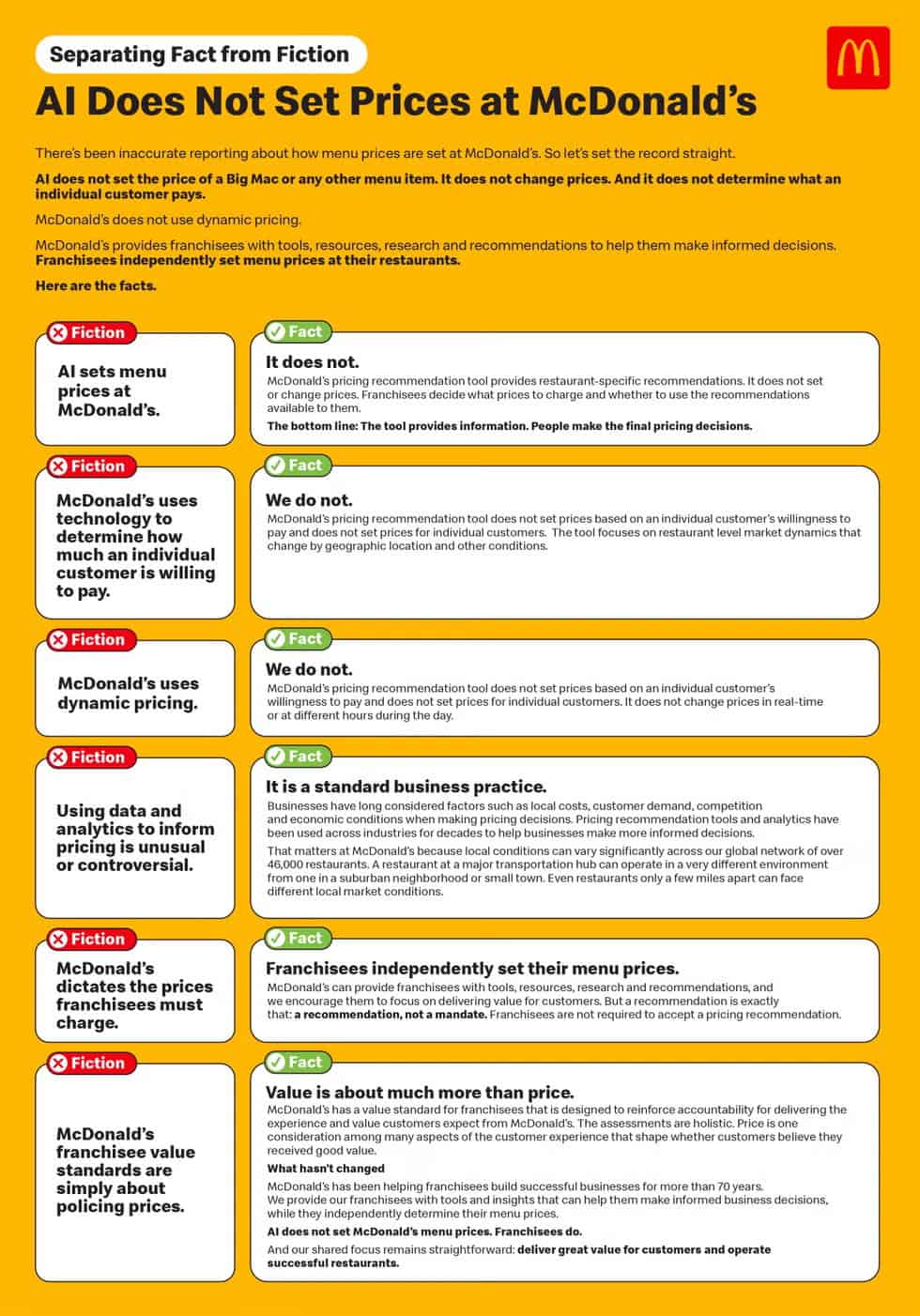
According to McDonald’s, the technology functions strictly as a background analytical tool. It evaluates overhead costs, regional competitor pricing, and local customer demand to offer pricing estimates, but leaves the final decision in human hands.
Advice, not an automated mandate
Addressing concerns about corporate overreach, the company stressed that store operators remain in complete control of their local menus. As McDonald’s noted in its response, “a recommendation is exactly that: a recommendation, not a mandate. Franchisees are not required to accept a pricing recommendation.”
The fast-food giant also shut down fears of surge-style dynamic pricing (the practice of altering prices continuously throughout the day based on surge demand) or software that calculates personalized charges for individual consumers.
Furthermore, corporate leaders rejected the idea that internal performance evaluations are used to force pricing compliance. They argued that franchise reviews assess the entire customer journey rather than just receipt totals, emphasizing that “value is about much more than price.”
The fine line between suggestion and control
While McDonald’s maintains a clear line between algorithmic advice and corporate orders, the debate highlights a shifting landscape for consumers. Artificial intelligence may not be directly punching in the numbers at the register, but its influence behind the scenes is undeniably growing — leaving customers to wonder where a helpful recommendation ends and a price hike begins.
Sources:
McDonald’s
Delish