
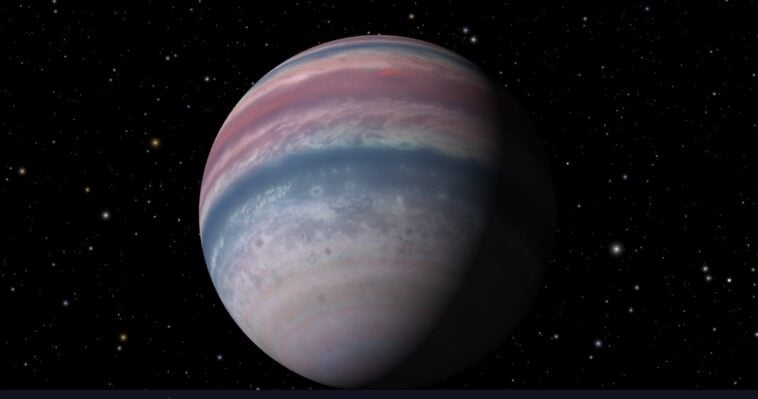
Astronomers have detected a radio signal coming directly from a planet outside the solar system for the first time, and the bursts appear to be driven by giant auroras.
Using the MeerKAT radio telescope array in South Africa, a team led by Harvard and Smithsonian astrophysicist Kevin Ortiz Ceballos captured repeating radio pulses from the planet Beta Pictoris b, a gas giant 64 light-years from Earth, about twelve times heavier than Jupiter.
The findings published in a non-peer-reviewed preprint represent a major potential first, as no previous radio detection had been unambiguously traced to an exoplanet rather than its host star.
Whether the bursts came from the planet or its star wasn’t obvious at first. The researchers pinned it down by lining up their radio images against distant quasars, which barely move against the sky and work well as fixed markers.
With the signal confirmed on the planet, the researchers traced its origins to auroral radio emission, which accompanies the kind of light show seen near Earth’s poles, only far stronger, set off when charged particles slam into a planet’s upper atmosphere.
Anyone hoping for something more exotic is only setting themselves up for disappointment.
The bursts allowed the team to estimate the strength of the planet’s magnetic field. They landed on a staggering minimum of 1,250 gauss, the first direct measurement of a magnetic field for a planet outside the solar system. For comparison, Jupiter’s field measures roughly 4.3 gauss, and Earth’s is barely half a gauss.
This kind of magnetic field is critical, as it works like a shield, keeping a star’s stream of particles from stripping a planet’s atmosphere away, much like how Earth depends on the protection of its own field to keep both its air and its surface life safe from radiation.
Now that researchers know how to detect these planetary shields, the team anticipates the same method to be trained on other giant exoplanets, noting that a five- to seven-fold improvement in instrument sensitivity expected from next-generation radio observatories should bring them within reach.
Sources: arXiv, SARAO-MeerKAT, SKAO, NASA, Live Science