
Take it with a sip of water, and it never comes back out.
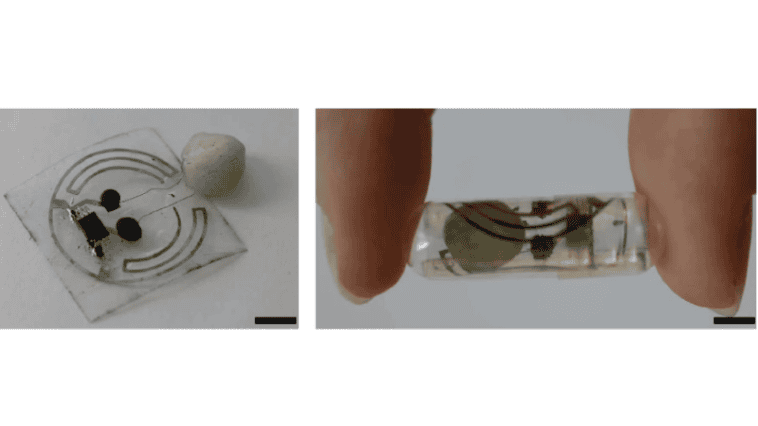
MIT researchers have engineered a prototype battery designed to power ingestible medical devices for several days before completely dissolving in the gut.
In animal trials detailed in the scientific journal Nature Chemical Engineering, the paper-thin batteries kept devices running inside pigs (whose digestive systems closely resemble humans) for up to three days before melting away without a trace.
Ditching the heavy metal
Batteries in current swallowable devices have to be sealed shut so nothing leaks into the body, and they hog most of the room in the capsule.
By contrast, the new prototype is built with nontoxic minerals, a magnesium anode, and a molybdenum trioxide cathode bound by cellulose nanofibrils. The finished battery comes out thin and bendy, a lot like a sheet of paper.
“For many of the systems we’re developing, we need power, and we power the system through different ways,” said Giovanni Traverso, senior co-author and professor of mechanical engineering at MIT. “Often, we use batteries, so the question here was: Could we develop a battery that was bioresorbable, and then apply that across a range of application areas?” Traverso explained.
Left bare, stomach acid would chew through it in no time. So it gets dipped in beeswax, and some versions get a second coat made from a desert shrub.
Don’t expect it to charge a phone, though. The smallest version fits inside an everyday gelatin capsule and has enough juice for low-power electronics, and that’s about it.
In one pig, the battery powered a wireless ingestion monitor, essentially an RFID tag designed to track whether patients take their medications. Positioned in the esophagus, it pinged a receiver five feet away every time the animal swallowed a pill. In another, it ran a capsule that zapped the stomach lining and bumped up the hunger hormone, ghrelin, without causing tissue damage anyone could spot.
In both cases, only the paper batteries melted away. The gadgets themselves, essentially the conventional circuit boards that actually transmitted the radio signals and delivered the electrical pulses, both passed through the pigs’ digestive tracts and came out the other end in one piece.
This means the technology is only a partial fix. Until researchers can make the electronics as bioresorbable as the battery, swallowable gadgets will still carry the risk of solid components getting stuck in the gut.
Consistency is another hurdle. Batteries from the same batch didn’t all last the same length of time, thanks to uneven wax and loose layers. Getting that to perform evenly is next on Traverso’s list.
If researchers can iron out those issues, human trials testing the dissolvable battery in the pill-tracking RFID sensor could begin in roughly two years.
Sources: Nature Chemical Engineering, MIT News, Nature Asia, Live Science