
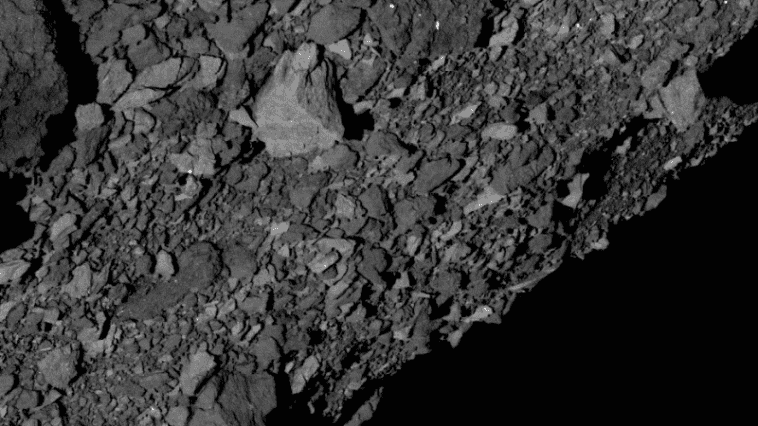
Bennu is currently hurtling through space on an orbit that crosses Earth’s own path, earning it a spot on NASA’s list of potentially hazardous asteroids. Yet if this mountain of space rock ever headed our way, deflecting it might look very different from what scientists once imagined.
You could push a finger through the surface of the asteroid with little effort, which is a strange thing to say about a 500-meter-wide rock orbiting the Sun.
That is the upshot of a new study published in Nature Communications led by Paul Sánchez, a senior research associate at the University of Colorado Boulder, who offers a comparison that makes the number land.
“If you form a small cylinder with freshly ground coffee, its strength is about 50 Pa, and you can still poke a hole into it with a single finger. The surface of Bennu is 50 times weaker than that,” Sánchez told Phys.org.
The physics holding Bennu together
The paper treats the asteroid as what it actually is: a pile consisting of boulders, pebbles, and dust, loosely heaped together rather than fused into anything solid. How well such a pile holds depends heavily on how much fine material is packed into the gaps between the larger chunks and the size and shape of those grains.
Bennu, it appears, is running short of this material, and on an asteroid so small, such a shortage leaves gravity with more to do than it can manage. Yet the asteroid has managed to hold together. It turns once every 4.3 hours, far too slowly for its own spin to threaten it.
Large rubble-pile asteroids, however, almost never rotate faster than once every 2.2 hours. Anything quicker, and their own spin would throw the loose material off. Astronomers previously assumed this limit to be universal until smaller asteroids turned up spinning well past this fixed time and yet remained in one piece, meaning something other than gravity is involved.
Sánchez and his colleagues proposed an answer back in 2010: van der Waals forces, the faint attraction between particles sitting practically on top of one another. On Earth, they’re swamped by gravity. But on an object where gravity barely registers, fine dust can act as a weak cement between the rocks.
The problem with the early models was that they assumed the grains were round. Real asteroid fragments, however, are jagged, flattened, and stretched, with shape determining how tightly particles pack and how many points of contact they make.
Testing Bennu’s strength
To test their theory, Sánchez and his team simulated 78 granular bridges, essentially clumps of small particles squeezed between two meter-wide boulders, then slowly pulled the boulders apart to see what the bridge could take. They found out that the smaller grains held better because more of them fit into the same space. Angular grains held better still, interlocking rather than resting against each other at a single point.
Then they ran Bennu’s own material through the framework, using measurements from the samples NASA’s OSIRIS-REx spacecraft brought back to Earth in 2023. The patch of ground the spacecraft sampled came out weaker than 1 Pa and possibly as low as 0.001-0.01 Pa under assumptions close to the measured average particle size. For perspective, a single sheet of paper resting flat on a table exerts about one pascal of pressure.
The spacecraft had already shown how feeble the surface is back in 2020 when the OSIRIS-REx mission’s robotic sampling arm reached into the asteroid 200 million miles away from us. The arm sank far deeper than mission scientists expected, and a later Science Advances analysis of the touchdown described the subsurface as having “near-zero cohesion.”
It isn’t that Bennu lacks dust entirely. It lacks enough of the very fine stuff to fill the gaps between bigger particles, leaving too few microscopic contacts for those cohesive forces to work through.
All of which stops being academic the moment someone tries to deflect one. NASA managed exactly that in 2022, when the DART spacecraft crashed into the small asteroid moonlet, Dimorphos, and cut about 33 minutes off its orbit around asteroid Didymos, with the debris thrown off the surface contributing a large share of the push.
Predicting that kind of response means knowing how a target fractures and ejects material, and that is notoriously hard to judge from Earth.
Sources: Nature Communications, Scheeres et al. 2010, Icarus, NASA TAG Release, Pravec & Harris 2000, Icarus, OSIRIS-REx, Didymos & Dimorphos, Phys.org