
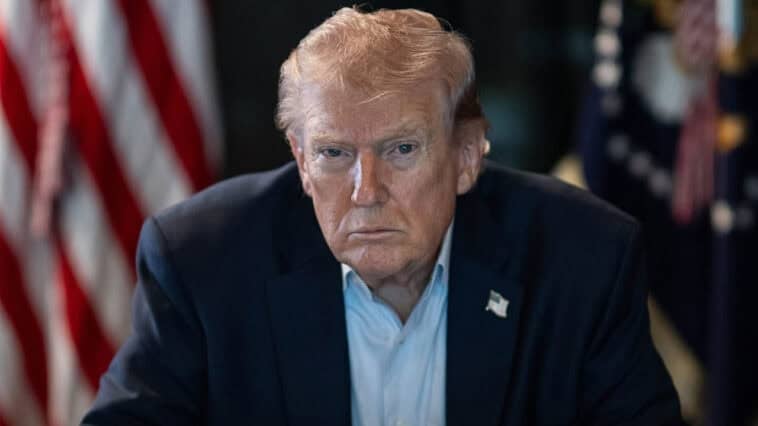
President Donald Trump is brushing aside growing concerns about the dangers of artificial intelligence, calling warnings about AI taking over the world and harming humanity a “hoax” while rejecting calls for stronger guardrails. His stance comes as some of the biggest names in the tech industry are sounding increasingly alarmed about how quickly the technology is advancing, creating a striking divide between Washington and the companies building AI. But with warnings growing louder and the global race for AI dominance intensifying, Trump’s position could have major consequences for how the technology develops. So why is the president dismissing the concerns?
Economic edge over AI fears
President Donald Trump spent Monday aggressively pushing back against calls from tech industry leaders for tighter government regulation on cutting-edge artificial intelligence. In a flurry of social media posts, Trump made it clear that keeping America ahead of China and preserving massive AI-driven economic gains takes top priority over growing public anxiety about the technology’s potential dangers.
Trump dismissed safety warnings as a “SICK conspiracy” designed to hamper American innovation, asserting that his own oversight is all that is needed to keep advanced AI models in line. Comparing the public alarm to past political controversies, he took direct aim at critics of AI infrastructure.
“The people that say AI is going to destroy the World, and that Data Centers are bad for your neighborhood, are the same people that said, just a short time ago, that the World would be extinguished by ‘Climate Change,’” Trump wrote. “That HOAX never worked out for them, and now they’re on to the next one.”
A live stage defense
By Monday evening, Trump had posted on the topic six times, signaling how deeply the issue has swept into national political debate. To double down on his stance, he phoned Nvidia CEO Jensen Huang while the chipmaker chief was speaking live on stage at a summit in Los Angeles.
Huang, who has remained skeptical of apocalyptic AI predictions, put the president on speakerphone in front of the audience. Trump touted his family ties to the Massachusetts Institute of Technology as proof of his grasp on high tech, adding a plainspoken verdict:
“I also have common sense about AI. The robots will not be taking over. The AI will not be taking over the rest of the world. The whole thing is a hoax.”
Trump’s vocal defense follows discussions with advisers and tech figures after a weekend at his golf resort in Ireland, where he rejected calls from executives like Anthropic CEO Dario Amodei for a global slowdown in AI development. Vice President JD Vance and other administration officials similarly questioned the true motives behind the executives’ sudden demands for regulation.
The White House view on AI guardrails
Despite public skepticism and unease within his own party, Trump remains steadfast in his belief that existing authority is more than sufficient to control tech giants.
“The only control or ‘guardrails’ that AI needs is a STRONG AND SMART (High IQ!) PRESIDENT, and the U.S.A. has that, in spades!” Trump declared on Truth Social.
He reiterated that the nation already possesses “tremendous CRIMINAL and REGULATORY power over these companies!” while accusing executives like Amodei of “now pretending to be a ‘perfect little angel.’”
For Trump, the industry represents an unprecedented economic engine —a “golden goose” driving stock market surges and fueling manufacturing through massive data center expansion.
Capitol Hill weighs the risks
While the White House moves to protect tech growth, congressional leaders are treading carefully. House Speaker Mike Johnson cautioned against rushing into burdensome red tape, noting that over-regulation could undermine national security by giving China the upper hand. Senate Majority Leader John Thune echoed a preference for a “light touch” to maintain competitiveness.
However, some lawmakers argue urgent action is necessary. Senator John Kennedy plans to introduce legislation requiring an AI “kill switch”.
“It just says all of you have to have a kill switch so you can shut this thing down if your model becomes the Terminator,” Kennedy noted.
Senator Bernie Sanders expressed hope that Congress will “rise to the occasion,” even acknowledging the body is “at best, a slow-moving institution.”
Global stakes in Washington
The debate comes at a critical geopolitical moment, as U.S. officials prepare for an upcoming state visit from Chinese leader Xi Jinping. Trump claimed social media posts that Xi “announced that China will be doing absolutely nothing to stand in the way of AI, or its future,” signaling that any unilateral American slowdown would hand Beijing a decisive lead. With intergovernmental dialogues between the two nations scheduled to resume, the race for global dominance remains at the center of the White House agenda.
Source:
CNN