
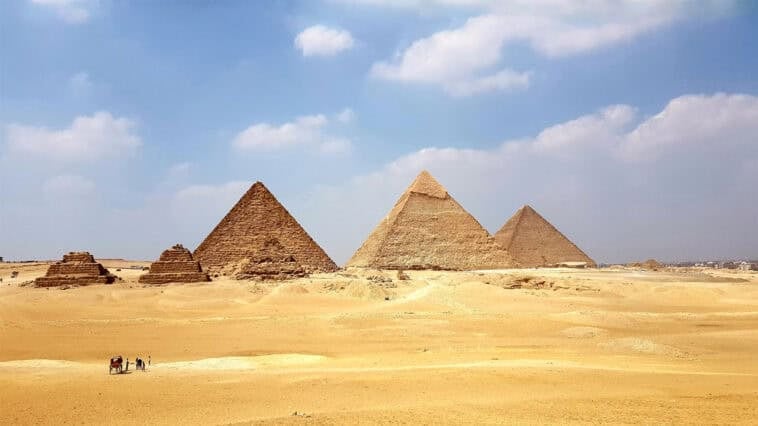
For thousands of years, the Great Pyramid of Giza has been widely regarded as a monumental tomb built for Pharaoh Khufu. But a new theory is challenging that familiar explanation, suggesting the ancient wonder may have been designed to preserve something far more unusual: knowledge of the heavens. An independent researcher claims the pyramid’s precise dimensions contain hidden mathematical and astronomical patterns linked to the Moon, stars, and planets. If the theory is correct, the 4,500-year-old structure may have been created as a giant stone record meant to outlast its builders. But what exactly do the mysterious measurements reveal, and could they really prove the pyramid was more than a tomb?
While conspiracy theories have long credited extraterrestrial visitors with building Giza’s iconic monuments, a new hypothesis suggests the Great Pyramid does hold an otherworldly secret—just a purely mathematical one. According to independent researcher Sefy Levy, the 4,500-year-old structure functions like an ancient, stone-built “Da Vinci Code,” with its precise dimensions acting as a giant vault for astronomical data.
In a paper published on the SSRN preprint server, Levy argues that the pyramid’s height, base, and sloping sides were intentionally designed around a secret numerical system. Rather than serving merely as a monumental tomb for the Pharaoh Khufu, the structure may have been constructed to safeguard advanced ancient knowledge against the erosion of time.
“The pyramid is not a container for knowledge,” Levy declared. “It is the knowledge, made stone.”
Astronomy written in stone
To unlock these hidden messages, Levy analyzed the monument’s key proportions using fractional math identical to the methods employed by ancient Egyptian scribes. The resulting calculations repeatedly aligned with major astronomical cycles visible to the naked eye:
- Lunar Orbit: One key calculation yielded 27.5, coming remarkably close to the 27.55-day lunar perigee—the time it takes for the Moon to complete its cycle to its closest point to Earth.
- The Vanishing Star: Another recurring calculation produced the number 70, matching the exact 70 days the star Sirius disappears from the night sky, blocked by the sun’s glare.
- Planetary Motions: Additional measurements mirrored the recurring orbital paths of Saturn, Jupiter, Venus, and Mars, alongside fundamental mathematical constants like pi and the golden ratio (phi).
To test whether these overlaps were pure chance, Levy ran a computer simulation analyzing 100,000 randomly dimensioned pyramids. Only 2.4% of the virtual models produced similar mathematical matches, leading him to conclude that the Great Pyramid’s design was deliberately engineered.
However, the study has not yet undergone peer review, meaning its methods and conclusions have not been independently evaluated through the standard academic review process.
A lost homeland
Levy goes further with his hypothesis, proposing that the pyramid was built not for Khufu, but as a tribute to Benben—the primordial mound of creation in ancient Egyptian mythology. He speculates that this legendary site was inspired by the Eye of the Sahara, a geological formation in Mauritania where the civilization’s ancestors may have lived before climate shifts forced them toward the Nile Valley.
Under his theory, a prolonged drought caused the region to dry out, prompting people to migrate toward the Nile. The pyramids were then supposedly constructed as monuments honoring their ancestral homeland.
However, mainstream Egyptologists emphasize that there is currently no physical or historical evidence supporting this origin story.
The latest mystery surrounding the pyramids
Levy’s claims arrive amid renewed speculation about what may still be hidden beneath or around the Pyramids of Giza.
Earlier this year, Italian researchers claimed they may have found evidence of a possible Sphinx-like structure beneath the pyramids, along with what they described as signs of a vast underground complex.
The researchers also pointed to lines connecting the pyramids with the known Sphinx, arguing that the alignment could indicate another mound beneath which a second feline-shaped monument may be located.
Like Levy’s proposal, those claims have generated considerable interest but remain controversial.
For now, the Great Pyramid’s purpose remains grounded in the archaeological evidence surrounding ancient Egyptian funerary practices. Levy’s interpretation offers a far more unconventional possibility: that one of humanity’s most famous monuments was not simply built to honor the dead, but also to preserve the knowledge of the living for generations to come.
Source:
New York Post