
Humanoid robots have become an increasingly common sight, but seeing them used as the face of an anti-AI protest is something ironic and far more unusual. In Warsaw, around 30 robots were positioned outside Poland’s digital affairs ministry with flags and messages demanding stronger AI rules and protection for human jobs. The unusual demonstration was intended to draw attention to fears that AI and automation could eventually replace workers. But why did organizers put robots at the center of a protest about the risks of robots and AI?
Robots become the unlikely face of an AI protest
As anxiety over AI-driven layoffs and unchecked automation continues to dominate headlines, one Polish group chose to confront the issue using the very tools raising those concerns: a protest staged entirely by robots.
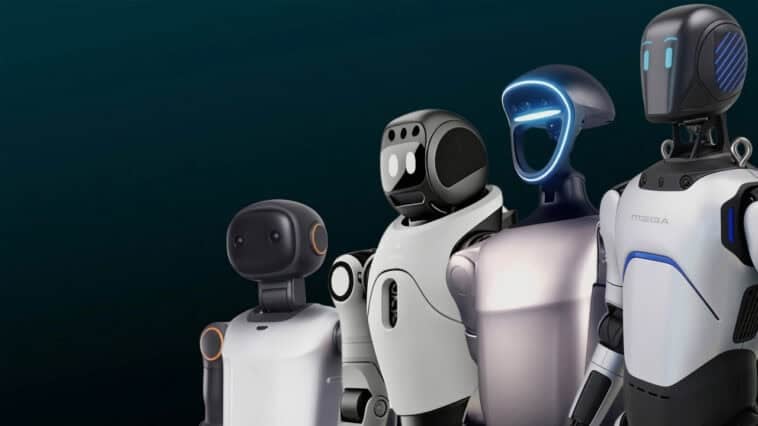
Organized by Democratism, an initiative aiming to spark debate on how automation impacts the labor market, the demonstration brought together approximately 30 machines outside the Ministry of Digital Affairs in Warsaw. Waving flags in front of government offices, the fleet ranged from bipedal humanoids to dog-like quadrupeds, showcasing the immediate reality of modern robotics.
Loudspeakers played automated chants demanding urgent policy action, including “Defend workplaces,” “Time for rules,” and “Don’t wait, regulate.”
To emphasize the sophistication of today’s machines, organizers let the hardware speak for itself.
“The robots present here are meant to show that this technology is already a reality,” the organizers stated via an Agibot A3, an advanced humanoid featuring integrated voice-recognition powered by a large language model.
Around 30 robots joined a protest in front of Poland’s digital affairs ministry, calling for stronger AI regulations.
The demonstration was organised by campaigners to spark debate on how AI and robots could replace workers. pic.twitter.com/QEbvchb2RS
— Al Jazeera English (@AJEnglish) September 7, 2026
Protest highlights fears over AI replacing workers
The demonstration focused heavily on concerns that advances in AI and robotics could eventually reduce the need for human workers. Organizers said they wanted to draw attention to both physical jobs that could be affected by humanoid robots and cognitive work that could increasingly be handled by AI systems.
“We particularly want to address the issue of the potential replacement of people both by humanoid robots and by artificial intelligence in cognitive work,” Democratism organizer Grzegorz Kuliś told AFP.
Kuliś argued that action is needed before the technology advances even further.
“If we don’t react now, we may soon have a problem… these robots can already move around freely, they’re already ‘protesting.’”
The demonstration was significant enough to draw Poland’s Digital Affairs Minister, Krzysztof Gawkowski, out of the ministry building to speak with organizers directly on site. Gawkowski acknowledged the growing challenge, noting that “uncontrolled (AI) models, implemented into humanoids that will also keep evolving as robotisation moves forward, are a major problem.”
Activism or high-tech PR?
Despite the public policy focus, the demonstration carries a notable commercial twist. Kuliś is not just a concerned citizen; he is the Chief Information Officer and owner of Delta Robots, the technology firm that supplied the machines, as well as the head of an employment agency.
Because Delta Robots built the very machines on display, the event doubled as a high-profile press showcase for his commercial enterprise. However, using dramatic demonstrations to highlight capability is a familiar playbook in the tech industry. Major American AI developers like OpenAI and Anthropic have similarly emphasized the dangerous power of their own systems while simultaneously calling on governments to regulate the sector.
Whether Kuliś is pursuing genuine labor reform or following in the self-serving footsteps of Silicon Valley leaders remains open to debate. What is undeniable is that his spectacle marked the first known political demonstration carried out by humanoid robots — and as automation accelerates globally, it almost certainly won’t be the last.