
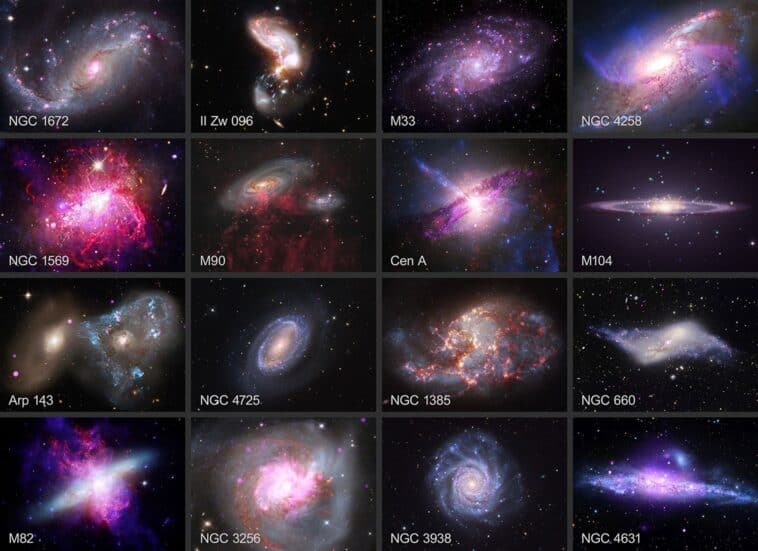
NASA has just given us 16 more reasons to stare at the universe instead of answering our emails. Scientists have released a dazzling new gallery of galaxies that NASA is calling “cosmic gems.” The gallery combines decades of X-ray observations from the Chandra X-ray Observatory with data from some of humanity’s most powerful telescopes.
The collection includes galaxies shaped like spirals, blobs, sombreros and even a whale. Some are peacefully forming stars, while others are locked in spectacular cosmic collisions. But these are not just beautiful pictures for your next desktop wallpaper. By studying galaxies far beyond our own, scientists hope to better understand the past and possible future of the Milky Way.
These aren’t your average space photos
Each of the 16 newly released images contains X-ray data collected by NASA’s Chandra X-ray Observatory over its decades in space. Chandra, which launched in 1999, observes the universe in X-ray light, allowing scientists to detect some of the most energetic and extreme phenomena in space.
That data was then combined with observations from an all-star lineup of telescopes, including the James Webb Space Telescope, Hubble Space Telescope, the Imaging X-ray Polarimetry Explorer, the Neil Gehrels Swift Observatory and NuSTAR, along with instruments on the ground.
The result is the ultimate cosmic crossover episode. Different telescopes see the universe in different wavelengths of light, revealing details that our eyes and ordinary cameras simply can’t see. Put that information together, and suddenly galaxies become much more than distant smudges in the night sky.
Meet the galaxy that looks like a whale
One of the standouts in the collection is NGC 4631, better known as the Whale Galaxy. Viewed from the side, the spiral galaxy has a long, stretched-out appearance that earned it its aquatic nickname.
Our own Milky Way is also a spiral galaxy, complete with a central concentration of stars and enormous arms that stretch outward like a cosmic pinwheel. Unfortunately, because we live inside the Milky Way, taking a nice selfie of the entire thing is not currently an option.
There is also a Sombrero Galaxy
The gallery also features M104, famously known as the Sombrero Galaxy because of its distinctive shape. Unlike classic spiral galaxies, M104 has characteristics that make it something of a cosmic hybrid, with features associated with both spiral and elliptical galaxies.
Elliptical galaxies tend to have less obvious structure and fewer dramatic arms than their spiral cousins. They also often contain older stars and can grow to truly enormous sizes. Basically, if spiral galaxies are the flashy protagonists of the universe, elliptical galaxies are the mysterious ancient characters who have clearly seen some things.
The galaxies that refuse to follow the rules
Not every galaxy fits neatly into a category. The new collection also includes irregular galaxies, which, as the name suggests, don’t follow the familiar spiral or elliptical blueprint.
They come in all kinds of strange shapes and sizes, proving that even on a cosmic scale, some things simply refuse to use a template. And then there are the galaxies caught in the middle of major celestial drama.
Space collisions are absolutely wild
Several images offer a glimpse of what happens when galaxies interact and collide. Systems such as Arp 143 and II Zw 096 reveal the chaotic transformations that can occur when enormous collections of stars, gas and dust encounter one another. These cosmic crashes can trigger waves of new star formation and dramatically reshape entire galaxies. They can also influence the behavior of supermassive black holes lurking at the centers of galaxies.
Thankfully, these collisions unfold over unimaginably long periods of time, so it’s less like watching two cars crash and more like watching an extremely slow-motion disaster movie that lasts millions of years.
Looking at other galaxies helps us understand home
NASA’s new gallery isn’t just an excuse to remind us that space has the best graphics. Scientists study distant galaxies because they offer clues about how galaxies evolve, merge, and transform over time. And because the Milky Way is a galaxy too, understanding what happens elsewhere in the universe can help scientists piece together our own cosmic history.
Sources: New York Post, Scientific American