
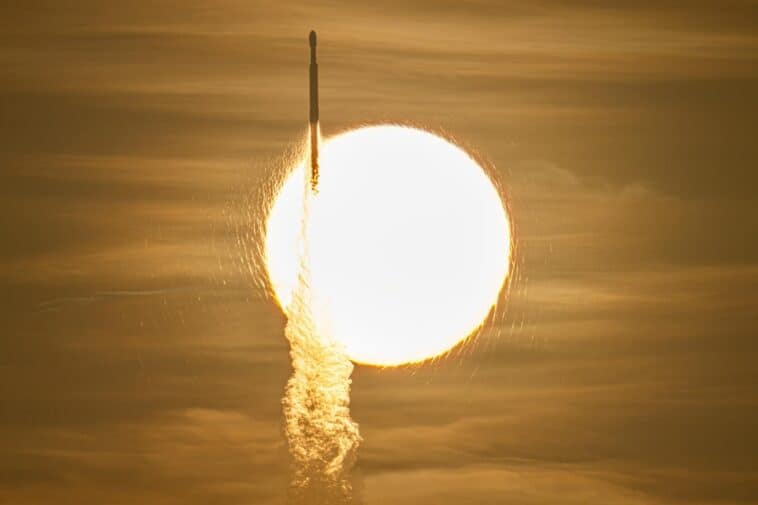
NASA has launched a telescope with a field of view at least 100 times wider than that of Hubble’s.
The Nancy Grace Roman Space Telescope lifted off on Sunday, August 30, 2026, at 7:26 a.m. EDT, aboard a SpaceX Falcon Heavy from Launch Complex 39A at Kennedy Space Center in Florida.
Designed to unravel the mystery that is dark energy, Roman pairs sharp infrared vision with its wide-field imager.
Its surveys will map billions of galaxies, study dark matter, examine black holes, and look at everything from objects in our own solar system out to the edge of the observable universe.
Orbit and legacy
The telescope will travel about a million miles from Earth to settle at the Sun-Earth Lagrange point L2.
The observer is a namesake of NASA’s first chief astronomer, Nancy Grace Roman, one of the agency’s architects of the modern science program. She joined NASA in 1959 and took on the chief astronomer role in 1960.
Although Roman formally retired from her primary position in 1979, she later returned as a contractor and consultant, including work at Goddard’s Astronomical Data Center, before fully stepping away around 1997. Having spent decades at NASA and laying the foundational work for the earlier Hubble telescope, she earned the nickname “mother of Hubble.”
The mission has a planned five-year prime duration, with NASA hoping to extend operations for as long as a decade.
During that time, data from Roman will be released publicly once it’s processed, and the telescope will operate alongside the James Webb Space Telescope (launched in 2021), which is already in orbit, giving scientists two very different views of the same universe.
Sources: NASA, Roman’s Pre-Launch Coverage, Jet Propulsion Laboratory, Scientific Observatory Details, New York Post