
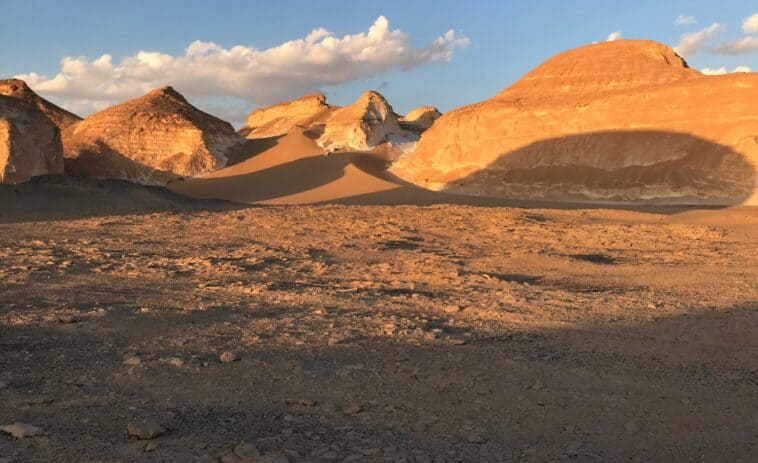
Seventy million years ago, Egypt’s Western Desert sat under a warm, shallow sea. Fourteen fossilized shark teeth recovered from beneath the Abu-Tartur Plateau, roughly 650 kilometers southwest of Cairo, are what gave it away.
The specimens in question, which belonged to five distinct extinct shark species, were detailed in a study published in the scientific journal Cretaceous Research. The study was led by researchers from Cairo University, with their discovery bringing the total number of shark species documented at the site to seven.
Among these, two species, namely the Serratolamna cf. serrata and Squalicorax bassanii, have never been recorded in Egypt.
The study also highlights one discovery as particularly extraordinary, which is that of the needle-toothed shark Scapanorhynchus cf. raphiodon. This specimen may be the first of its kind ever documented in Africa and potentially the youngest fossil record of the species ever found.
A mosaic of hunters
The teeth vary widely in shape, ranging from thin, needle-like forms to wide, serrated, or curved edges, suggesting the sharks occupied diverse niches and hunted different kinds of prey. While some species likely prowled closer to shore, others may have spent more time in deeper water.
This variety of predators points to a thriving ecosystem, as evidenced by the small fish, invertebrates, and marine reptiles recovered from the same phosphate-rich layer. Meaning, this is not just about a stray animal anymore. It’s the discovery of an entire, thriving marine ecosystem.
The layer dates to the Late Cretaceous, a period occurring roughly between 100.5 and 66 million years ago, when the Earth was hotter and more humid than it is today.
Researchers believe a process called active upwelling played a role in supporting this sort of abundant ecosystem. Cold water rising from deeper parts of the sea would have likely carried nutrients toward the surface, feeding plankton and other small organisms that in turn fed the rest of the marine food chain.
Sources: ScienceDirect, Taylor & Francis, IFLScience, New York Post