
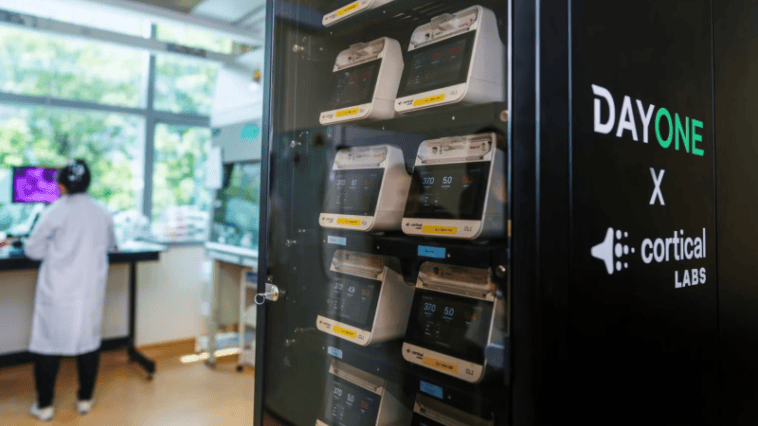
Singapore’s newest data center prototype, which launched recently inside NUS’s (National University of Singapore) Life Sciences Institute (LSI), is powered by roughly 4 million living human neurons, and someone has to feed them every three days.
The facility, built by the Australian biotech firm Cortical Labs in partnership with NUS Medicine and DayOne, a Singapore-headquartered data center operator that closed a $4.5 billion funding round in June 2026, targeting a $20 billion valuation, is the first server rack anywhere to use actual brain cells as its primary computing substrate rather than silicon designed to imitate them.
Twenty units make up the installation, each one a CL1 holding at least 200,000 lab-grown neurons resting on an electrode-fitted silicon chip. The cells, originally derived from human blood and reprogrammed into stem cells before being cultured into neurons, communicate with a computer through electrical signals that the system interprets as processing power.
Keeping them alive requires a dedicated life-support system that delivers regular doses of sugar, micronutrients, and pH buffers along with a gas mixer supplying carbon dioxide, oxygen, and nitrogen. Even with all of that, the neurons last only about six months.
Where biological hardware wins
Cortical Labs founder and chief executive Chong Hon Weng is careful about the claims of the technology. He is not arguing that neurons outperform chips at conventional computing tasks, and he readily concedes that anything requiring speed, precision, and repeatability, including the large language models behind tools like ChatGPT, remains firmly in silicon’s territory.
Instead, his case rests on a narrower set of problems where training data is scarce, and conditions keep changing.
“The establishment of this prototype shifts the conversation from research to commercial application. Biological computing supplements AI in areas where data is sparse, learning from far less and adapting as conditions change. Our aim is to uncover the use cases where that advantage matters most, in areas such as drug discovery, humanoid robotics, cybersecurity, and fraud detection,” Chong said at the official unveiling of the prototype.
The energy argument is much more straightforward. Each CL1 draws 30 watts, including its life-support systems, less than a handheld calculator, while an Nvidia H100 SXM, a powerful data center GPU, can consume up to 700 watts under demanding tasks, and a server carrying eight of them approaches 10,200 watts once supporting hardware is counted. Because the neurons generate almost no heat, the cooling infrastructure that dominates conventional data centers becomes unnecessary.
This advantage is particularly valuable where data centers accounted for 5.3 percent of national electricity consumption in 2019, rising to 7 percent the following year as the pandemic accelerated digitalization. The government had even imposed a temporary halt on new construction in 2019 while it worked out a greener path forward.
Scaling biological computing
Cortical Labs has spent years demonstrating that biological systems can be trained at all. Its earlier platform, DishBrain, taught cells in a dish to play Pong back in 2022. Last February, the company showed roughly 800,000 neurons learning to play Doom.
The commercial version of that work now runs in Melbourne, where 120 CL1s serve about 20 paying customers, which are mostly corporate research divisions and universities experimenting with robotics and gaming. A month of access to a single unit costs US$2,200, roughly half the US$4,300 major cloud platforms charge to rent a high-end AI chip.
For NUS, the appeal extends well beyond computing. Rickie Patani, who directs the Neurobiology Programme at the LSI and chairs the Neuroscience Translational Research Programme at NUS Medicine, uses stem cells derived from patient blood to model Alzheimer’s, Parkinson’s, and motor neuron disease. Growing human neurons rather than relying on animal tissue gives researchers a platform that is both closer to human biology and easier to justify ethically.
The site is also serving as a practical trial run, helping partner Cortical Labs work out the staffing and skills a commercial operation would require locally. Plans call for scaling up to 1,000 units, pending regulatory approval along with energy efficiency and safety testing.
Sources: NUS Medicine, DayOne, The Straits Times