
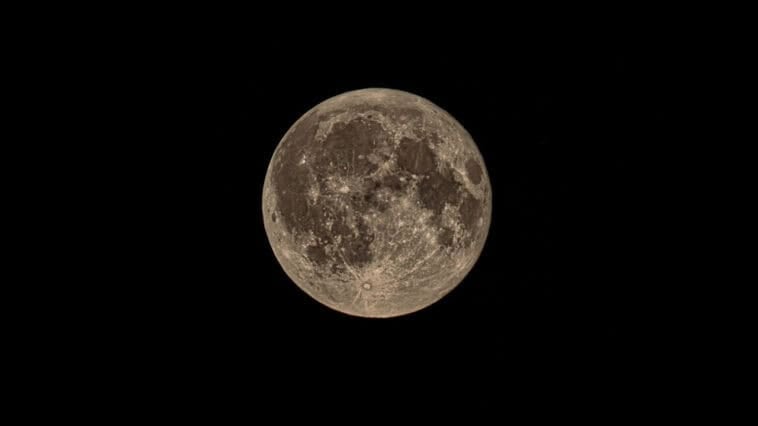
What if the moon could become more than a bright object in the night sky, but a place where people actually live and work? Voyager Technologies CEO Dylan Taylor believes that future could arrive sooner than you might think, predicting that moon bases could be up and running in the early 2030s. From lunar mining and construction to entirely new space-based careers, the next decade could change what we consider a “workplace” — but how realistic is this vision, and who would actually want to live there?
The Moon could become the next workplace
While a commute to orbit sounds like a distant dream, commercial space pioneers insist the shift is already underway. Technical groundwork is transitioning space from an exclusive research zone into an accessible economic hub.
“Humans will definitely be living and working in space,” billionaire space executive Dylan Taylor exclusively told Fortune. “The next step would be the moon. That’ll happen in the 2030s — probably early 2030s. We’ll have a moon base, people living and working on the moon. You’ll be able to look up at the moon and see lights on the moon.”
Taylor points out that off-world living isn’t entirely unprecedented. Humanity has maintained a continuous presence in low-Earth orbit on the International Space Station (ISS) for 26 years. However, the private space sector is aggressively working to transition these operations from specialized astronaut crews to everyday workers.
What jobs could exist on the Moon?
The future extraterrestrial economy will rely heavily on physical infrastructure, creating positions that advanced artificial intelligence cannot manage alone. Key growth sectors include orbital data centers, lunar power grid construction, and resource mining.
“You’re not going to be able to program Optimus to do everything on the moon,” Taylor noted, referencing Tesla’s humanoid robot. “You’re going to have to have humans to figure it out.”
Taylor isn’t offering commentary from the sidelines. His credentials span both corporate finance and aerospace engineering. After building successful ventures across real estate, banking, and electronics, he pivoted at age 37 to pursue commercial space flight. He backed early ventures like Space Adventures and Relativity Space before founding Space for Humanity in 2017 to expand flight access.
In 2019, he launched Voyager Technologies, which went public on the NYSE with a $3.8 billion valuation. Today, Voyager holds critical NASA contracts to build the commercial replacement for the ISS, and Taylor himself flew into orbit aboard a 2021 Blue Origin mission as the 606th human in space.
Mars is a much bigger challenge
While lunar bases offer practical proximity for commerce, Mars presents an entirely different set of environmental challenges.
“Just because it’s so much further away,” Taylor explained. “Radiation is so much more of a bigger problem.”
Because of those severe conditions, Taylor views Mars primarily as an insurance policy for human survival rather than a standard residential hub
“I agree with Elon [Musk] that we want to have some diversification, in case something really bad happens here — an asteroid or something like that,” Taylor said. “The moon really isn’t sufficient diversification. The moon and the Earth are really the same planetary system.”
Ultimately, relocation to Mars will be driven by personal ambition rather than routine job transfers
“A lot of people don’t want to live on Mars,” Taylor said, placing himself among the adventurous minority. “I’d rather do the adventure. We’re all on a one-way trip, whether we know it or not. It’s just where you want to end up.”
He believes that shared drive will eventually establish initial red planet settlements. “They have the adventurer gene, which I think I have,” Taylor added. “There’s enough people that would do that that you could start a small colony — but this whole notion that we can create an entire civilization, terraform ours, it’s going to take a long time to do that.”
Taylor’s aggressive timeline is far from an isolated prediction; it aligns closely with a broader vision shared across Silicon Valley and the aerospace sector.
SpaceX CEO Elon Musk has long driven space accessibility, intending to reach Mars as early as 2028.
Meanwhile, Blue Origin founder Jeff Bezos predicts that “millions of people” will live in space by 2045, relying on autonomous machines for heavy surface labor. “I don’t see how anybody can be discouraged who is alive right now,” Bezos noted at Italian Tech Week, emphasizing that robots will handle remote lunar tasks on our behalf.
OpenAI’s Sam Altman echoes this optimism for the next generation, envisioning recent graduates taking on “completely new, exciting, super well-paid” jobs in space that will make traditional entry-level careers look entirely obsolete by comparison.
Source:
Fortune