
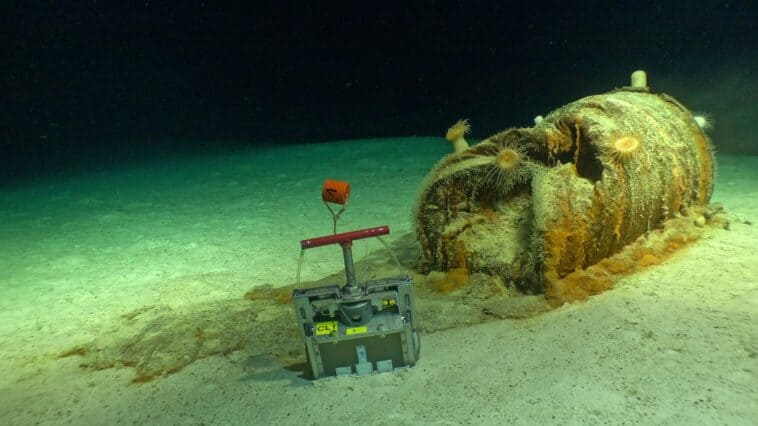
More than 200,000 barrels of radioactive waste were dumped in the Northeast Atlantic during the second half of the 20th century.
In a French expedition under the NODSSUM project (Nuclear Ocean Dump Site Survey Monitoring) that ran from May 27 to June 28, 2026, about 30 scientists aboard the Pourquoi Pas? used the manned submersible Nautile for 20 dives below 15,400 feet, the first detailed close look at the containers in decades, and found that several were so corroded that their contents had spilled onto the surrounding mud.
On-site readings showed radionuclides (unstable atoms that emit radiation as they break down) above background levels, with cobalt-60 and niobium-94 (both produced mainly inside nuclear facilities and rarely appear in ordinary environmental fallout) being the clearest signs of the waste itself. Cesium-137 and americium-241 were also registered, but because both of these isotopes are also produced by weapons testing and nuclear accidents, their origins are harder to pin down.
Meanwhile, life has colonized the containers. Anemones, sponges, and crabs grow on the barrels, which offer the only hard surface amidst the seabed filled with soft mud for a long way in any direction.
Whether these sea creatures are absorbing anything remains unknown. To investigate, the team collected sediment, water, organism, and microbial samples near the barrels, along with a comparison set from natural rocky habitats nearby.
The waste itself was found to be low-level material, mixed with concrete or bitumen and sealed in metal. Permanent containment seems to have never been the goal. The disposal strategy of the time likely assumed that the contents would leak out gradually and disperse into the ocean.
Records cited by CNRS (French National Centre for Scientific Research) indicate that France alone dumped more than 46,000 barrels across two operations in 1967 and 1969, though other European countries used the same dumping ground, so researchers are still working out which barrels came from where.
A detailed mapping survey last year by the robot Ulyx located 3,355 individual containers and collected 5,000 liters of water samples, 345 sediment cores, and 34 fish and crustacean specimens, allowing the 2026 dives to focus on specific barrels of interest.
Patrick Chardon of Clermont Auvergne University and Javier Escartín of the École Normale Supérieure (ENS) in Paris lead the project. For Escartín, the central question going in was whether radionuclides had escaped and in what form. Half of that now has an answer, as the expedition has confirmed the escape. What remains now is months of lab work that will determine the form and extent.
OSPAR Convention (The Convention for the Protection of the Marine Environment of the North-East Atlantic), which oversees protection of the Northeast Atlantic, is using the results from the NODSSUM project’s early findings to fill in what it knows about the old dumping sites.
Source: cnrs, French Oceanographic Cruises, Earth