
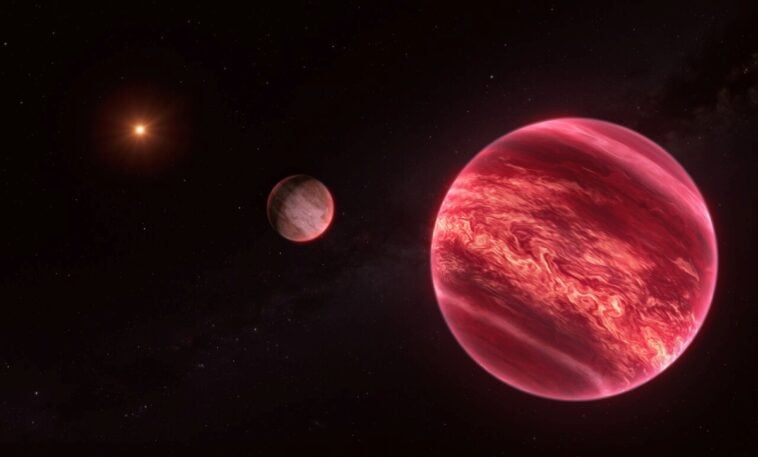
Astronomers have found what looks like the first moon outside our solar system, though the team is cautious about calling it one given its unique orbital arrangement.
The paper, reporting the findings (Planetary-Mass Exosatellite Detected Around a Star’s Substellar Companion), recently appeared in the multidisciplinary journal Nature.
The object in question sits in the CD-35 2722 system, a stellar neighborhood located 73 light-years away in the constellation Columba. At its center sits a star with about half the Sun’s mass, orbited by a brown dwarf.
This brown dwarf, some 37 times Jupiter’s mass, too massive to be classified as a planet and too light to sustain fusion, is now the focus of attention as the newly detected object circles it approximately every 170 days, with a minimum mass roughly equal to that of Jupiter (near 0.9 Jupiters).
That arrangement is where the vocabulary falls apart.
“This system is somewhat hard to define using Solar-System-based words like ‘planet’ and ‘moon,'” said Kevin Hoy, the ESO (European Organisation for Astronomical Research in the Southern Hemisphere) astronomer who led the work, in a statement. The problem he notes is that “the exosatellite is clearly massive enough to be a planet, but it does not orbit a star, though it orbits an object that orbits a star.”
“Being the third wheel in this system makes us want to call it a moon, even if it is nothing like the small, rocky moons we have in our system,” Hoy added.
Detecting the wobble
The team used CRIRES+ (the Cryogenic High-Resolution InfraRed Echelle Spectrograph) on the ESO’s Very Large Telescope (VLT) in Chile, applying radial velocity analysis, the same method that turned up the first exoplanet around a Sun-like star in 1995.
In practice, the technique looks for small wobbles in a body’s motion caused by something pulling on it.
Alice Zurlo of Universidad Diego Portales, who directs YEMS (Millennium Nucleus on Young Exoplanets and their Moons) and worked on the study, put the size problem plainly.
“The satellite we report is a giant gaseous body orbiting a highly massive companion, itself several times the mass of Jupiter,” she explained. “We have a clear delineation between the planets and the Sun in the Solar System, so defining things like moons is simple. In the CD-35 2722 system, where we are blurring the lines between stars, planets, and moons, the whole thing becomes more complicated to describe,” Zurlo added.
While more than 6,000 exoplanets have been confirmed, the search for exomoons remains at zero. Candidates have surfaced over the years, and none have held up to scrutiny. A team led by Quentin Kral, for instance, reported hints of a satellite in the HD 206893 system a few months ago using the VLT interferometer, but that too stopped short of a firm detection.
The pattern is clear. Confirmation of an exomoon requires more observations and a level of sensitivity that current instruments have yet to reach. That gap may soon be closed with ESO’s Extremely Large Telescope, which is expected to enter service in early 2029, boasting 20 times the light-collecting power of the VLT.
Sources: Nature, ESO, arxiv, ESO Animation, Wired