
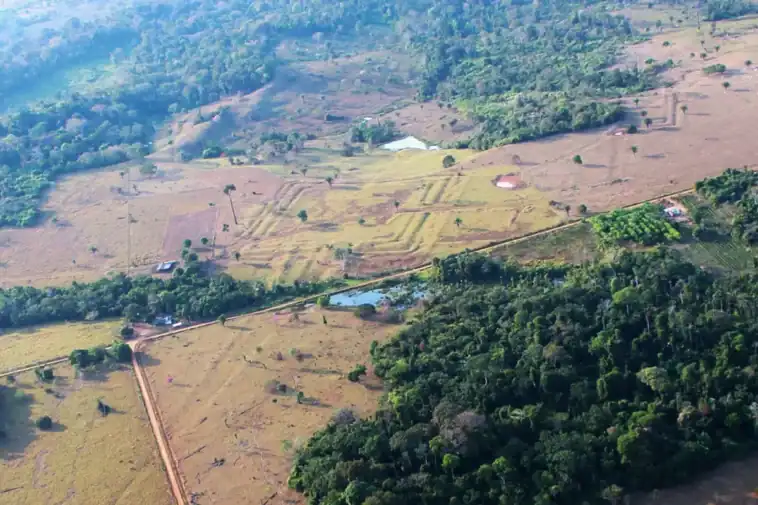
When you think of the Amazon, the first thing that comes to mind is the image of a wilderness completely untouched by ancient human hands. Well, new research led by archaeo-anthropologist Martti Pärssinen from the University of Helsinki is turning that belief upside down.
Scientists were able to scan the dense canopy of Southwestern Amazonia by flying high-tech airborne LiDAR (Light Detection and Ranging) tech. What they found is as mind-blowing as it is revolutionary.
Pärssinen and his team found hundreds of ancient earthworks left behind by a massive pre-Columbian society known as the Aquiry civilization. They believe this Amazonian civilization, spanning an estimated 183,000-square-kilometer area of the Amazon, lasted from 600 BC to AD 850.
The scientists scanned a 4,497-square-kilometer (roughly the size of Harris County, Texas) swath of southwestern Amazonia in Brazil using LiDAR.
The remote-sensing technology that shoots light pulses to map terrain right through dense forest canopy helped the team identify 432 ancient earthworks, alongside 396 completely new, undocumented structures. These earthworks, otherwise known as geoglyphs, were in large formations comprising circles, squares, rectangles, and octagons.
The researchers estimate that 20,000 to 30,000 of these geoglyphs could be hiding under the trees across the 183,000-square-kilometer area.
A sprawling population
Based on the density of the sites, the Aquiry civilization had an estimated 1.25 million to 3 million people at its peak around 100 to 300 AD. Scientists note that this population estimate could shift as more data comes in.
“If similar results are found elsewhere in Amazonia, the total precolonial population density and its effect on the current Amazonian soil and forest structure, biodiversity and even some modeling of the global climate should be re-evaluated,” the researchers wrote.
Shattering the “untouched rainforest” myth
According to the scientists, it took around 300 members of the Aquiry civilization to build and maintain a geoglyph.
This thriving civilization used the newly-discovered earthworks for public, ceremonial and political centres for invited visitors, without permanent occupation or defensive structures.
“The cultures and societies that composed the Aquiry shared a common worldview and constructed ceremonial centers in a variety of monumental geometric forms, characterized by deep ditches and high outer embankments,” Pärssinen said.
Pärssinen and his team believe the Aquiry made a massive impact on their surroundings by clearing forests to make space for their geoglyphs. They also farmed and gathered crops like maize, squash, manioc, nuts, and peach palms throughout the region.
While the exact cause of their decline around 850 AD remains a mystery, Pärssinen noted that these discoveries completely shatter the long-held notion that the Amazon was an empty, untouched wilderness before European colonists arrived.
The million-dollar mystery
Even though this new research is shaping how we view the Amazon, big questions remain. And none is as big as why the Aquiry civilization disappeared between 850 and 1000 AD. Pärssinen points out that while the fate of the Aquiry civilization remains unknown, the timing of its decline matches up with major collapses occurring in other parts of the Americas.
“The collapse may be related to the disappearance of other groups of people, such as the Classic Maya in Central America and the Tiwanaku and Wari civilizations in the Andes,” Pärssinen concluded.
However, researchers plan to expand LiDAR scanning to other regions across Greater Amazonia to see if even more lost societies are waiting beneath the green canopy of the great Amazon.
Sources: New York Post, Nature, Archaeology Magazine