
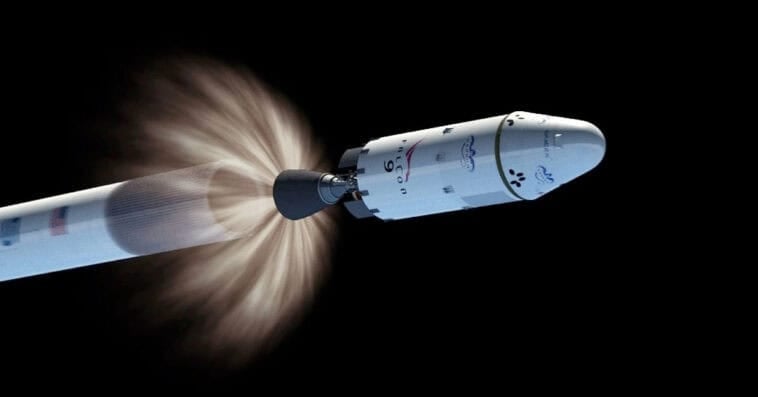
A forgotten piece of SpaceX hardware is about to make headlines once again — but not for the reason anyone expected. After spending more than a year drifting silently through space, the wayward rocket stage is now on an unavoidable collision course with the Moon, where it will end its journey in spectacular fashion. The rare impact is more than just a dramatic celestial crash, as scientists believe it could offer a unique chance to learn more about the lunar surface and the growing problem of space debris. Here’s what is expected to happen when the rocket finally slams into the Moon.
From orbital limbo to lunar impact
Fresh off the heels of the historic Artemis II crewed voyage, the Moon is preparing for another arrival—though this one will be far less gentle.
On August 5, an errant four-ton component from a SpaceX Falcon 9 rocket is slated to slam into the lunar surface at more than seven times the speed of sound. Traveling at roughly 5,400 mph, the uncrewed booster stage will carve out a brand-new crater and kick up an enormous cloud of dust that astronomers around the globe are eager to observe.
This dramatic lunar hit marks a surprise finale for the rocket hardware. Back in January 2025, the Falcon 9 upper stage played a crucial role in delivering two robotic lunar landers into space: the Blue Ghost-1 built by Texas-based Firefly Aerospace and the Resilience lander from Japan.
After completing its primary job, the 8,800-pound booster stage was left drifting in space. Lacking the remaining fuel needed to burn back toward Earth or escape into deep space, the hardware entered a chaotic “orbital limbo.” Over the past year and a half, gravitational forces slowly tugged at the abandoned craft, eventually locking it onto a collision course with the Moon’s near side, close to the ancient Einstein Crater.
What happens when 4 tons of metal hit the Moon?
For planetary scientists, a rocket colliding with the Moon at thousands of miles per hour is a rare and valuable gift. To prepare for the event, researchers have been running complex physics simulations to predict what the impact will actually look like.
William Jo, a graduate student at the University of Texas, led a modeling study (published on the preprint server arXiv) to map out the blast dynamics. His team’s calculations indicate that the collision will unleash an ejecta spike — a central column of dust, rock, and pulverized soil blown upward by the explosion — stretching between 47 and 60 miles high into the thin lunar sky.
Simultaneously, a research team led by New Mexico planetary scientist Benjamin Fernando estimates that the crash will punch a crater roughly 66 to 98 feet wide into the Moon’s crust. While that is a substantial footprint, Fernando notes it is smaller than a crater created by a natural asteroid of the same weight. That is because the rocket stage is essentially a hollow metal tube, meaning its energy disperses differently than a solid, dense space rock.
Could people see the Moon crash from Earth?
The biggest question for backyard astronomers and skywatchers is simple: Will the collision produce a flash bright enough to see from Earth?
The short answer is a definitive “maybe.”
“Our calculations suggest the plume should be several orders of magnitude brighter than the dark-sky background for the first few minutes after impact,” Jo explained to Space.com. “So the plume should be visible, though I’d stress this is a single nominal case. The real one will look different, and the numbers are on the optimistic side.”
Fernando’s team similarly concluded that the impact flash and rising dust plume will be “potentially observable” through professional ground observatories and orbital space telescopes. However, they caution that the exact brightness remains difficult to pinpoint, meaning amateur moongazers using standard backyard telescopes might only see a faint blur — if anything at all.
Still, experts urge observers to tune in.
“It will probably be at least worth taking a look,” said study co-author Bill Gray, an astronomer who develops the widely used Project Pluto orbital tracking software. “Maybe we’ll see the flash. Maybe we’ll see rocks ejected from the crater. Maybe we’ll even see both.”
Why the impact matters for future Moon missions
While a bright flash would be a welcome spectacle, researchers emphasize that the true value of August 5th lies in the scientific data.
Whenever heavy objects strike the Moon, they offer a real-world test for physics models that simulate high-speed impacts. Understanding how lunar dust (or regolith) behaves during an impact is essential for designing safe landing sites, protecting surface infrastructure, and predicting hazards for future astronauts.
“Watching this one gives us a rare chance to open up ejecta-plume science and calibrate those models against a real event, which matters for every future thing we deliver to the moon,” Jo emphasized.
Beyond the immediate physics lessons, the incident serves as a stark reminder of an escalating problem in space exploration: space junk.
Gray notes that while this specific collision poses no physical danger to people on Earth and won’t disrupt the Moon’s overall structure, it highlights a growing “carelessness about how leftover space hardware is disposed of.”
As private companies and space agencies ramp up lunar missions — including SpaceX’s development of its massive, next-generation Starship vehicle — tracking and managing spent rocket stages will only become more critical. For now, scientists are treating this lost booster not as trash, but as a lucky spark for lunar science.
Sources:
arXiv
Space.com
New York Post