
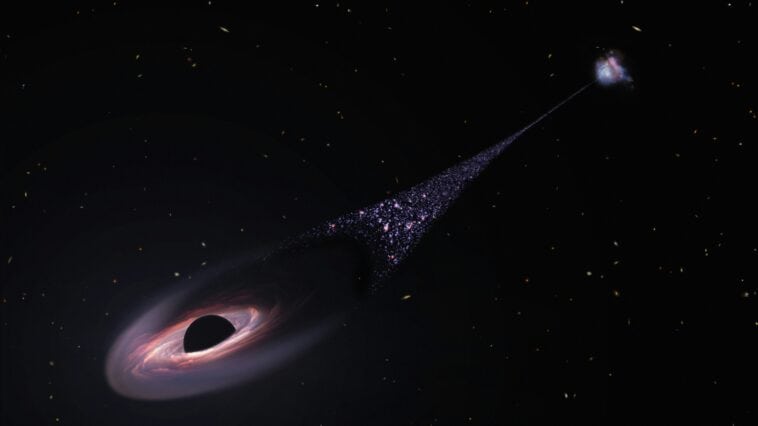
Imagine a super-advanced alien civilization that needs insane amounts of energy way beyond our puny solar panels and wind turbines to power their mega-cities, AI overlords, or whatever interstellar wonders they’re up to. Where do they get it? Scientists say they might be tapping straight into the ultimate cosmic powerhouses: black holes.
The great alien energy theory
Astronomers think these highly advanced alien civilizations might be wrapping whole megastructures around black holes to siphon off their mind-boggling power. And the coolest part? Astronomers think we might actually be able to spot the leftover heat from these cosmic power plants using technology we already have right here on Earth.
“We’re aware it’s a very out-there theory,” paper co-author Olivia Curtis, of the Penn State Extraterrestrial Intelligence Center (PSETI), said. “But we wanted to ground everything in physical facts and try to actually think of what physical observables we might actually be able to detect.”
The ultimate cosmic power outlet
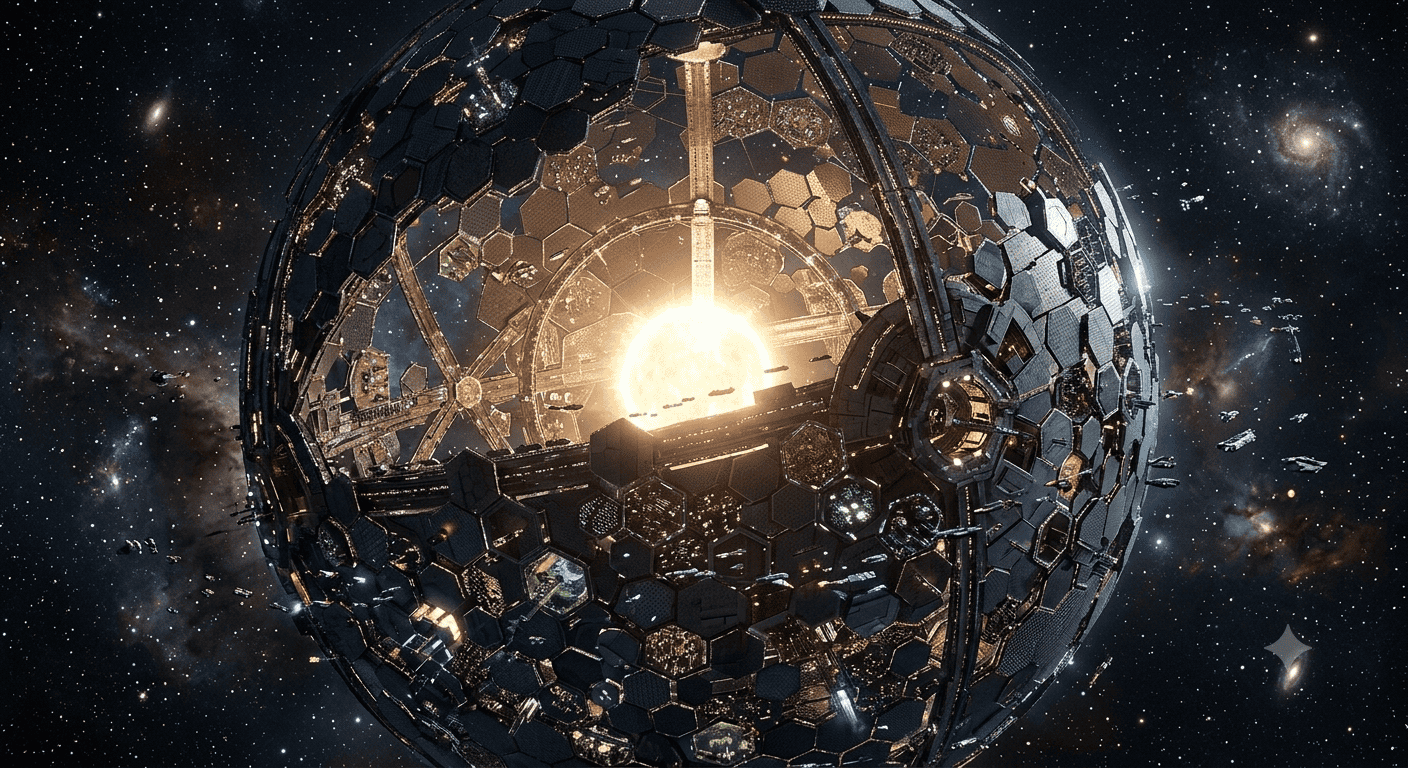
The idea of building giant energy collectors in space isn’t entirely new. Back in 1960, physicist Freeman Dyson proposed the Dyson sphere, a hypothetical megastructure built around a star to capture its entire energy output. The original concept was basically a giant shell or swarm of satellites built around a star—like the sun—to catch its energy.
Now, an international team of researchers—originally pioneered by scientists at National Tsing Hua University in Taiwan and built upon by researchers at PSETI—is taking that concept a step further. Instead of stars, their research looks at whether a super-advanced society could construct Dyson spheres around black holes to harvest their vast reservoirs of energy.
While black holes are famous for swallowing everything that gets too close, the regions directly outside their point of no return—the event horizon—actually spit out astonishing amounts of energy. Gravity at and within the event horizon is so strong that not even light can escape, but outside that boundary, radiation blasts freely into space.
Moving beyond Sun power
To pull off a stunt as daring as drawing power from black holes, aliens would need a Dyson sphere, which has long been considered the ultimate flex for an advanced civilization.
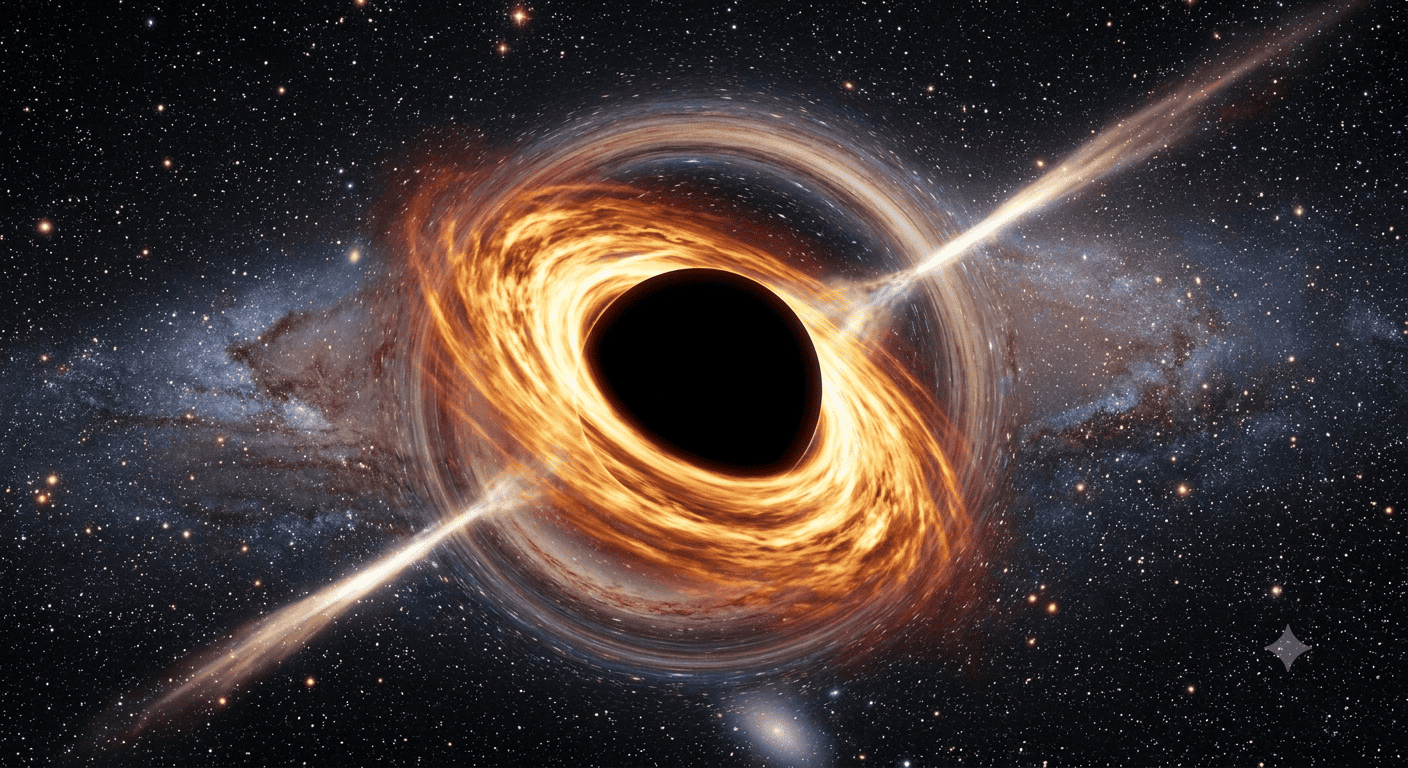
Supermassive black holes sit at the centers of galaxies, eating everything in sight and blasting out plasma jets packed with more energy than a million suns. They are famously described as the most energetic phenomena in the cosmos, making them the ultimate power supply for any civilization capable of taming them.
Six ways to tap into a black hole
In their foundational 2021 study, the Taiwanese research team evaluated six potential energy sources surrounding a black hole that an advanced ET civilization could try to tap:
- Accretion disks: The ultra-hot, swirling rings of gas and matter falling into the black hole.
- Relativistic jets: Super-fast beams of plasma shooting out from the black hole’s poles, which could produce up to 10 times more power than the disk itself.
- Hot coronas: Swirling high-energy plasma sitting around the inner accretion disk, boosting radiation output by up to 50 percent.
- Bondi accretion: Gas pulled in from interstellar space.
- The cosmic microwave background: Leftover background radiation from the early universe.
- Hawking radiation: Quantum-level emissions escaping from near the black hole itself.
Curtis knows the whole thing sounds like pure sci-fi, but she points out it’s not that far-fetched when you look at where our own tech is heading.
“We’re imagining that if some form of life wanted to extract the largest energy gradient that they possibly could, they’d naturally find it sits at the center of their galaxy,” she said.
Crazy theory meets serious challenges
Of course, setting up a power station that draws energy from a black hole is not the same thing as installing a solar panel on your roof. You can’t just drop a power grid around the black hole and call it a day.
As Curtis explained, to be able to achieve such a feat, energy collectors would need to be about 3 light-years away from the black hole in order to actually have a satellite not immediately melt due to the radiation.
These theoretical power stations would also need to be sitting outside the event horizon, to avoid everything being pulled into the black hole. But even at a safe distance, communicating across a giant structure surrounding a black hole poses a hilarious lag problem. How do you send data from one side of a 3-light-year sphere to the other?
According to Curtis, sometimes high-tech problems require low-tech solutions: “It turns out that at these distance scales, if you want to transmit a zettabyte of information, it’s just faster to sling your hard drive at it instead of trying to beam the information yourself.”
Not everyone’s buying it… yet
Of course, there are skeptics. Harvard’s Avi Loeb (the guy who’s famously open to wild ideas like alien tech on ‘Oumuamua) told the Post that the risks near an active black hole are way bigger than the rewards. Luminous quasars would tear apart infrastructure, and the X-rays and cosmic rays would wreck both biology and electronics.
“Also, the environment is highly hazardous for the construction workers of such infrastructure because of powerful X-rays and cosmic rays [that] would damage not only the bodies of biological workers but also the electronic wiring of any robots or AI systems,” he said. “All in all, I would stay away by many thousands of light years from supermassive black holes.”
Still, as Curtis pointed out, it feels less crazy when we’re already dreaming up space-based data centers for our own AI needs.
While the study does not prove black-hole-powered Dyson spheres exist just yet, it gives scientists a clear, testable roadmap for what to look for next time they peer through telescopes like the James Webb Space Telescope.
Sources: New York Post, ScienceAlert, arXiv