
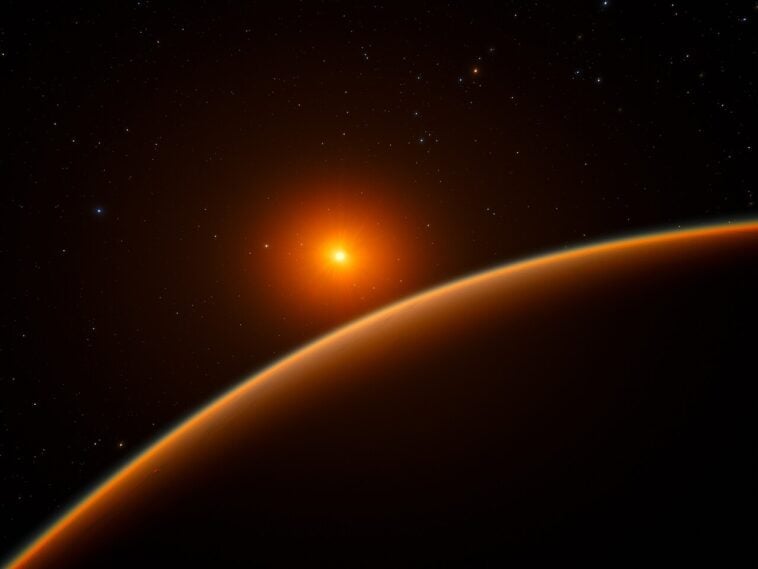
A planet 48 light-years away is leaking helium from its upper atmosphere, a discovery that’s gotten astronomers excited.
The planet in question, LHS 1140 b, was first spotted in 2017. NASA and many astronomers describe it as a super-Earth in the habitable zone with a radius 1.73 times Earth’s and a mass 5.6 times as large.
However, refined models (incorporating updated mass/radius measurements and JWST data) favor a water-rich ocean world (with 9–20% of its mass as water) over a purely rocky composition.
The new study published recently in the journal Science reports that the helium signal provides strong evidence of a substantial, underlying atmosphere, one of the three things a planet needs before anyone starts using the word “habitable.”
Though some observations note signal variability and call for further confirmation, the planet also appears to meet the other two criteria, which are a rocky (or water-rich) composition and an orbit at the right distance for potential liquid water.
“At this point, we have absolutely no evidence for life on the planet,” lead author Collin Cherubim told the New York Times. “But we think all of the really important, essential ingredients are there,” he added.
What makes LHS 1140 b different
Water could account for as much as 20% of the planet’s mass, based on current estimates. The star it orbits is a red dwarf, also named LHS 1140. The planet itself sits roughly ten times closer to its star than Earth sits to the Sun.
This proximity sounds like a problem until you factor in the star itself, which is smaller and much cooler than the Sun, which means that the planet ends up receiving about half the sunlight Earth does.
Red dwarfs have a reputation for being violent, with flares and outbursts powerful enough to strip away nearby planets of their atmosphere, making close orbits around them risky. This star, however, is dim and largely inactive, no longer throwing off much radiation, according to the European Southern Observatory (ESO).
Researchers previously developed a theoretical model of atmospheric evolution to predict how lighter gases like hydrogen and helium would be blown off by a star’s outbursts. When applied to LHS 1140 b, the model predicted an upper atmosphere dominated by helium, exactly what observations with the Magellan Clay Telescope now show.
If the theory holds, this would be the first planet found with the potential to sustain life. While earlier candidates like the TRAPPIST-1 planets have long been considered to have potential for habitability, none have had their atmospheres directly confirmed yet.
It would also suggest Earth isn’t as unusual as it currently appears. With millions of stars cataloged, but only 6,316 confirmed exoplanets and atmospheres on rocky worlds in habitable zones even rarer still, this discovery is significant.
Sources: Science, NASA Exoplanet Archive, NYT, European Southern Observatory, NYP