
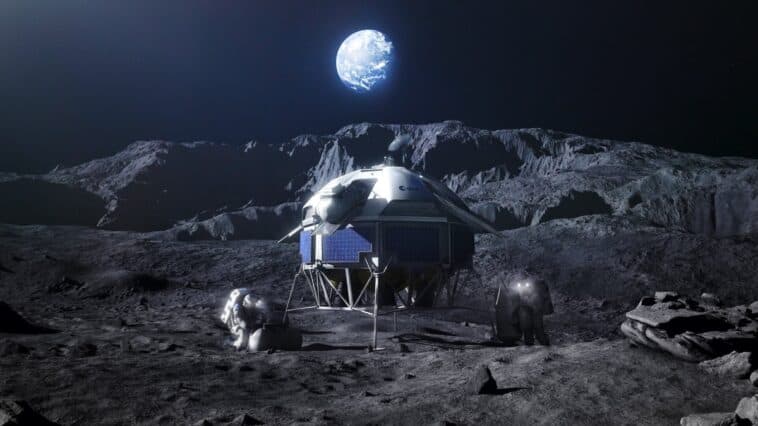
Near the moon’s poles, ancient ice sits undisturbed in permanently shadowed craters. Locked within it could be organic molecules likely delivered by asteroids and comets that hit the moon billions of years ago. Researchers believe these molecules could be the same kind that eventually gave rise to life on Earth, according to a new study.
Unlike Earth, where billions of years of geological activity have erased any such record, the moon has barely changed. Its ice at its poles essentially serves as a time capsule of prebiotic chemistry.
“We know we have organic molecules in the solar system — in asteroids, for example,” said Silvio Sinibaldi, the European Space Agency’s planetary protection officer and senior author of the study. “But how they came to perform specific functions like they do in biological matter is a gap we need to fill,” he added.
The study, published in the Journal of Geophysical Research: Planets (a journal of the American Geophysical Union), highlights the risk that contamination from lunar landers could obscure these pristine records.
The cost of touching down
Left alone, the ice in these permanently shadowed regions would largely remain preserved for billions of years, protected from most surface processes. But NASA plans to land crewed Artemis missions at the lunar south pole, where the exhaust from those landers could compromise or obscure the scientific value of these pristine sites.
To assess the risk, researchers ran computer models simulating how methane, the main organic compound in the planned lander exhaust, would move across the surface after a south pole landing. As the moon has no atmosphere, the methane could spread fast and reach the north pole in under two lunar days.
“Their trajectories are basically ballistic,” said lead author Francisca Paiva, a physicist at Instituto Superior Técnico in Portugal. “They just hop around from one point to another,” she added.
The simulations showed that within a lunar week, roughly seven months on Earth, more than half the methane had settled into the cold polar regions, with 42 % ending up at the south pole and 12% at the north, the same cold traps holding the ancient ice.
There may be workarounds. The study suggests colder landing sites could slow the methane down and limit how far it travels. More simulations are needed to figure out how other exhaust compounds behave and what else astronauts might bring that could contaminate the environment.
Paiva drew a parallel to protected places on Earth. “We have laws regulating contamination of Earth environments like Antarctica and national parks,” she noted. “I think the moon is an environment as valuable as those,” Paiva concluded.
Sources: Advanced Earth and Space Sciences, AGU (paper), Space