
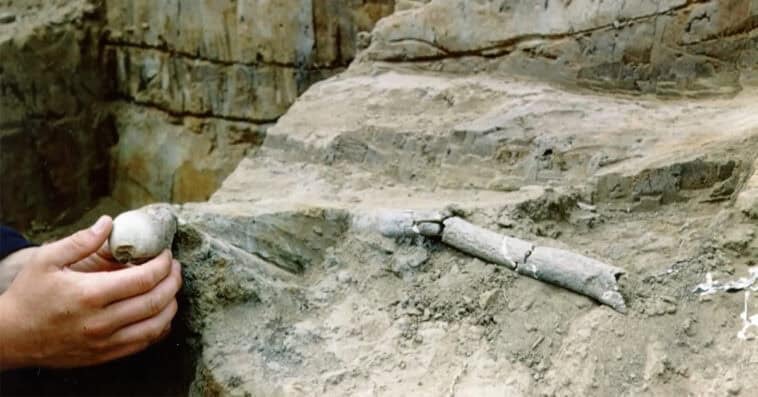
For more than a century, scientists have pieced together the story of how humans first reached North America through ancient artifacts, DNA evidence, and archaeological discoveries — but a stunning new find off the California coast could add an unexpected chapter to that history. Researchers have uncovered 13,000-year-old bones that may challenge existing ideas about early human migration and offer new clues about how the first Americans traveled across the continent. If confirmed, the discovery could reshape our understanding of one of humanity’s greatest journeys and reveal a forgotten path taken by ancient populations thousands of years ago.
Ancient remains challenge the traditional story of America’s first settlers
Far off the coast of Southern California, the rugged and isolated Channel Islands have become a treasure trove of discoveries that are forcing scientists to rethink the earliest chapters of human history in North America. The islands, sometimes described as a “lost world” because of their unique ecosystem and preserved archaeological record, have revealed evidence of ancient human activity dating back thousands of years.
Among the most significant discoveries is the 13,000-year-old skeleton known as the “Arlington Springs Man,” considered one of the oldest directly dated adult human remains ever found in North America. The discovery has played a major role in changing how researchers view the timeline of human migration across the continent.
The remains were uncovered in 1959 on Santa Rosa Island, one of the northern Channel Islands, buried about 37 feet beneath layers of sand, mud, and gravel. At the time, the find challenged the widely accepted belief that the first people to arrive in North America belonged to the Clovis culture, a prehistoric group once considered the earliest known inhabitants of the continent.
The discovery suggested that humans may have reached North America thousands of years before the Clovis people, opening the possibility that earlier migration routes existed.
Today, a new documentary is bringing renewed focus to how this single discovery upended decades of scientific belief.
A possible coastal route into North America
For decades, many scientists believed the first Americans traveled from Asia through an inland passage that opened between massive ice sheets during the last Ice Age. However, discoveries from the Channel Islands have strengthened another theory: that ancient humans may have traveled along the Pacific coastline using boats.
Researchers believe early coastal travelers may have followed what scientists call “kelp highways” — underwater ecosystems rich in marine life that could have provided food and resources for groups moving along the shoreline. These coastal routes may have allowed ancient populations to avoid blocked inland pathways and gradually move southward.
“This connects with the whole idea of a coastal migration, an ancient coastal migration where people would have been using watercraft and going around glaciers when they encountered them and working their way down until they came to California,” said UC Santa Barbara anthropology professor John Johnson.
According to Johnson, the people who settled on the Channel Islands may have eventually developed into the Chumash, an Indigenous group whose descendants have lived along California’s central and southern coast for thousands of years.
“People showed up on this island 13,000 years ago or thereabouts and evolved through time into the group we know as the Chumash,” Johnson said.
Islands preserve clues from a lost ecosystem
The Channel Islands have revealed far more than evidence of ancient human settlement. Archaeologists have also discovered remains of pygmy mammoths, a smaller species of mammoth that evolved on the northern islands.
Unlike the massive woolly mammoths that stood up to about 14 feet tall and weighed as much as 20,000 pounds, pygmy mammoths were dramatically smaller. These island-dwelling animals typically measured between 4.5 and 7 feet tall at the shoulder and weighed around 2,000 pounds.
Scientists believe the pygmy mammoths disappeared around the same period that humans arrived on the islands and global climate conditions began shifting. However, researchers have not determined a single confirmed reason for their extinction. Possible explanations include environmental changes, human activity, or a combination of factors.
Today, the Channel Islands continue to provide scientists with a rare window into the distant past. From ancient human remains to vanished animals and forgotten migration routes, the discoveries hidden beneath the islands’ surface are helping researchers piece together a far more complex story of how people first arrived and survived in North America.
To learn more about these archaeological discoveries, you can watch the previously mentioned documentary here.
Source:
New York Post