
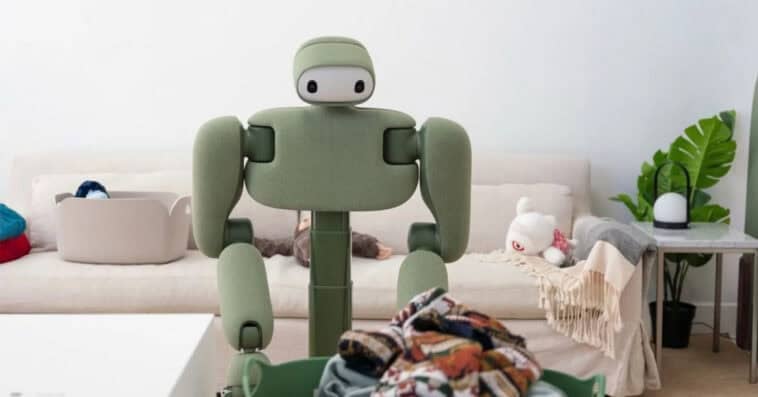
Household chores could soon become a thing of the past if the latest generation of home robots lives up to the hype. Weave Robotics has unveiled Isaac 1, a $7,999 robot capable of folding laundry, making beds, and tidying up — all at a price that significantly undercuts many of its rivals. As excitement builds around the launch, the robot is raising an even bigger question: has the race to bring affordable robot assistants into everyday homes finally reached a turning point, or is there more to the story than the impressive price tag?
Isaac 1 enters the race for the smart home
The domestic robot butler is officially moving out of the realm of science fiction and onto the living room floor. Silicon Valley startup Weave Robotics, a Y Combinator-backed firm founded by former Apple and Carnegie Mellon engineers, has pulled back the curtain on its newest creation: Isaac 1.
Unveiled on Wednesday, the mobile domestic helper is generating massive waves across social media, with the company’s official launch post on X quickly amassing over 13 million views and 14,000 likes.
Available for preorder with a $250 deposit, Isaac 1 is hitting the market with an upfront price of $7,999 or an alternative subscription model at $449 per month. Deliveries are scheduled to begin this fall, starting first in California before expanding across the U.S.
The announcement has triggered intense speculation about the future of domestic automation. As Chris Paxton, an AI innovation lead at Agility Robotics, succinctly posted on X: “$8k home robot. Closer and closer to never doing chores again.”
Similarly, Silicon Valley angel investor and All-In Podcast cohost Jason Calacanis noted the sheer gravity of the moment, writing on X: “It’s about to get very strange folks.”
Aggressive pricing in the AI arms race
What has truly captured the industry’s attention is the robot’s price tag. While a fleet of tech companies is working toward building humanoid robots, none have yet achieved deployment at a meaningful scale. By pricing Isaac 1 under $8,000, Weave Robotics is directly undercutting its closest competitors, fueling hopes that advanced home automation could become accessible to the broader public much sooner than anticipated.
For context, robotics firm 1X recently announced that its highly anticipated Neo home robot —which commands a much steeper price tag of around $20,000 — will open for preorders and start initial deliveries later this year. Meanwhile, Elon Musk stated during Tesla’s Q1 earnings call in April that production for their own long-delayed humanoid robot, Optimus, is slated to begin in late July or August. While Tesla envisions Optimus eventually handling everything from factory assembly to caregiving and household chores, the automotive giant has yet to lock in an official consumer price.
Built specifically for life at home
Unlike competitors that try to construct general-purpose bipedal humanoids modeled after the human body, Weave argues that true utility requires a specialized approach.
“We’ve believed since our founding that home robots need to be built for the home from the get-go, and from the ground up,” the company shared on X during the launch. “Isaac 1 is the robot we set out to build when we founded Weave: it’s the robot we wanted for our own homes.”
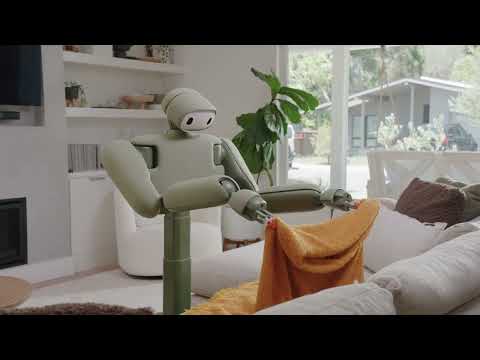
Architecturally, Isaac 1 relies on a stable, wheeled motorized base rather than legs, allowing it to navigate flat floors smoothly. It features a collapsible body covered in soft fabric panels that allow its height to adjust from a compact 3 feet up to 5 feet 9 inches. Wrapped in an award-winning design, the robot comes in five distinct pastel color options intended to blend into modern home aesthetics.
According to Weave’s launch statement: “Isaac 1, with an award-winning design and custom hardware in every inch, is built to enable you by handling the most tedious tasks around your home so that you don’t have to. All while blending into the fabric of your home, whether it’s working, or at rest.”
The machine builds on the data gathered by its stationary predecessor, Isaac 0, which has been operational in select California locations. According to the company, Isaac 0 “has folded for 2000+ hours for our customers and folds 1000+ pounds of laundry every week,” proving that their software foundation can handle intensive domestic labor.
Mostly autonomous — with human backup
In practice, Isaac 1 is engineered to focus on two labor-intensive domestic routines: “laundry flow” (gathering dirty garments, carrying hampers, folding clean clothes) and “daily reset” (tidying up stray toys, clearing clutter, and making beds).
The startup notes that the machine operates autonomously by default. However, engineering a robot to navigate the messy, unpredictable reality of a human household is famously difficult. Unlike AI chatbots that train on an endless abundance of text from the internet, physical robots suffer from a lack of real-world data to map out diverse interior layout spaces.
To solve this, Weave’s business model includes a unique safety net: teleoperation. If the robot encounters a strange object or an unfamiliar obstacle and gets stuck, a remote human specialist can securely step in via a cellular or Wi-Fi connection to take manual control of the arms and guide the machine through the task.
This mechanical design has met with mixed reactions online. Simon Taylor, head of market development at the fintech firm Tempo, commented on X that the machine essentially looks like a “Roomba with arms”—evoking the image of iRobot’s famous puck-shaped vacuum. Other observers on social media were less charitable, describing early footage of the robot’s physical movements as “slow” and “clunky.”
Data, privacy, and what comes next
Beyond the mechanical performance, the introduction of a camera-equipped, internet-connected machine into the private spaces of a home raises immediate data privacy concerns.
On its website, Weave explicitly states that it uses personal information to improve or upgrade its services. However, it remains unclear whether video feeds or spatial data collected from inside customer homes will be fed back into servers to train the robot’s broader AI model.
For early adopters, the ultimate trade-off will likely come down to a choice between absolute privacy and total domestic convenience. As Weave gears up for its autumn rollout, the tech world will be watching closely to see if Isaac 1 can successfully transition from a buzzy internet phenomenon into a genuinely indispensable household appliance.
Source:
Business Insider