
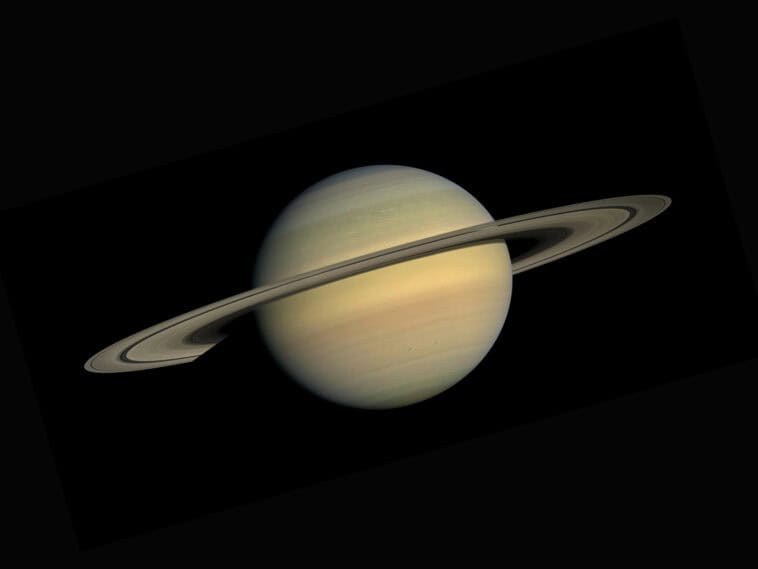
Road-tripping across the solar system sounds a lot more realistic when there’s somewhere to refuel along the way. According to a new NASA-backed study, Saturn’s largest moon, Titan, may have everything future astronauts need for a deep-space pit stop, including vast amounts of hydrocarbons that could be turned into fuel, food, plastics, and other essential supplies.
The idea is still highly speculative, but researchers believe Titan’s rich chemical resources could one day make it a key stop for missions traveling deeper into the solar system.
Why scientists are excited about Titan
Titan has always been one of the most intriguing places in our solar system. Unlike most moons, Titan has a thick, nitrogen-rich atmosphere and is covered with rivers, lakes, and seas. The difference is that these bodies of liquid aren’t filled with water. They’re filled with methane and ethane.
According to study lead author Conor Nixon, an astronomer at NASA’s Goddard Space Flight Center, Titan is essentially overflowing with hydrocarbons. “Titan is gushing with hydrocarbons — what we call oil and natural gas on Earth,” Nixon told Universe Today.
Those hydrocarbons include methane, propane, butane, kerosene-like compounds, and other chemicals that could be incredibly valuable for future explorers.
But there’s a catch — to burn fuel, you need oxygen, and Titan’s atmosphere has almost zero.
Fortunately, there is a cosmic workaround. While Titan’s sky won’t help you light a match, its crust is sitting on a goldmine of water ice. Future astronauts wouldn’t bring oxygen from Earth; they would harvest local ice and use electrolysis (running an electric current through water) to split it into hydrogen gas and breathable, combustible oxygen.
More than just rocket fuel
The study suggests Titan’s resources could support much more than spacecraft refueling. According to researchers, these compounds could potentially be used to manufacture rocket fuel, solvents, synthetic rubber, plastics, spare parts made with 3D printers, and utensils and other everyday supplies.
Scientists even suggest some materials could eventually be used as feedstocks for producing food and pharmaceuticals. This means that Titan could function as anything from a refueling depot to a long-term human settlement.
A pit stop for the outer solar system
One reason Titan stands out is its location. Orbiting Saturn, Titan could potentially serve as a staging point for missions headed to destinations farther from Earth, including Uranus, Neptune, and other moons orbiting Saturn. Future astronauts could theoretically stop at Titan to replenish fuel and stock up on raw materials before continuing deeper into space.
The concept is somewhat similar to the way airports or highway rest stops support long-distance travel on Earth, except this one would sit nearly a billion miles from home.
There are some very big problems
As appealing as Titan sounds on paper, living there would be extraordinarily difficult. For starters, average surface temperatures hover around minus 290 degrees Fahrenheit. Titan’s atmosphere is also about 50% denser than Earth’s, while gravity is only about one-seventh as strong as what humans experience here. Building and maintaining infrastructure under those conditions would be an enormous engineering challenge.
That is why researchers emphasize that the idea remains firmly in the realm of future possibilities rather than near-term mission planning. However, even though a human outpost on Titan is still decades away (if it happens at all), NASA is already preparing to explore the moon more closely. The agency plans to launch its Dragonfly mission in 2028. Dragonfly, a nuclear-powered rotorcraft, will explore Titan’s surface and investigate whether the moon contains the ingredients necessary to support life.
The mission should also provide scientists with a much better understanding of Titan’s chemistry and its potential as a destination for future exploration.
Source: New York Post